
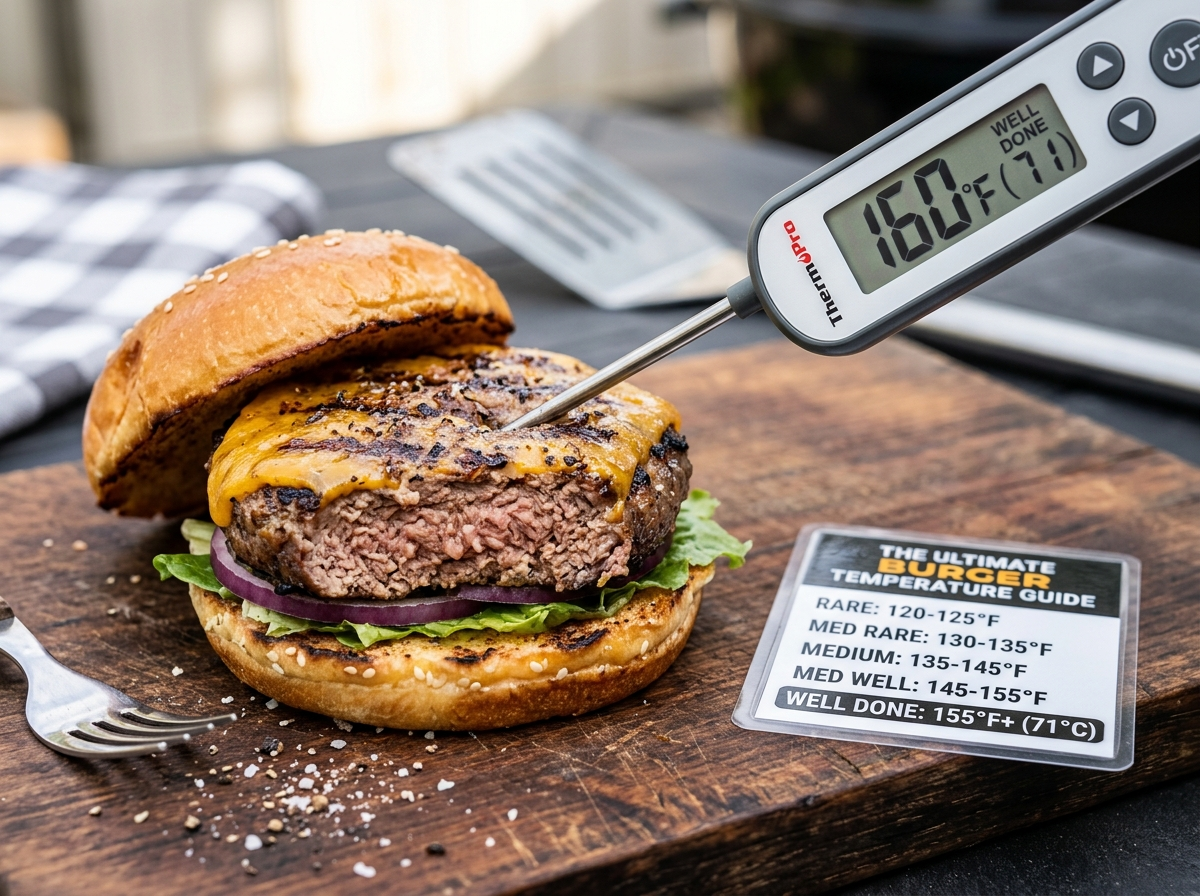
A single degree can ruin a perfectly good burger. You take that beautiful patty off the grill, slice into it, and it’s either raw in the center or dry as cardboard. According to USDA food safety data, ground beef is involved in more foodborne illness cases than whole cuts — and the main reason is that people guess doneness instead of measuring it.
That’s the thing about burgers. Unlike a steak, where you can get away with a quick poke-and-feel test, ground meat plays by different rules. The grinding process pushes surface bacteria deep into the meat, which means internal temperature isn’t just about taste. It’s about safety.
This guide covers every doneness level, the exact temperatures you need, how different cooking methods affect your results, and what to do with non-beef burgers that have their own temperature rules entirely. Whether you’re grilling in the backyard, working a flat top, or pan-frying on a Saturday afternoon, you’ll walk away knowing exactly when to pull your burger.
Why Internal Temperature Matters More for Burgers Than Steaks
Here’s something a lot of home cooks don’t realize. A whole muscle steak — your ribeye, your New York strip — has bacteria sitting on the outside surface. When you sear it, that surface heat kills what needs killing. The inside can stay rare without much risk.
Ground beef is a completely different situation. When meat goes through a grinder, everything on the surface gets mixed throughout the patty. That E. coli or Salmonella that was chilling on the outside? It’s now potentially sitting right in the center of your burger. This is exactly why the USDA sets a minimum safe temperature of 160°F (71°C) for ground beef.
Now, does that mean you must cook every burger to 160°F? That’s your call. Plenty of restaurants serve medium and medium-rare burgers daily. But understanding the risk lets you make an informed decision rather than a blind one.
Pro Tip: If you love a pink center but want to minimize risk, buy whole cuts and grind your own hamburger meat at home. When you control the grinding process, the freshness and cleanliness of the meat are in your hands. Many high-end burger joints do exactly this.
The Complete Burger Temperature Breakdown
Let’s get into the specific numbers. These temperatures represent the internal reading at the thickest part of the patty — not near the edge, not near the surface, but dead center.
Rare (120°F – 125°F / 49°C – 52°C)
A rare burger has a cool, deep red center. The texture is soft, almost mushy in the middle, with a very thin band of brown on the outside. Honestly, rare burgers aren’t that common even at restaurants because of the food safety concerns with ground meat. Most places that do serve them use freshly ground, high-quality beef and make you sign off on the risk.
The flavor at this level is intensely beefy, but the texture isn’t for everyone. If you’re going rare, you absolutely need to start with the best meat for burgers — freshly ground from a trusted source, ideally ground that same day.
Medium Rare (130°F – 135°F / 54°C – 57°C)
This is the sweet spot that burger purists chase. You get a warm, red-to-pink center with juices that run freely when you press the patty. The outside has a solid sear, while the inside stays tender and moist. If you want to understand why this temperature creates such a different experience from well-done, it comes down to fat rendering — at 130°F–135°F, intramuscular fat starts melting just enough to coat your palate without fully liquefying out of the patty.
Warning: Medium-rare ground beef does carry higher foodborne illness risk than fully cooked. This doneness level is best reserved for freshly ground, high-quality beef. Pre-packaged ground beef from the supermarket has been through more handling and processing, increasing exposure to bacteria.
Medium (140°F – 145°F / 60°C – 63°C)
A medium burger gives you a pink center that’s warm all the way through. The juices are still present but not as freely flowing as medium rare. For a lot of people, this is the practical sweet spot — you get flavor and moisture without the safety anxiety of a rare cook.
Most sit-down burger restaurants default to medium when you don’t specify. There’s a reason for that. The fat has rendered enough to create flavor, the proteins have firmed up enough for a satisfying bite, and the center still has color and life.
Medium Well (150°F – 155°F / 66°C – 68°C)
You’ll see just a slight hint of pink at medium well. The center is hot, mostly gray-brown, with a faint blush if you catch it at exactly the right moment. Juices are noticeably reduced compared to medium, and the texture is firmer.
Here’s where technique starts to really matter. At medium well, keeping your burgers juicy becomes a real challenge. The fat-to-lean ratio of your grind, how thick you make the patty, and whether you’re using a lid to trap heat — all of these factors determine whether you get a respectable medium-well burger or a disappointing dry puck.
Well Done (160°F+ / 71°C+)
No pink. The center is fully gray-brown, the texture is firm, and the juices have largely cooked out. This is the USDA’s official safe temperature for ground beef, and it’s what you should target for kids, elderly family members, pregnant women, or anyone with a compromised immune system.
But well done doesn’t have to mean terrible. The secret is fat content. A proper fat ratio for burgers — ideally 80/20 or even 75/25 — gives you a built-in insurance policy against dryness. That extra fat keeps rendering and basting the meat internally, even as it cooks past 160°F. A well-done burger made from 93/7 lean ground beef? Yeah, that’s going to taste like a hockey puck. A well-done burger made from a good 80/20 chuck blend? Still pretty solid.
How Carryover Cooking Changes Everything
This is the part most people skip, and it costs them. When you pull a burger off heat, it doesn’t stop cooking. The residual heat stored in the outer layers continues pushing inward, raising the internal temperature by 3°F to 7°F during the resting period.
What does this mean practically? If you want a finished temperature of 135°F (medium rare), you should pull your burger off at around 130°F. If you want 145°F (medium), pull it at 140°F. Waiting until your thermometer reads your target temp while the burger is still on the grill means you’ll overshoot every single time.
The effect is more dramatic with thicker patties. A half-inch smash burger has very little mass to retain heat, so carryover cooking is minimal — maybe 1°F to 2°F. A thick, pub-style three-quarter-inch patty? That can climb 5°F to 7°F after resting. Patty thickness directly affects how aggressively you need to account for carryover.
Quick Fact: Resting also lets juices redistribute. A burger cut immediately after cooking loses noticeably more moisture than one rested for even 2 to 3 minutes. Don’t skip this step.
Temperature by Cooking Method: It’s Not One-Size-Fits-All
The target internal temperature stays the same regardless of how you cook. But the way you get there — and how easy it is to hit your target — changes significantly with your cooking method.
Grilling (Charcoal or Gas)
Grilling introduces the most variables. Flare-ups, hot spots, wind, grate distance from coals — all of these affect your cook. For standard burgers on the grill, you want your cooking surface at 400°F to 450°F. This gives you a good sear without charring the outside before the inside comes up to temp.
If you’re debating equipment, the charcoal vs. gas debate comes down to flavor preference and control. Gas gives you consistent, adjustable heat. Charcoal gives you smokier flavor but requires more attention. Either way, your thermometer doesn’t care what’s creating the heat — it only cares about the number.
Timing guideline for a 3/4-inch patty on a grill at 400°F–450°F: roughly 4 minutes per side for medium rare, 5 minutes per side for medium, and 6 to 7 minutes per side for well done. But always verify with a thermometer. These times shift based on patty thickness, outdoor temperature, and how often you open the lid. For a deeper breakdown, check out this guide on the best temp for burgers on the grill.
Flat Top / Griddle
A flat top provides even, consistent contact heat — no hot spots, no flare-ups, no guesswork. This is how most restaurants cook burgers, and there’s a reason. The metal surface creates a uniform Maillard crust that’s hard to replicate on grill grates. If you’re curious about the flat top vs. grill comparison, it really comes down to whether you value crust or char.
Set your flat top to 375°F to 400°F for regular patties. Smash burgers are a different story — you want the surface ripping hot, closer to 450°F to 500°F, and you’re cooking so thin and fast that internal temperature is almost irrelevant. A properly smashed burger cooks through in about 2 minutes per side. By the time you get a crust, the inside is done.
Cast Iron / Pan Frying
Cast iron works similarly to a flat top. Preheat the pan over medium-high heat for at least 5 minutes before your patty goes in. The thermal mass of cast iron holds heat well, so you get consistent searing even when the cold meat drops the surface temperature momentarily.
If you’re frying at home without a deep fryer, a cast iron skillet is your best friend for burgers too. The key is don’t crowd the pan. Two patties max in a 12-inch skillet. More than that and you’re steaming the meat instead of searing it, which leads to gray, bland exteriors and uneven cooking.
Oven Finishing
For really thick burgers — anything over an inch — some cooks use a reverse-sear method. You start the patty in a 250°F to 275°F oven until the internal temp hits about 10°F to 15°F below your target, then finish with a hard sear on a screaming hot pan or grill for 60 to 90 seconds per side. This gives you edge-to-edge even doneness with a beautiful crust. It’s more work, but the results on a thick pub burger are noticeably better.
Beyond Beef: Temperature Rules for Other Burger Meats
Beef isn’t the only thing people form into patties, and different proteins have different safety thresholds.
Turkey and Chicken Burgers
Poultry burgers need to reach 165°F (74°C) — no exceptions, no “I like it a little pink” options. Salmonella is more prevalent in poultry than in beef, and there’s no medium-rare turkey burger that’s worth the food poisoning risk. Because you’re cooking to a higher temp, moisture loss is a bigger challenge. Adding a tablespoon of olive oil or a splash of Worcestershire sauce to the ground meat before forming patties helps.
Pork Burgers
The USDA updated its pork guidelines back in 2011, dropping the recommended internal temp from 160°F to 145°F with a 3-minute rest for whole cuts. But ground pork follows ground meat rules — 160°F (71°C) is the safe target. Pork burgers can be surprisingly flavorful when you mix in some of the same seasonings you’d use for beef burgers.
Lamb Burgers
Ground lamb follows the same USDA guideline as ground beef: 160°F (71°C) for guaranteed safety. Many people cook lamb burgers to medium (145°F) because lamb fat has a higher melting point than beef fat, and overcooking makes it waxy and unpleasant. The flavor profile of lamb also pairs better with a pink center.
Plant-Based and Meatless Burgers
Here’s one that trips people up. Plant-based burgers from brands like Impossible and Beyond don’t carry the same bacterial risks as raw meat, but temperature still matters for meatless burgers. Impossible Foods recommends cooking to 160°F — not for safety per se, but because the plant proteins and fats are engineered to behave like beef at that temperature. Undercook them and the texture is gummy. Hit the right temp and you get that meaty, juicy bite they’re designed to deliver.
Choosing and Using a Meat Thermometer
If you’re still poking burgers with your finger or cutting them open to check doneness, you’re losing juices and guessing at the same time. A meat thermometer removes all the uncertainty.
Instant-read digital thermometers are the best option for burgers. They give you a reading in 2 to 4 seconds, and good ones are accurate within ±1°F. Insert the probe into the side of the patty horizontally, pushing it to the center. Going in from the top on a thin patty often puts the probe tip past the center and into the pan or grill grate, giving you a false reading.
For anyone serious about their burger game, spending $15 to $30 on a quality instant-read thermometer is the single best investment you can make. If you want specific recommendations, this breakdown of the best thermometers for burgers covers what to look for.
Did You Know? Dial thermometers (the ones with a round face and a thick probe) can take 15 to 20 seconds to register, and their probes are so thick that they require deeper insertion — not ideal for a thin burger patty. Digital instant-reads are faster, thinner, and more accurate.
Factors That Affect How Fast Your Burger Reaches Temperature
Two burgers on the same grill can hit their target temperatures at completely different times. Here’s what creates those differences.
Patty thickness is the biggest factor. A 1/4-inch smash burger cooks in under 3 minutes total. A 3/4-inch pub burger takes 8 to 12 minutes. The relationship isn’t linear either — doubling thickness more than doubles cook time because heat has to travel through more mass.
Starting temperature of the meat matters too. A patty straight from the fridge (38°F–40°F) takes longer than one that’s been sitting at room temperature for 15 to 20 minutes. Some cooks recommend tempering burgers for 15 minutes before cooking. This works, but don’t leave ground meat out for more than 30 minutes — bacteria multiply rapidly between 40°F and 140°F, which the USDA calls the “danger zone.”
Fat content plays a role. Fattier grinds (80/20, 75/25) conduct heat slightly differently than lean grinds (90/10, 93/7) because fat and water transfer thermal energy at different rates. In practice, the difference in cooking time is small, but the difference in why burgers dry out is enormous. Lean patties go from “done” to “overdone” in a much narrower window.
Altitude affects cooking if you’re above 3,000 feet. Lower atmospheric pressure means moisture evaporates faster and temperatures may behave slightly differently, especially on grills. You might need to add a minute or two of cook time at higher elevations.
The Flip Debate: Once or Multiple Times?
There’s an old backyard rule that says you should only flip a burger once. It’s one of those things that sounds authoritative but doesn’t hold up under scrutiny.
Food scientist J. Kenji López-Alt tested this extensively and found that flipping frequently — every 30 to 60 seconds — actually produces more even cooking and can reduce total cook time by up to 30%. The logic makes sense: frequent flipping means neither side gets too far ahead of the other, and the burger cooks more evenly from edge to edge.
That said, there’s a practical tradeoff. Frequent flipping works great on a flat top or in a pan. On a grill with grates, too much flipping can cause the patty to break apart, especially with loosely packed or higher-fat grinds. For grill cooking, knowing when to flip your burgers — typically when the bottom third of the patty has changed color — strikes the right balance between even cooking and structural integrity.
Smash Burgers: A Temperature Exception
Smash burgers deserve their own mention because they break the normal temperature rules. When you take a ball of beef and smash it flat against a ripping-hot surface, you’re creating a patty that’s so thin — usually 1/4 inch or less — that it cooks through almost instantly.
With smash burgers, you’re not really targeting an internal temperature. You’re targeting a crust. The entire point is maximum Maillard reaction — that deep, caramelized, almost crunchy exterior. By the time you achieve that crust on both sides, the inside is cooked through. No thermometer needed for a true smash burger, as long as your surface is hot enough (450°F+ on the cooking surface) and your patty is thin enough.
This also makes smash burgers the safest option if you’re worried about food safety with ground beef. Because they cook through so completely and so quickly, there’s virtually no risk of underdone centers.
The comparison between smash burgers and regular burgers really comes down to what you value more: the caramelized crust of a smash or the thick, juicy interior of a traditional patty.
Quick Reference: Burger Doneness at a Glance
For easy reference while you’re actually standing at the grill, here’s the condensed version:
Rare: 120°F–125°F — Cool red center, very soft
Medium Rare: 130°F–135°F — Warm red-pink center, juicy
Medium: 140°F–145°F — Warm pink center, firm but moist
Medium Well: 150°F–155°F — Slight pink, firm texture
Well Done: 160°F+ — No pink, fully cooked through
Pull your burger 3°F to 5°F before your target and let it rest for 2 to 3 minutes. Carryover cooking handles the rest.
For an even more detailed visual breakdown, the burger doneness chart lays this all out with visual references.
FAQ
What’s the safest temperature for a burger?
The USDA recommends 160°F (71°C) for all ground beef. At this temperature, harmful bacteria like E. coli O157:H7 and Salmonella are eliminated. If you’re cooking for children, elderly adults, pregnant women, or immunocompromised individuals, 160°F should be your non-negotiable minimum. Cooking to lower temperatures is a personal risk assessment.
Can I eat a medium-rare burger safely?
You can, but it carries more risk than a fully cooked burger. Restaurants that serve medium-rare burgers typically use freshly ground, high-quality beef — often ground in-house — to minimize bacterial contamination. If you grind your own meat at home from whole cuts and cook it promptly, the risk drops significantly compared to using pre-packaged ground beef that’s been handled multiple times.
How do I check burger temperature without cutting it open?
Use a digital instant-read thermometer. Insert the probe horizontally through the side of the patty, pushing the tip to the center. This gives you an accurate core reading without cutting the burger open and releasing all those juices. A good instant-read thermometer costs $15 to $30 and pays for itself in perfectly cooked burgers.
Do plant-based burgers need to reach the same temperature as beef?
Plant-based burgers don’t carry the same raw-meat bacterial risks, but they’re formulated to taste and feel best at around 160°F. Undercooking them results in a mushy, unappetizing texture. The fats and proteins in brands like Impossible and Beyond are designed to undergo specific changes at that temperature — so you’re not cooking for safety as much as for quality.
Does the type of meat change the target temperature?
Yes. Ground poultry (turkey, chicken) must reach 165°F. Ground pork and ground lamb should hit 160°F for safety. Beef is also 160°F per USDA guidelines, though many people choose to eat it at lower temps. Each type of ground meat has different risks and different fat compositions that affect both safety thresholds and how the burger tastes at various doneness levels.
Your Next Burger Starts With a Number
Temperature isn’t a suggestion — it’s the single variable that separates a burger you’re proud of from one you apologize for. Get yourself an instant-read thermometer if you don’t already own one. Learn where your grill or pan runs hot. Account for carryover cooking. And stop guessing.
The beauty of cooking by temperature is that it works every time, regardless of patty size, meat type, or cooking method. Once you internalize these numbers, you’ll never cut into a burger to “check” again. You’ll just know.
Fire up the grill, season your meat with something that actually adds flavor, and let the thermometer do the thinking. Your best burger is one accurate reading away.