
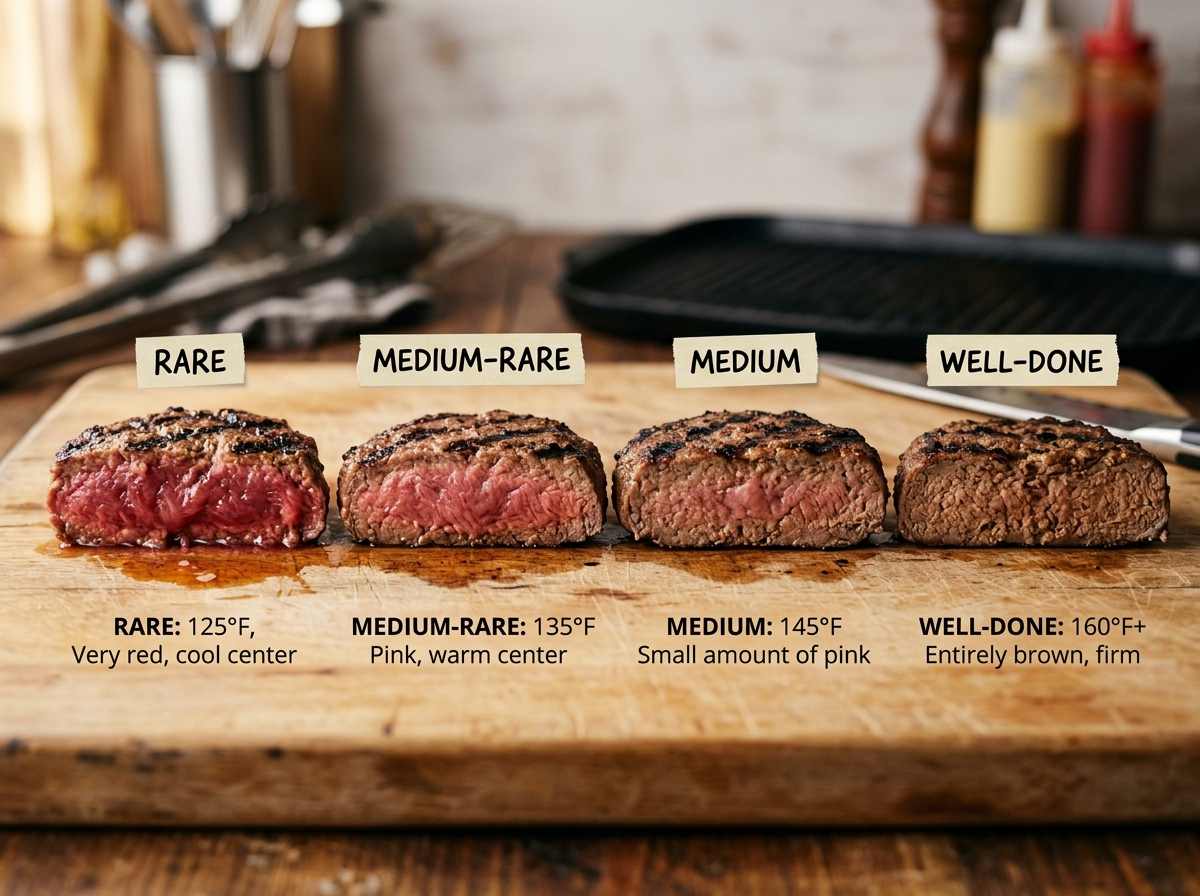
USDA says ground beef should reach 160°F / 71°C for safety, but most people still judge burgers by color alone. That’s where things go wrong. One patty turns juicy, the next turns dry, and you’re left guessing what happened. The burger doneness chart explained in this article clears that up. You’ll see what each temperature means, what it looks like, and how to cook a burger that matches your taste without the guesswork.
What the burger doneness chart really means
A burger doneness chart is just a map between internal temperature and texture. It tells you how firm, juicy, and warm the center of the patty should feel at each stage.
That sounds simple, but people often mix up two different goals. One goal is taste and texture. The other is food safety. For whole cuts like steak, a pink center can be normal. For ground beef, the rules are different because the meat is mixed during grinding. That’s why the chart helps, but it doesn’t replace safe cooking habits.
Quick fact: a burger can look brown on the outside and still be undercooked in the middle. It can also stay pink after it’s fully cooked. Color helps, but it doesn’t tell the full story.
If you want a deeper breakdown of safe targets, our burger internal temperature guide pairs well with this chart. For a tighter look at the texture side of things, check our best burger temperatures for every doneness level.
Safety vs. preference: both matter
Here’s the honest truth. Many burger charts show rare, medium-rare, medium, medium-well, and well-done because people like to know what each stage feels like. That’s useful. But for ground beef, USDA’s safe finish line is still 160°F.
So if you’re cooking for kids, older adults, pregnant people, or anyone with a weaker immune system, don’t treat the lower ranges like a green light. Use the chart as a reference, but keep safety in mind.
Warning: don’t assume “pink” means unsafe or “no pink” means safe. The thermometer is the better judge.
Burger doneness temperatures at a glance
Here’s the basic chart most home cooks look for. These ranges are common cooking references for beef burgers, not the safety target.
| Doneness | Internal Temp | What You’ll See | Usual Feel |
|---|---|---|---|
| Rare | 120–125°F | Cool red center | Very soft, very juicy |
| Medium-rare | 130–135°F | Warm red center | Tender, juicy, loose texture |
| Medium | 140–145°F | Warm pink center | Balanced and still juicy |
| Medium-well | 150–155°F | Slight pink in the center | Firmer, less juice |
| Well-done | 160°F+ | Little to no pink | Firm, least juicy |
A lot of people stop at the table and think that’s enough. It’s a good start, but the real value comes from understanding what those numbers feel like on a plate.
If medium-rare is your sweet spot, our medium rare burger temperature guide goes one step deeper.
What each burger doneness level feels like
Rare: 120–125°F
Rare burgers are soft in the center and very warm on the outside, with a red middle that stays cool to warm. The texture is loose, almost buttery, and the juices are easy to notice.
For a lot of home cooks, this is more of a curiosity than a target. It’s not the safest choice for ground beef, so most people won’t cook a burger this way at home.
Medium-rare: 130–135°F
Medium-rare gives you a warm red center and a very juicy bite. The patty still feels tender when you press it, and the middle stays loose instead of tight.
This is the range many burger fans talk about when they want a “restaurant-style” bite. It gives you a strong beef flavor and a soft center. That said, if you’re cooking ground beef for people who need extra food safety protection, this isn’t the place to stop.
If you want to cook for texture first and safety second, this range is where the chart becomes really helpful. The trick is to pull the burger a little early, because it will keep cooking after it leaves the heat.
Medium: 140–145°F
Medium is where a lot of people land. The center should look warm pink, not red, and the burger should still feel moist. It has more structure than medium-rare, but it doesn’t cross into dry territory the way overcooked burgers often do.
If you’re cooking a thicker patty, medium can be a very practical target. You get a good crust on the outside and a center that still has some juice. It’s also easier to hit this level consistently than rare or medium-rare, especially on a hot grill or skillet.
This is the point where many home cooks say, “Okay, that’s the burger I wanted.”
Medium-well: 150–155°F
Medium-well burgers have only a little pink left in the middle. The texture gets firmer, and the juices start to thin out. It still tastes like a burger, but the bite isn’t as soft or juicy as the lower ranges.
Some people prefer this because they don’t want much pink in the center. Others choose it because they feel more comfortable getting closer to the safe range without going all the way to a dry finish.
If your burgers tend to dry out fast, this range leaves less room for error. A minute too long can push you straight into well-done territory.
Well-done: 160°F+
Well-done means no visible pink and a firmer bite. For ground beef, this is the USDA-safe target. If you’re cooking for someone who needs the safest option, this is the number you should care about.
The downside is simple: the longer you hold a burger at this level, the more moisture it loses. That doesn’t mean a well-done burger has to taste bad. It just means you need better meat, better heat control, and better timing.
A good thermometer matters even more here. If you overshoot by 5 to 10 degrees, the burger can go from firm to dry pretty fast.
How to check burger doneness the right way
Use a fast-read thermometer
If you only change one habit, make it this one. A fast-read thermometer removes the guesswork. You don’t need to cut into the patty. You don’t need to poke it ten times. You just check the center and move on.
An instant-read thermometer is usually the easiest choice for home cooks. If you cook burgers often, a probe thermometer can also help, but for most people a quick digital read is enough.
Our best thermometers for burgers roundup can help if you don’t already own one.
Check from the side, not just from the top
For thicker burgers, slide the thermometer in from the side so the tip lands in the center. That gives you a better reading than stabbing down from the top, where the probe can miss the true middle.
For smash burgers, the patties are so thin that timing matters more than with thick burgers. You can still use a thermometer, but the window between juicy and overdone is smaller, so stay close to the pan.
Pro tip: check one burger first, then use that result to guide the rest. If all the patties are the same size, they’ll usually finish in a similar range.
Let the burger rest
A burger doesn’t stop cooking the second you lift it off the heat. It keeps climbing a few degrees while the juices settle. That’s called carryover cooking, and it matters more than most people think.
So if your target is medium or medium-well, pull the burger a little early. Let it rest for a couple of minutes, then check the texture. That short pause helps the juices stay inside instead of running out on the plate.
If your burgers often end up dry, our how to keep burgers juicy article has some easy fixes that work well with this step.
Why burger color can fool you
Color is helpful, but it’s not a perfect guide. Ground beef can turn brown before it reaches the temp you want, and it can stay pink even after it’s fully cooked.
That happens because heat, oxygen, fat, and the meat’s natural chemistry all affect the final color. Salt and seasoning can change it too. So can the grind itself. A burger from one butcher may look different from a burger made from another blend, even if both reach the same internal temp.
Did you know? A patty can look “done” on the outside while the center is still many degrees away from your target.
That’s why the chart is best used with a thermometer, not instead of one.
What changes the right target for your burger
Patty thickness matters
A thick burger holds heat differently from a thin one. A 1-inch patty gives you more time to react. A thin patty gives you almost none.
That’s why a chart is only the starting point. Two burgers can both be “medium,” but the thick one may still feel juicier because it cooked more slowly and kept more moisture inside.
If you’re trying to decide how thick to form your patties, that choice changes the result more than many people expect. Thick patties need lower, steadier heat. Thin patties need close attention and a faster check.
Fat ratio changes the feel
A burger with more fat usually tastes juicier at the same temperature than a lean one. An 80/20 blend often gives you a better cushion against dryness than 90/10.
That doesn’t mean fat solves everything. A greasy burger can still be overcooked. But it does mean the same doneness level can feel very different depending on the meat blend.
So if your burgers keep drying out, don’t just blame the thermometer. Look at the meat itself too.
Heat source changes the speed
A grill, a skillet, and a flat-top all behave a little differently. A grill gives you direct flame and stronger char. A pan gives you more contact heat. A flat-top spreads heat evenly and can make timing more predictable.
That’s one reason burger doneness gets tricky. A burger on a screaming-hot surface can hit the crust stage fast while the center still lags behind. If you’ve ever had a patty that looked perfect outside but felt off inside, this is probably why.
The best move is to learn how your own cooking setup behaves. One stovetop burner or one grill zone may run hotter than another, even if the numbers look the same.
Common burger doneness mistakes people keep making
A few habits can throw the chart off fast. Pressing the patty with a spatula squeezes juice out. Cutting into it early lets heat escape. Trusting color alone can fool you. And forgetting carryover cooking can push a burger past the point you wanted.
These mistakes are small, but they stack up. That’s usually how a burger goes from “almost right” to dry and overcooked.
Another common miss is flipping too often or too late. If you wait too long, one side can overbrown before the inside catches up. If you want cleaner timing, our when to flip burgers guide helps you judge the right moment.
Practical tips for hitting your preferred doneness
Start with the end result in mind. If you want medium, pull the burger around 140°F to 142°F and let rest do the rest. If you want medium-well, aim a little lower than the final number so the carryover heat can finish the job.
Keep the patty shape even. A burger that’s thicker in the middle and thinner on the edges cooks unevenly. A small dimple in the center can help it stay flatter while it cooks.
Also, don’t cook every burger the same way if they aren’t the same size. A 4-ounce patty and a 7-ounce patty won’t finish together just because they’re on the same pan. If you’re cooking for a group, cook similar sizes together and check the first one with a thermometer.
If you want better control, the meat blend matters too. Our best burger temperatures for every doneness level post and burger internal temperature guide can help you match the right temp to the result you want.
And if you’re still getting dry burgers even when the temp looks right, go back to the basics in how to keep burgers juicy. That one habit set can change the whole plate.
A simple way to remember the chart
Think of it like this:
Rare is soft and cool.
Medium-rare is soft and warm.
Medium is balanced.
Medium-well is firm.
Well-done is fully cooked and firmest of all.
That’s the easiest mental shortcut. If you remember the feel, the numbers make more sense.
Still, if you want the cleanest result every time, use the chart plus a thermometer. That combo beats guessing, every single time.
- FAQ Section
What temperature is a medium burger?
A medium burger usually lands around 140–145°F in the center. It should have a warm pink middle and feel juicy but a little firmer than medium-rare. If you’re cooking ground beef, remember that USDA safety guidance still points to 160°F.
Is a pink burger safe to eat?
Not always. Pink color does not prove a burger is raw, and it also does not prove it’s safe. Ground beef can stay pink at high temperatures, so the best way to know is with a thermometer.
What is the safest temperature for ground beef burgers?
The safest finish line for ground beef burgers is 160°F / 71°C. That’s the temperature USDA uses for ground beef safety. If you’re serving kids, older adults, pregnant people, or anyone with a weaker immune system, that’s the target to use.
Do burgers keep cooking after you take them off the heat?
Yes, they do. That’s called carryover cooking. A burger can rise a few degrees while it rests, so it’s smart to pull it a little early and let it finish off the heat.
- Conclusion
The burger doneness chart works best when you treat it like a tool, not a guessing game. Use the temperature ranges to match the texture you want, then finish with a thermometer so you’re not relying on color alone. If you remember one thing, make it this: pick your target before the pan or grill gets hot, pull the burger a little early, and give it a short rest. That small habit can turn an average burger into one you’ll want to make again.