
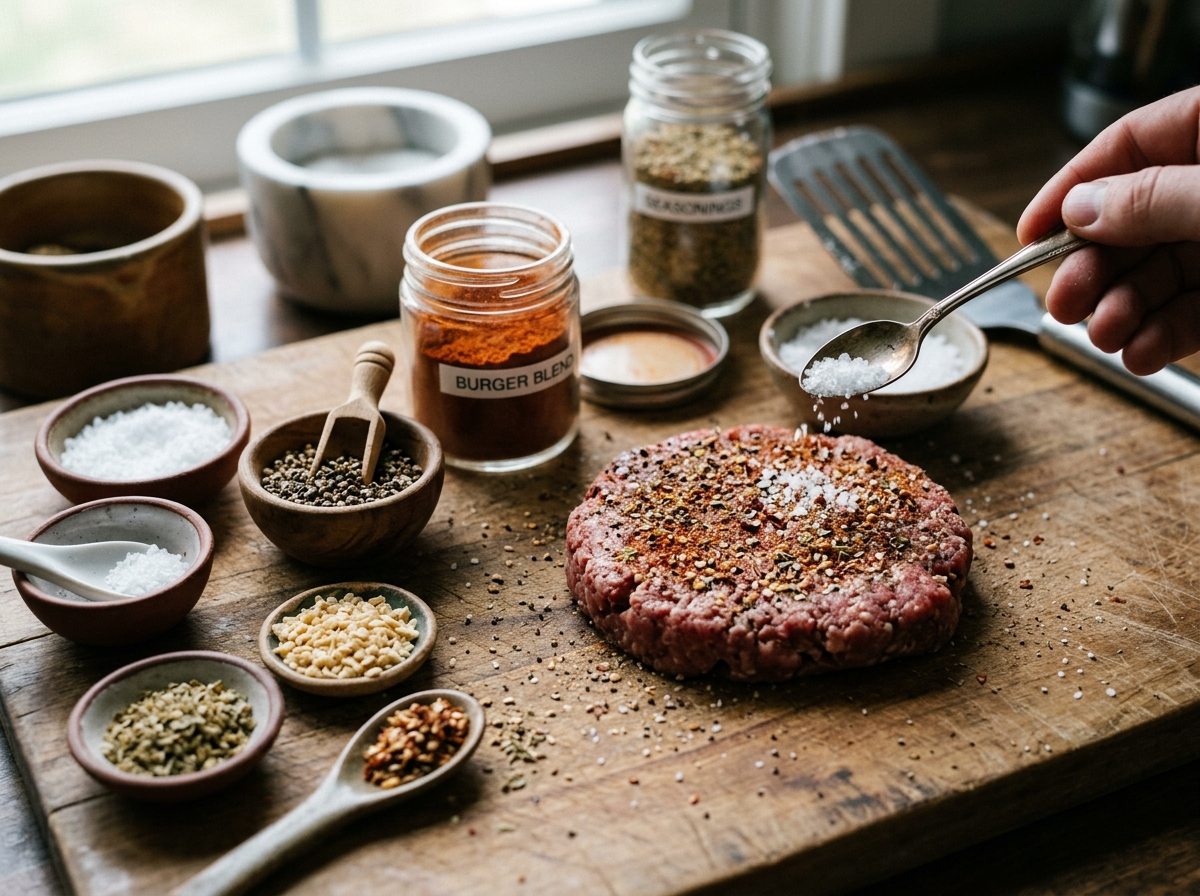
A plain burger patty made with good beef already tastes pretty decent on its own. But the right seasoning? That’s what takes it from “decent” to the kind of burger people remember. The kind where someone stops mid-bite and asks, “What did you put in this?” And the funny thing is, you don’t need a cabinet full of exotic spices to get there. Sometimes it’s just two or three ingredients, applied the right way, at the right time. That’s exactly what we’re going to talk about here — the best seasonings for burgers, how to use them properly, and a few flavor combos that might change your whole grilling game.
Why Seasoning Matters More Than You Think
Here’s something that trips up a lot of home cooks. They’ll spend $12 on quality ground beef, pick the right bun, slice fresh tomatoes — and then barely dust the patty with a pinch of salt. Or worse, they’ll mix a random handful of spices straight into the meat and wonder why the burger tastes muddled.
Seasoning isn’t just about “adding flavor.” It’s about enhancing what’s already there. Good beef has this rich, savory, slightly sweet quality. The right seasoning amplifies that. The wrong approach buries it under a pile of garlic powder and dried oregano.
Think of it like adjusting the volume on a great song. You don’t want to crank the bass so high you can’t hear the vocals. You want balance.
And there’s a science angle here too. Salt, for instance, doesn’t just “add saltiness.” It triggers a reaction on your tongue that makes other flavors more perceptible. Black pepper adds a gentle heat that wakes up your palate. Even a tiny bit of sugar in a rub can promote better caramelization on the crust. These aren’t random additions — they’re doing actual work on your patty.
The takeaway? A well-seasoned burger isn’t about more seasoning. It’s about the right seasoning.
The Foundation: Salt and Black Pepper
Let’s start with the classics, because honestly, you could stop right here and still make an excellent burger.
Kosher salt and freshly ground black pepper. That’s been the go-to combo for professional cooks, backyard grillers, and smash burger enthusiasts for decades. And there’s a good reason — it works.
Kosher salt (brands like Diamond Crystal or Morton are the most popular) has larger, flakier crystals compared to table salt. Those bigger crystals are easier to pinch, distribute more evenly, and dissolve into the surface of the patty without over-seasoning one spot. Table salt, by contrast, packs tighter. A teaspoon of table salt delivers almost twice the saltiness of a teaspoon of kosher salt. So if you’re using table salt, go easy.
Black pepper is the other half of this equation, and freshly cracked pepper makes a noticeable difference compared to pre-ground. Pre-ground pepper sitting in your pantry for six months has lost most of its volatile oils — those are the compounds that give pepper its aroma and warmth. A cheap pepper grinder solves this instantly.
Pro Tip: Season the outside of the patty, not the inside. Mixing salt directly into the ground meat can draw out moisture and make the texture tighter, almost sausage-like. You want a burger, not a meatball. Salt the exterior generously right before it hits the grill or the flat top, and you’ll get a flavorful crust with a juicy interior.
If you’re making smash burgers at home, this approach is especially important. The patty is thin, the cook time is fast, and surface seasoning is really all you need.
Garlic Powder — The Unofficial Third Essential
Ask ten burger lovers what their third seasoning pick would be after salt and pepper, and at least seven will say garlic powder. It’s earned that spot.
Garlic powder brings this warm, savory depth that blends naturally with beef. It doesn’t overpower. It rounds things out. And unlike fresh minced garlic, it won’t burn as quickly on a hot cooking surface. Fresh garlic on a 500°F flat top turns bitter in seconds. Garlic powder, on the other hand, just gets toasty and fragrant.
You don’t need much — about half a teaspoon per pound of meat is a solid starting point if you’re mixing into the beef, or a light dusting on the exterior alongside your salt and pepper.
Quick note on garlic salt: It’s garlic powder mixed with salt. If you use it, reduce your other salt. Double salting is the fastest way to ruin an otherwise good patty.
Onion Powder — The Quiet Workhorse
Onion powder flies under the radar compared to garlic, but it does something really useful in a burger seasoning blend. It adds sweetness. Not a sugary sweetness, but a mellow, savory-sweet note that balances the richness of the beef.
If you’ve ever wondered why restaurant burgers taste a little “fuller” than yours, there’s a decent chance onion powder is part of the answer. Most commercial burger seasoning blends include it. It’s also a core ingredient in many homemade burger rubs.
Granulated onion works just as well — it’s a slightly coarser grind. Same flavor. Your call on texture preference.
Where onion powder really shines is in combination. Salt, pepper, garlic powder, and onion powder together? That’s basically the backbone of American burger seasoning. Simple. Proven. Hard to mess up.
Paprika — Smoky, Sweet, or Both
Paprika is where things get more interesting because you’ve got options.
Sweet paprika (the most common variety you’ll find in grocery stores) adds a mild, slightly sweet warmth and gives the burger a beautiful reddish color on the crust. It won’t change the flavor dramatically, but it contributes a subtle background note that’s pleasant.
Smoked paprika (often labeled “pimentón”) is the bolder cousin. It brings an actual smoky flavor, which can be fantastic if you’re cooking on a flat top or skillet and want to mimic that charcoal-grilled taste. A little goes a long way here. Half a teaspoon per pound of meat is plenty. Too much, and your burger starts tasting like liquid smoke — not great.
Hungarian hot paprika adds a gentle heat along with the color. It’s not cayenne-level spicy, but it’s got a kick.
Paprika works as both a surface seasoning and a mix-in. If you’re building your own spice blend, it’s one of the most versatile additions you can make.
Building a Custom Burger Seasoning Blend
Now that you know the individual players, let’s talk about putting them together. A great homemade burger seasoning blend gives you consistency. You mix it once, store it in a jar, and grab it every time you’re forming patties.
Here’s a blend that works on just about any burger — beef, turkey, pork, even meatless patties:
For roughly 2 pounds of ground meat:
2 teaspoons kosher salt, 1 teaspoon black pepper, 1 teaspoon garlic powder, ½ teaspoon onion powder, ½ teaspoon smoked paprika. That’s it. Five ingredients. Mix them in a small bowl and apply to the outside of your patties.
Want to make a bigger batch for storage? Multiply by four, keep it in an airtight jar, and it’ll stay good for three to four months.
Did you know? Most commercially sold “burger seasoning” blends on the shelf use these exact same ingredients as a base, just with added fillers like silicon dioxide (anti-caking agent) and sometimes sugar. Making your own is cheaper and lets you control the salt level.
Seasonings for Specific Burger Styles
Not every burger is the same, and the best seasoning depends on what you’re going for. A Texas-style patty wants different treatment than a burger with Asian-inspired toppings. Let’s break this down by style.
Classic American Backyard Burger
Stick with the basics — salt, pepper, maybe garlic powder. Let the beef speak. This is the burger you throw on the charcoal or gas grill on a Saturday afternoon with cold drinks nearby. The toppings (ketchup, mustard, pickles, American cheese) carry a lot of flavor already, so the seasoning on the patty just needs to be clean and simple.
Smash Burger
Salt and pepper, applied right before the smash. That’s the tradition. When you press a ball of beef onto a screaming hot flat top, you want maximum contact with the cooking surface. The salt helps draw out just enough surface moisture to promote a hard, crispy, deeply caramelized crust — which is the entire point of a smash burger.
Some people add a dash of garlic powder to the mix. That works. But don’t overthink this one. The Maillard reaction (that’s the chemical browning process) does the heavy lifting flavor-wise.
Steakhouse-Style Thick Burger
For a thicker patty — something you’d cook to a specific internal temperature like medium or medium-rare — you want seasoning that creates a savory, almost steak-like crust. Coarsely ground black pepper, kosher salt, and a hint of smoked paprika work beautifully here. Some cooks add a touch of dried thyme or rosemary. Both pair naturally with beef, and when they hit the heat, they release aromatic oils that smell incredible.
If you’re grinding your own beef (which gives you control over fat ratio and meat selection), a steakhouse seasoning approach makes the most sense. You’ve invested effort in the grind — don’t mask it with too many spices.
Southwestern / Tex-Mex Burger
Now we’re getting into bolder territory. Add cumin and a pinch of cayenne to your base blend. Cumin brings that earthy, warm, distinctly Southwestern flavor, and cayenne adds controlled heat. Chili powder (the blended kind with cumin, oregano, and garlic already in it) also works as a shortcut here.
Top this burger with pepper jack cheese, pickled jalapeños, and a chipotle mayo, and you’ve got something special.
The “Everything Burger” with Bold Flavors
Sometimes you want a burger that punches you in the mouth (in the best way). For those days, try adding Worcestershire powder — yes, it comes in powdered form — along with a bit of mustard powder and brown sugar. The Worcestershire adds umami depth, mustard adds tangy heat, and brown sugar promotes caramelization and balances the savory notes.
This is the kind of seasoning profile you’d find on burgers at food trucks. Speaking of which, if you’ve ever thought about starting a food truck, having a signature seasoning blend like this is one way to build a following.
Fresh Seasonings vs. Dried — Does It Matter?
Short answer: yes, but not always in the way you’d expect.
Fresh herbs like parsley, cilantro, and basil look great and taste vibrant — but they don’t bring much to a cooked burger patty. Most of their flavor comes from volatile oils that evaporate quickly under high heat. So by the time your patty is done, those bright, fresh notes are mostly gone.
Dried versions of those same herbs hold up better because the flavor is more concentrated. Dried oregano, dried thyme, and dried rosemary actually perform well on burgers because they release their flavors slowly as the meat cooks.
The exception? Fresh garlic and fresh onion. These can work mixed into the meat for certain styles (like a homemade blend for thick grilled patties), but you need to mince them very finely. Big chunks create uneven seasoning and texture issues.
For most burger applications, dried seasonings and powders are the practical choice. Save the fresh herbs for your toppings and sauces.
Seasoning Techniques That Actually Make a Difference
Knowing what to season with is only half the equation. How you apply it matters just as much. Here are a few approaches that separate a forgettable burger from a standout one.
Season the Outside, Not the Inside
We touched on this earlier, but it’s worth repeating because it’s probably the most common seasoning mistake home cooks make. Mixing salt into the ground meat before forming patties changes the protein structure. The salt starts dissolving the myosin in the beef, which binds the meat together more tightly. That’s perfect for sausage. Terrible for burgers.
You want a patty that’s juicy and loose-textured on the inside with a well-seasoned crust on the outside. So form your patties first. Season generously on both flat sides. Then cook.
The only exception might be a thick pub-style burger where you want some seasoning distributed throughout. Even then, go light on the salt inside and heavier on the exterior.
Season Right Before Cooking
Don’t season your patties and then leave them sitting on a plate for 30 minutes. The salt will pull moisture to the surface, and that moisture will interfere with browning. Season, then immediately place the patty on the hot cooking surface.
Use Your Fingers, Not a Shaker
Pinching seasoning between your thumb and fingers gives you better control and more even distribution than shaking from a container. Hold your hand about 10-12 inches above the patty and let the seasoning rain down. You’ll cover more surface area and avoid clumps.
This is actually the technique most restaurant line cooks use. Watch any cooking show closely — the seasoning almost always comes from pinched fingers, not a shaker.
Underrated Seasonings Worth Trying
Beyond the standard lineup, there are a few seasonings that don’t get enough credit in the burger world.
Celery salt has a subtle, almost herbal saltiness that pairs surprisingly well with beef. It’s a key ingredient in Chicago-style hot dogs, and it works on burgers too — especially with pickles and yellow mustard.
White pepper is sharper and more pungent than black pepper, with a slight fermented quality. If you want pepper flavor without the visible black specks (for aesthetic reasons or just something different), white pepper is your move.
Coriander — the ground seed, not the fresh leaf — adds a citrusy, slightly floral note. Mixed with cumin and black pepper, it creates a seasoning profile that feels Middle Eastern-inspired. Great on lamb burgers especially, but it works on beef too.
MSG (monosodium glutamate) is the elephant in the room. A lot of people still avoid it based on outdated concerns, but food science has largely debunked the idea that MSG causes adverse reactions in normal amounts. The FDA classifies it as “generally recognized as safe.” What it does do is amplify umami — that deep, savory, meaty flavor. A quarter teaspoon mixed into your seasoning blend can make the burger taste notably more “beefy.” Ajinomoto is the most common brand. Try it once and see what you think.
What About Liquid Seasonings?
Worcestershire sauce is the most popular liquid seasoning for burgers, and it’s been used this way since at least the mid-20th century. A few dashes mixed into the ground meat adds a complex flavor — tangy, sweet, salty, and fermented all at once. The anchovies and tamarind in Worcestershire give it that hard-to-pin-down umami quality.
The downside? Adding liquid to ground meat can make it sticky and harder to form into patties. If you go this route, use a light hand — no more than a tablespoon per pound of beef. And don’t overwork the meat while mixing it in.
Soy sauce works similarly, bringing salt and umami in liquid form. It’s especially good for burgers with Asian-inspired toppings like teriyaki glaze, pickled cucumbers, or sriracha mayo.
Hot sauce mixed into the meat (just a teaspoon or two) adds background heat without being obvious. Frank’s RedHot and Crystal are mild enough to blend in. If you want more fire, Louisiana-style sauces or even a few drops of habanero sauce will do it.
Seasoning Turkey and Chicken Burgers
Beef is forgiving. It has fat, it has natural flavor, and it can handle a simple salt-and-pepper treatment just fine. Turkey and chicken burgers? They need more help.
Poultry is leaner and milder, so the seasoning has to compensate. This is where you can afford to be a little heavier-handed. Garlic powder, onion powder, smoked paprika, and a touch of cumin work really well together on a turkey burger. Some cooks add a bit of Worcestershire sauce and Dijon mustard directly into the ground turkey before forming patties — the extra moisture actually helps here since turkey can dry out fast.
For chicken burgers, consider a Nashville hot approach — cayenne, paprika, garlic powder, brown sugar, and a bit of black pepper. It adds personality that plain ground chicken desperately needs.
The key with poultry burgers is that you almost want to season the inside, unlike beef. Since these patties don’t have the same beefy richness to fall back on, distributing flavor throughout the meat makes a real difference.
How Much Seasoning Per Pound of Meat?
This is one of the most searched questions around burger seasoning, and the answer depends on your blend and your taste. But here’s a general guideline that gives you a reliable starting point.
For a simple salt-and-pepper burger: about 1 teaspoon of kosher salt and ½ teaspoon of black pepper per pound of ground beef. That’s your baseline. Adjust from there based on how salty you like things.
For a full seasoning blend (salt, pepper, garlic powder, onion powder, paprika): about 1½ to 2 teaspoons of the blend per pound. If you’re seasoning the exterior only, you can eyeball it — a generous pinch per side of each patty.
⚠️ Warning: If you’re using a pre-made seasoning from the store, check the sodium content. Some commercial blends are extremely salty. Lawry’s Seasoned Salt, for instance, is basically salt with a few added flavors. Using it the same way you’d use a homemade blend will likely make your burgers too salty.
Timing Your Seasoning: Before, During, or After?
Most seasonings go on before cooking. But there are a few exceptions worth knowing about.
Before cooking: Salt, pepper, garlic powder, onion powder, paprika, cumin, and any dry rub ingredients. Apply them right before the patty hits the heat.
During cooking: This is when you’d add cheese (obviously), but also things like a brush of Worcestershire sauce or a sprinkle of seasoning on the just-flipped side. If you’re cooking on a flat top, you can press some seasoning into the raw side right after flipping.
After cooking: Flaky finishing salt (like Maldon) is best applied right after the patty comes off the heat. The residual warmth helps the crystals cling. A light sprinkle of finishing salt on top of the cheese or directly on the crust adds a burst of flavor in the first bite.
Fresh cracked pepper also works as a finishing touch, especially on a steakhouse-style thick burger.
Pairing Seasonings with Toppings and Cheese
Your seasoning doesn’t exist in a vacuum. It’s working alongside your cheese, toppings, and sauces. Thinking about these pairings can take your burger from good to genuinely memorable.
A patty seasoned with just salt and pepper pairs beautifully with sharp cheddar, caramelized onions, and a tangy sauce. The simplicity of the seasoning lets the toppings shine.
A Southwestern-seasoned patty (cumin, cayenne, chili powder) wants pepper jack cheese, avocado, and maybe some game day chili cheese style toppings.
A smoked paprika-heavy patty works great with smoked gouda, crispy bacon, and barbecue sauce. The smoky notes stack on each other in a way that feels intentional.
If you’re going for something creative — like one of these 25 creative burger ideas — matching your seasoning to your topping theme makes the whole thing taste more cohesive.
FAQ
What’s the simplest seasoning for burgers that still tastes great?
Kosher salt and freshly ground black pepper. That’s genuinely all you need for a good burger, especially if you’re using quality ground beef with the right fat content. Season the outside of the patty generously right before cooking. Two ingredients, zero complexity, real results.
Should I mix seasoning into the burger meat or put it on top?
For beef burgers, put it on the outside. Mixing salt into ground beef changes the texture — it makes the patty denser and chewier, more like a sausage. For turkey and chicken burgers, mixing seasoning in is actually a good idea because poultry needs more help with flavor and the leaner meat benefits from internal seasoning.
Can I use steak seasoning on burgers?
Absolutely. Most steak seasonings contain salt, pepper, garlic, onion, and sometimes crushed red pepper or coriander — all of which work perfectly on burgers. Montreal Steak Seasoning is the most common example, and it’s a solid choice if you don’t want to build your own blend. Just watch the salt content since these tend to run salty.
How do I know if I’ve over-seasoned my burger?
The best test is to cook a small tester piece. Pinch off a tiny bit of seasoned meat, flatten it into a mini patty, and cook it in a skillet for about a minute per side. Taste it. If it’s too salty or too spicy, you can adjust the remaining meat. This 30-second test saves you from serving eight over-salted burgers to your friends.
Your Next Cookout Starts Here
The best seasonings for burgers aren’t complicated, expensive, or hard to find. Most of them are already sitting in your spice cabinet. What separates a great burger from a bland one is usually just a matter of choosing the right combination and applying it at the right moment.
Start with salt and pepper. Get comfortable with that. Then branch out — try garlic powder, smoked paprika, or a full custom blend. Pay attention to how each addition changes the final taste. Once you find your go-to mix, you’ll stop reaching for store-bought seasoning packets and start trusting your own instincts.
And honestly? That’s the best part about cooking burgers at home. You get to experiment. You get to tweak. Next time you fire up the grill or heat up your skillet, try one new seasoning you haven’t used before. You might just find your new favorite burger.