
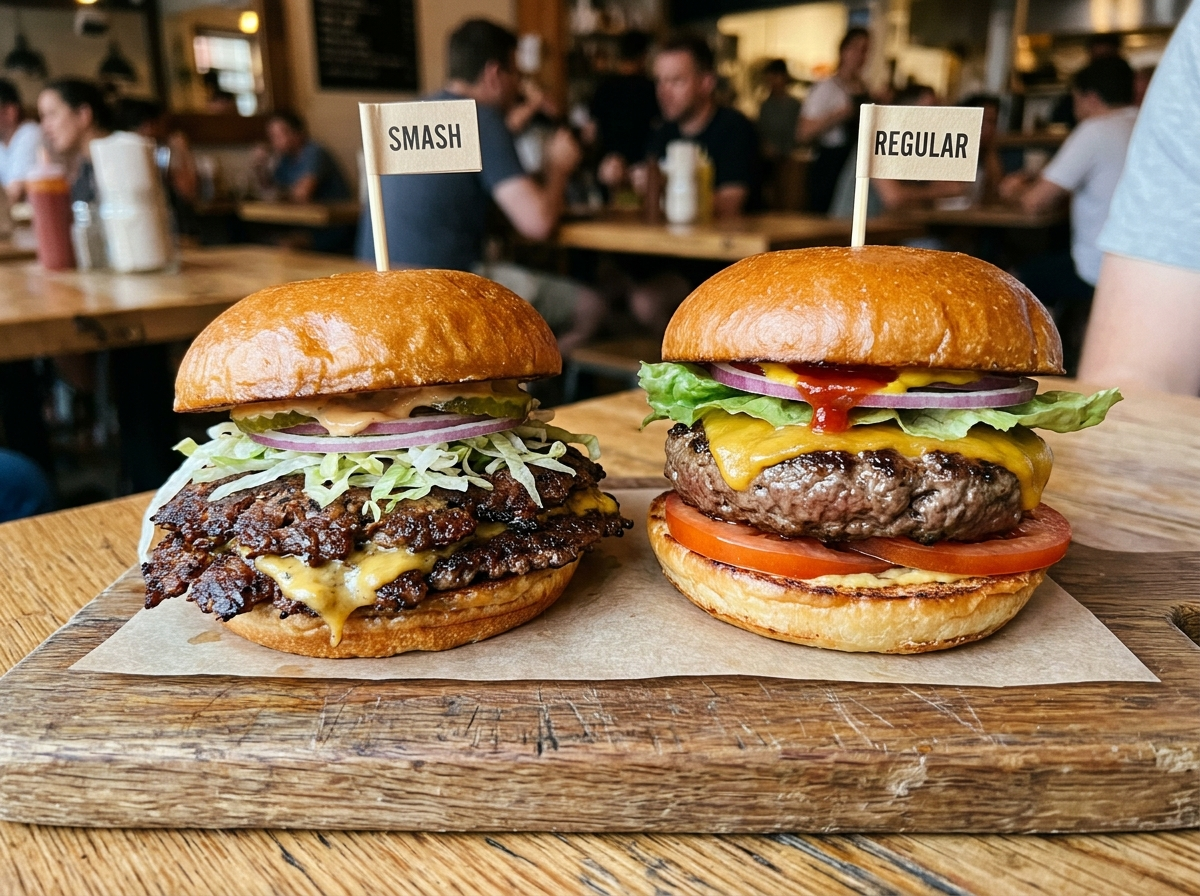
A thin, crispy-edged patty with caramelized crust on every surface — or a thick, juicy burger with a pink center and char marks from the grill. That’s the debate right there. Smash burgers and regular burgers both use ground beef, both sit between buns, and both can make your entire week better. But they’re honestly two very different eating experiences.
The smash burger craze has exploded over the last few years. What started in old-school diners and regional joints has turned into a full-blown movement. Food trucks, fast-casual chains, and backyard cooks everywhere are pressing balls of beef flat on screaming-hot griddles. Meanwhile, the traditional thick burger — the kind you throw on a grill and cook to your preferred doneness — hasn’t gone anywhere. It’s still the default at cookouts, steakhouses, and most backyards across America.
So which one is actually better? That depends entirely on what you’re after. And the differences go way deeper than just thickness. We’re talking about cooking science, flavor development, texture, the equipment you need, and even the type of beef that works best for each style. Let’s break it all down so you can figure out which one belongs on your plate — or maybe both do.
What Exactly Makes a Smash Burger a “Smash” Burger?
A smash burger isn’t just a thin patty. It’s a specific technique, and the technique is what creates that distinctive flavor.
You start with a loosely packed ball of ground beef — usually around 2 to 3 ounces — and place it on a flat cooking surface that’s been heated to extremely high temperatures (around 400–450°F on the surface). Then, within the first 30 seconds, you press it flat with a heavy spatula, a burger press, or even the back of a sturdy plate. That aggressive press is the whole point.
What happens next is pure food science. The Maillard reaction — the same chemical process that gives seared steak, toasted bread, and roasted coffee their deep flavors — kicks into overdrive. Because the patty is so thin and has maximum contact with the hot surface, you get an incredible amount of browning across the entire face of the burger. That brown crust isn’t just color. It’s hundreds of new flavor compounds forming in real time.
The edges go lacy and crisp. The fat renders out and essentially fries parts of the patty in its own grease. You get a burger that’s deeply savory, a little crunchy, and absolutely packed with that “grilled meat” flavor — even though it never touched a grill.
Pro Tip: Don’t press the patty more than once. That initial smash is everything. If you keep pressing, you squeeze out all the juice and end up with a dry, tough hockey puck.
If you want to try this at home, we’ve got a full walkthrough on making smash burgers at home that covers the gear, technique, and timing.
The Traditional Burger: Why Thick Patties Still Have Loyal Fans
The regular burger — let’s call it what most people picture when they hear “burger” — is a thicker patty, usually 5 to 8 ounces, formed by hand or with a press, cooked on a grill or flat-top to a specific internal temperature.
Where smash burgers are all about crust and crunch, traditional burgers are about interior juiciness. A thick patty gives you something a smash burger physically can’t: a gradient of doneness from the seared outside to a tender, pink (or at least moist) center. That bite where the exterior has some char but the inside is soft and beefy — that’s the experience people chase with a regular burger.
Thick burgers also hold up better under heavy toppings. Stack lettuce, tomato, onion, pickles, cheese, bacon, and a couple of sauces on a smash burger, and you’ll crush it. A thick patty can handle the weight. It provides structure.
There’s also the ritual of it. Grilling burgers over charcoal on a summer afternoon hits different than standing over a griddle in your kitchen. The smoky flavor, the grill marks, the sound of fat dripping onto hot coals — regular burgers carry a nostalgia that smash burgers are still building.
And if you’re someone who cares about doneness levels — medium-rare, medium, medium-well — thick burgers are your only real option. You can’t cook a smash burger to medium-rare. It’s too thin. It’s done in about 2 minutes total, and it’s well-done by design. Check out our burger doneness chart if you want to understand how thickness and temperature work together.
Flavor: Where Smash Burgers Pull Ahead (and Where They Don’t)
Let’s talk about taste, because that’s really what matters.
Smash burgers win on surface flavor. The ratio of crust to interior meat is much higher in a thin patty. Every bite gives you that intensely savory, caramelized, almost nutty flavor that comes from maximum Maillard reaction. People who try a well-made smash burger for the first time often say it tastes “beefier” than a regular burger — which is funny, because it actually has less beef in it.
That’s the trick. It’s not about more meat. It’s about more browning.
Regular burgers, on the other hand, win on beefy depth. A thick patty cooked to medium on a charcoal grill gives you that pure, mineral, almost steak-like flavor in the center. The outside has some char, but the star of the show is the juicy interior. If you’ve ever bitten into a properly cooked half-pound burger made with quality ground chuck and thought “this tastes like a steak” — that’s what a thick burger does best.
Did you know? The Maillard reaction starts at around 280°F and accelerates as temperatures rise. Smash burgers on a 450°F griddle get more browning in 90 seconds than a thick burger gets in 8 minutes on a grill. That’s why the flavor profile feels so different even though you’re using the same beef.
There’s also a smoke factor. Regular burgers cooked over charcoal or gas pick up a smoky flavor that smash burgers simply don’t get. A flat-top griddle doesn’t produce smoke. If that smoky char is something you love, the traditional route delivers it naturally.
Texture: Crunch vs Juiciness
This might be the single biggest difference between the two styles, and it’s where most people find their preference.
Smash burgers give you textural contrast. The edges are crispy, almost like a chip. The center is thin but still has enough moisture to feel meaty. When you add melted American cheese (the classic smash burger cheese because it melts into a gooey blanket), a soft potato bun, pickles, and sauce — every bite has crunch, salt, fat, acid, and softness all at once. It’s a lot going on in a small package.
Regular burgers give you uniform tenderness. The bite is softer, more consistent. The patty has give — it compresses a little, releases juice, and feels substantial in your mouth. For people who want their burger to feel like a meal, a thick patty delivers that satisfying density.
Here’s one thing most articles won’t tell you: smash burgers are harder to overcook in a practical sense. Because they’re meant to be fully cooked through, you don’t have the anxiety of hitting a perfect internal temp. They’re done when the crust is deep brown and the edges are crispy. Regular burgers, though? Overcook them by even a couple of minutes and you’ve crossed from juicy to dry. That’s why having a reliable thermometer for burgers matters so much with thick patties.
The Meat: Does the Same Beef Work for Both?
Short answer — yes, you can use the same ground beef. But the ideal choice is a little different for each style.
For smash burgers, you want an 80/20 blend (80% lean, 20% fat). That fat is essential. When the patty smashes down on the hot surface, the fat renders quickly and creates that frying effect on the edges. Too lean, and you’ll get a dry, papery patty with no crust. The fat is doing double duty: adding flavor and creating texture.
For regular burgers, 80/20 works great too, but you have more flexibility. Some people go 85/15 for a slightly leaner patty, especially if they’re grilling over charcoal where dripping fat can cause flare-ups. Others go 75/25 for maximum juiciness in a thick patty that needs to stay moist through a longer cook time.
The best fat ratio for burgers really depends on your cooking method and how thick you’re going. But as a general rule, smash burgers need that fat more because they don’t have thickness to protect them from drying out.
If you really want to level up either style, grinding your own hamburger meat gives you control over the cut, the fat percentage, and the grind texture. A coarser grind works beautifully for thick burgers, while a standard grind is perfect for smash patties.
Quick Fact: Some smash burger enthusiasts swear by adding wagyu tallow to the griddle before smashing. It adds a layer of rich, beefy fat that amplifies the crust. Worth trying if you want to experiment.
Equipment: What You Need for Each Style
Here’s where a practical difference shows up. You don’t cook smash burgers and regular burgers on the same setup — or at least, you shouldn’t.
Smash burgers need a flat-top surface. A cast iron skillet works if it’s large enough. A flat-top griddle (like a Blackstone) is ideal. A plancha works. What doesn’t work is a grill with grates. When you smash a ball of beef, it needs a flat, solid surface to press against. Grill grates let the meat push through the gaps, and you lose that full-contact sear.
We actually wrote a full comparison of flat-top vs grill for burgers that gets into the details on this. The short version: flat-tops are smash burger machines. Grills are traditional burger territory.
Regular burgers are grill-friendly. Gas grill, charcoal grill, even a pellet smoker — thick patties sit on the grates, develop grill marks, pick up smoke, and cook evenly through indirect and direct heat. You can also cook them on a flat-top, but you lose the smoky element.
Beyond the cooking surface, smash burgers require one extra tool: something to smash with. A heavy-duty stiff spatula works, but dedicated smash burger presses (a flat piece of heavy metal with a handle) give you more even pressure. Some people use a ball of parchment paper between the press and the meat to prevent sticking.
Cooking Time and Speed: A Real Difference
If you’re feeding a crowd, this matters a lot.
A smash burger patty cooks in roughly 2 to 3 minutes total. About 60 to 90 seconds per side. That’s it. You smash it, let it sear, flip it once, add cheese, and it’s done. Because most smash burgers are served as doubles (two thin patties stacked), you’re still looking at under 5 minutes per burger.
A thick regular burger takes 8 to 12 minutes depending on thickness, starting temperature of the meat, and your target doneness. A half-inch patty cooks faster than a three-quarter-inch patty. Medium-rare takes less time than well-done. You need to flip at least once, and you really should be checking internal temperature to avoid guessing.
So if you’re running a backyard cookout for 15 people, smash burgers on a large griddle can pump out food dramatically faster than grilling thick patties. That’s one reason food truck operators love the smash burger format — high volume, fast turnover, consistent results.
Warning: Speed is great, but don’t sacrifice the sear for efficiency. If you crowd too many smash patties on a griddle at once, the surface temperature drops and you get steamed grey meat instead of a dark, crispy crust. Leave space between patties. Work in batches if needed.
Toppings and Builds: How Each Burger Shines
The way you dress a smash burger is fundamentally different from how you build a traditional burger, and understanding this changes the whole experience.
Smash burgers lean toward simplicity and specific combos. The classic smash burger build is American cheese, diced white onion (raw or griddled), pickles, and a sauce — ketchup, mustard, or a special sauce. That’s it. The patty is thin, the bun is soft (potato buns are the standard), and everything stays in proportion. You don’t want heavy toppings overpowering the crispy edges.
The double or triple smash burger stacks thin patties with cheese between each one, creating layers of meat, melted cheese, meat, melted cheese. It’s the same idea as an In-N-Out Double-Double or a Shake Shack burger — small patties, big flavor, manageable size.
Regular burgers handle bigger, bolder toppings without falling apart. Thick-sliced tomato, a full lettuce leaf, thick-cut bacon, fried onion rings, jalapeños, avocado, a fried egg — all of these work on a thick patty because it has the structural integrity to hold everything together. This is where you can get creative. We’ve got 25 creative ways to make hamburgers more interesting if you want some ideas beyond the usual.
One other thing worth noting: smash burgers and regular burgers both benefit from the right seasoning. Simple salt and pepper works for both styles, but the timing and method differ. With smash burgers, you season the ball before smashing (or season the flat side right after smashing). With thick patties, you can season more generously on the outside. Our guide on how to season burgers properly covers both approaches.
What About Juiciness? Let’s Settle This
People assume smash burgers are dry because they’re thin and cooked all the way through. That’s not exactly wrong — but it’s not the full story.
A single smash patty, eaten alone, won’t feel as juicy as a thick burger cooked to medium. That’s physics. There’s less meat and less retained moisture. But smash burgers compensate in two ways.
First, the rendered fat doesn’t all leave the burger. Some of it stays trapped in the crust, adding richness to every bite. Second, smash burgers almost always come as doubles or triples, and when you stack those patties with melted cheese between them, the cheese acts as a moisture barrier. It traps steam, keeps things gooey, and the overall eating experience feels plenty juicy.
Regular burgers, when cooked properly, can be remarkably juicy. The key word there is “properly.” An overcooked thick burger is one of the driest, most disappointing foods on earth. There’s no crunchy crust to save it — just dry, grey, crumbly meat. If you’ve ever struggled with this, we wrote about why burgers dry out and how to keep burgers juicy — two pieces that address the most common mistakes.
So the juiciness debate isn’t really a fair comparison. It’s two different approaches to achieving satisfying moisture. Smash burgers use fat, cheese, and sauce. Regular burgers rely on internal temperature control and proper technique.
Cost and Portion Considerations
Here’s a practical angle most comparisons skip.
A smash burger uses 2 to 3 ounces of beef per patty. Even a double uses 4 to 6 ounces total. A regular burger typically uses 6 to 8 ounces for a single patty. If you’re buying a pound of ground beef, you can make roughly five to six smash patties or two regular burgers.
For families on a budget, smash burgers stretch a pound of ground beef further. You’re essentially getting more burgers per pound — and because the flavor is so concentrated from all that crust, you don’t feel like you’re eating less. A smash double with cheese feels like a full meal even though it’s technically less meat than a traditional half-pound burger.
This is also why smash burgers have become so popular in the restaurant and food truck world. Lower food cost per unit, faster cook time, and customers feel like they’re getting something special because of that crispy crust. The value equation works well for everyone.
Which Style Works Best at Home?
Both are totally doable in a home kitchen, but your setup determines which one will turn out better.
If you own a cast iron skillet or a flat-top griddle and a good ventilation system (or you cook outside), smash burgers are straightforward. Heat your surface screaming hot, portion your beef into balls, smash, flip, cheese, bun. The whole process moves fast and doesn’t require a thermometer or much guesswork.
If you have a charcoal or gas grill and prefer cooking outdoors, thick burgers are the natural move. You get that smoky flavor, you can control doneness with a thermometer, and you can use the right grilling temperature to get consistent results.
One thing to keep in mind: smash burgers create a lot of smoke and grease splatter indoors. If you don’t have a powerful range hood, you might want to take your cast iron skillet or griddle outside to a burner. Your smoke detectors will thank you.
And don’t sleep on the bun situation. Both styles deserve a bun that matches. Smash burgers work best on soft, squishy potato buns (Martin’s is the cult favorite). Thick burgers can handle sturdier buns — brioche, pretzel buns, or even a toasted Kaiser roll that won’t get soggy under the weight of a juicy patty and all its toppings.
So, Which Burger Is Better?
You knew this was coming — and the honest answer is neither, always.
Smash burgers are better when you want maximum flavor per ounce of beef, a fast cook, crispy texture, and a burger that punches above its weight class. They’re perfect for weeknight dinners, feeding a crowd, and satisfying that fast-food craving at home with way better quality.
Regular burgers are better when you want a steakhouse experience in burger form — thick, juicy, smoky, and cooked to your preferred temperature. They’re the backyard cookout standard for good reason. They work with every type of ground meat, they handle bold toppings, and they deliver a kind of satisfaction that only a thick, well-made patty can.
The best move? Learn both. Make smash burgers on Tuesday night when you want something quick and ridiculously tasty. Fire up the grill on Saturday and cook thick patties low and slow over charcoal. They’re not competing with each other — they’re two different answers to the same beautiful question: what’s for dinner?
FAQ
Is a smash burger healthier than a regular burger?
A single smash patty has less total beef (2–3 ounces vs 6–8 ounces), which means fewer calories and less fat per patty. But most people eat a double smash, so the difference narrows. The cooking method itself doesn’t change the nutritional profile much. What affects health more is the cheese, sauce, and bun you choose. Neither style is “health food,” and that’s perfectly fine.
Can you cook a smash burger on a regular grill?
Not effectively. Grill grates have gaps, so when you press the beef down, it pushes through the grates and falls apart. Smash burgers need a flat, solid surface — a cast iron skillet, a flat-top griddle, or a plancha. If you really want to do it on a grill, place a cast iron skillet or flat griddle on top of the grill grates and use that as your cooking surface.
Why do smash burgers taste more “beefy” even though they have less meat?
It’s all about the Maillard reaction. A thin patty pressed onto a very hot surface develops way more browned crust than a thick burger. That brown crust is where the intense, savory, “beefy” flavor lives. You’re not tasting more beef — you’re tasting more browning. The flavor-to-bite ratio in a smash burger is simply higher.
What’s the ideal thickness for a regular burger patty?
Most people find that ¾ inch works best for a home-cooked burger. It’s thick enough to cook to medium or medium-rare while still developing good exterior char. Go thinner than ½ inch and you’re basically in smash burger territory. Go thicker than an inch and you’ll struggle with an overcooked outside and raw center. We’ve got more details on how thick burgers should be if you want specific guidance.
Do smash burgers work with turkey or chicken ground meat?
They can, but results vary. Turkey and chicken are leaner than beef, so they won’t develop the same crispy, fatty crust. You’ll want to add a little oil to the griddle and be careful not to overcook them (which happens fast with lean meat). For leaner meats, a traditional thicker patty actually works better because you have more control over internal temperature and moisture retention.
Next time you’re standing in front of the meat case at the grocery store with a pound of ground beef in your hand, you don’t have to choose one style forever. Grab some potato buns and some brioche rolls. Fire up the griddle tonight and the grill this weekend. Try both, tweak both, and figure out which one makes you happier. Or just accept that you need both in your life — because honestly, you probably do.