
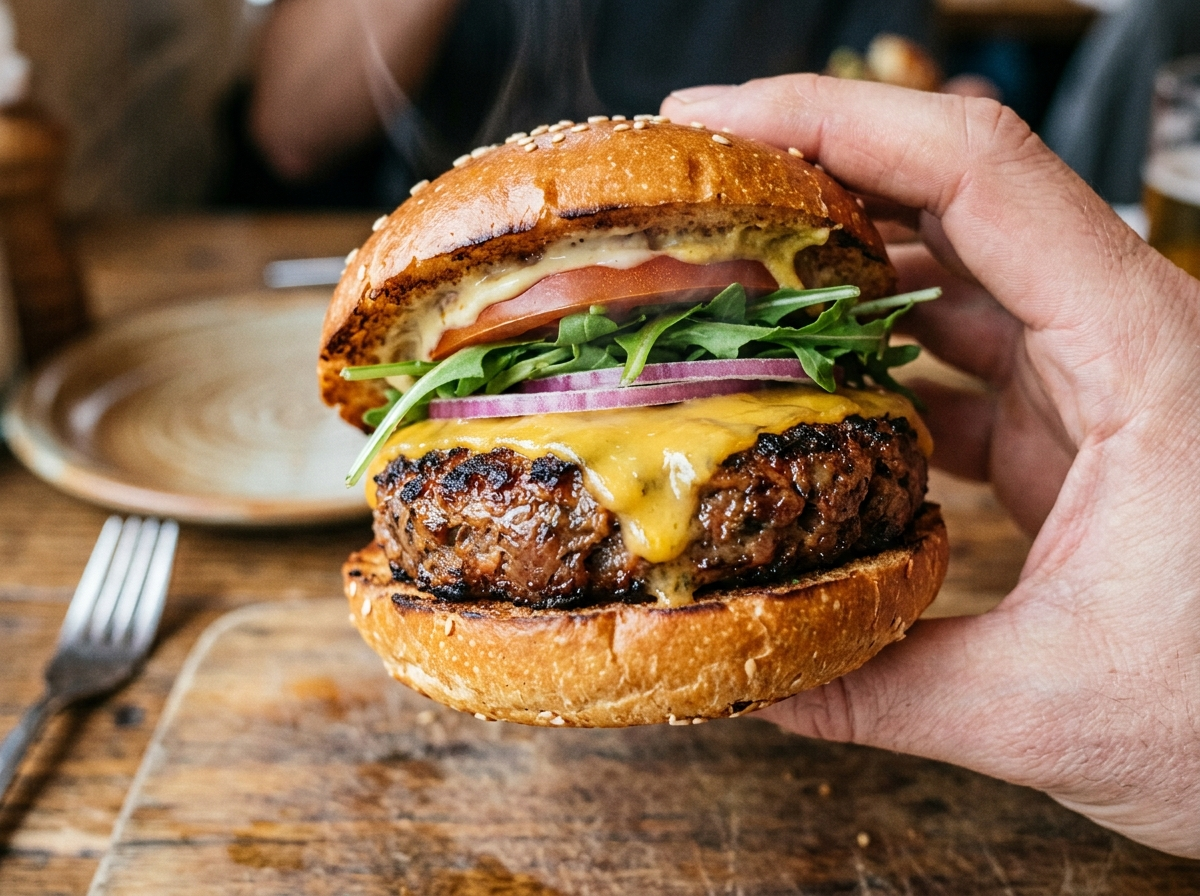
A meatless burger cooked at the wrong temperature doesn’t just taste bad — it can turn into a rubbery puck, a crumbly mess, or something that sticks to your grill like cement. And the frustrating part? Most people treat plant-based patties exactly like beef burgers on the grill. Same heat, same timing, same expectations. That’s where everything falls apart.
Whether you’re working with Beyond Meat, Impossible Burger, black bean patties, or something you shaped by hand in your own kitchen, temperature control changes everything. It affects texture, flavor, moisture, and even whether your burger holds together or disintegrates on the spatula.
This guide breaks down exactly why meatless burgers need their own temperature rules, what those rules are for different types of patties, and how to nail the perfect cook every single time — no guesswork required.
Why You Can’t Cook Meatless Burgers Like Beef
Here’s the thing most people don’t realize: beef burgers are forgiving. Ground beef has fat marbled throughout that melts slowly, keeps things moist, and gives you a decent window between “perfect” and “overcooked.” You’ve got some breathing room.
Meatless burgers? Not so much.
Plant-based patties rely on different fats — coconut oil, cocoa butter, sunflower oil — that behave completely differently under heat. These fats have lower melting points than animal fat. They go from solid to liquid much faster, which means your window for a perfect cook is narrower.
Cook a beef burger 30 seconds too long, and it’s still edible. Cook a meatless burger 30 seconds too long, and you might end up with something dry, tough, and genuinely unpleasant.
The protein structure is different too. Beef proteins gradually firm up as they cook, creating that familiar texture progression from rare to well-done. Plant proteins — like pea protein, soy protein, or wheat gluten — don’t work that way. They can go from soft to overdone without much warning.
If you’ve been using the ultimate burger temperature guide you rely on for regular burgers, you already understand how much temperature affects the final product. Meatless burgers just need a different playbook.
The Ideal Internal Temperature for Meatless Burgers
Let’s get specific, because vague advice like “cook until heated through” doesn’t help anyone.
For commercially made plant-based burgers (Beyond Burger, Impossible Burger, and similar brands), the target internal temperature is 165°F (74°C). Both Beyond Meat and Impossible Foods recommend this number on their packaging, and there’s a good reason for it.
Unlike beef, where you might target 130°F for medium-rare or 160°F for well-done based on personal preference, plant-based patties don’t have that same doneness spectrum. You’re not trying to achieve a specific level of “pinkness” — you’re trying to get the binding agents, fats, and proteins to set up properly so the texture feels right.
For homemade veggie burgers — the black bean, chickpea, lentil, or mushroom variety — the rules shift a bit. These patties often contain eggs, breadcrumbs, or other binders that need to cook through fully. Aim for that same 165°F internal temperature, but pay closer attention to the outside. Homemade patties brown differently, and a dark exterior doesn’t always mean a cooked interior.
Quick fact: The Impossible Burger actually contains heme (derived from soy leghemoglobin), which gives it that slightly pink, “meaty” appearance even when fully cooked. So don’t rely on color alone to judge doneness. Use a thermometer. Seriously.
If you’ve ever wondered how thermometers make a real difference for burgers, this is one of those situations where having a good instant-read thermometer isn’t optional — it’s essential.
Grill Temperature vs. Internal Temperature: Know the Difference
This is where a lot of confusion lives, so let’s clear it up.
Grill or cooking surface temperature is how hot your grill grates, pan, or flat top are. Internal temperature is what’s happening inside the patty itself. They’re two completely different measurements, and both matter.
For meatless burgers, your cooking surface should sit around 375°F to 400°F (190°C to 204°C). That’s medium to medium-high heat on most grills and stovetops.
Why this range? Go below 375°F and you won’t get enough Maillard reaction — that’s the browning and caramelization that gives any burger its crust and flavor. Your patty will cook through eventually, but it’ll look pale, taste flat, and have a soft, almost steamed texture. Nobody wants that.
Go above 425°F and the exterior chars before the interior heats through. The coconut oil or other fats in the patty melt out too fast, leaving you with a dry, tough center covered in a burnt shell.
That 375°F–400°F sweet spot gives you enough heat for a proper sear while still allowing the center to reach 165°F without burning the outside.
If you’ve cooked smash burgers at home, you know that technique uses very high heat for very thin patties. That works for beef because of its fat content and protein structure. For meatless patties, the smash technique requires some adjustments — thinner plant-based patties cook faster but can dry out in seconds on a screaming-hot surface.
How Different Cooking Methods Affect Meatless Burger Temperature
Not everyone’s grilling. And honestly, the cooking method you choose changes how you need to think about temperature management.
On the Grill (Gas or Charcoal)
Grilling meatless burgers is totally doable, but it comes with one big challenge: sticking. Plant-based patties don’t have the same fat content as beef to naturally lubricate the grates. Oil your grill grates well before the patty goes on, and don’t move it until a crust forms — usually about 3 to 4 minutes per side.
Keep your grill at that medium-high zone (around 400°F). If you’re using charcoal, that means waiting until the coals are ashed over and you can hold your hand about five inches above the grate for roughly 4 to 5 seconds before it gets uncomfortable.
One more thing — avoid pressing down on the patty with your spatula. This squeezes out those plant-based fats and moisture you need for a good result. If you’ve explored the differences between charcoal vs. gas for burgers, you know gas gives you more precise temperature control. That precision matters even more with meatless patties because the margin for error is slimmer.
On a Flat Top or Skillet
This is actually the best method for most meatless burgers, and here’s why: you get even, consistent heat across the entire patty surface, and you can control the temperature more precisely than on a grill.
Heat your pan or flat top to medium-high — right around that 375°F–400°F mark. Add a small amount of oil with a high smoke point (avocado oil works great). Place the patty down and let it sit undisturbed.
The flat surface contact creates a better crust than grill grates, and that crust helps lock in moisture. You’re looking at about 3 to 4 minutes per side for a standard thickness patty.
Curious about the flat top vs. grill debate for burgers? For meatless patties specifically, the flat top wins on consistency almost every time.
In the Oven
Baking works particularly well for homemade veggie burgers — the kind made from beans, grains, and vegetables. These patties are often more delicate and benefit from the gentler, all-around heat of an oven.
Set your oven to 375°F (190°C). Place patties on a parchment-lined baking sheet and cook for about 10 to 12 minutes per side, flipping once. The cook time is longer, but the even heat helps everything bind together without the risk of the patty falling apart on a grill.
For store-bought patties like Beyond or Impossible, the oven works too, but you won’t get the same sear quality. If you go this route, consider finishing with a quick 60-second sear in a hot skillet after baking to get that crust.
In an Air Fryer
Air fryers have become popular for meatless burgers, and they actually do a decent job. Set the temperature to 375°F and cook for about 8 to 10 minutes, flipping halfway through.
The circulating hot air crisps up the outside while keeping the inside moist. Just make sure you’re not overcrowding the basket — airflow is what makes an air fryer work, and blocking that airflow leads to uneven cooking.
Why Overcooking Is the Biggest Meatless Burger Mistake
Let’s talk about what actually happens inside a plant-based patty when you overcook it, because understanding the science helps you avoid the problem.
Commercial plant-based burgers like Beyond and Impossible use methylcellulose as a key binding agent. Methylcellulose has a unique property — it actually firms up when heated and softens when cooled, which is the opposite of how most food binders work. This is what gives these burgers their “meaty” bite when cooked properly.
But push the internal temperature too far past 165°F and that methylcellulose — along with the plant proteins — tightens up excessively. The fats render out completely. What you’re left with is a dry, dense, chewy disk that’s lost all the juiciness and tenderness you were going for.
Homemade veggie burgers have a different overcooking problem. Most rely on eggs, breadcrumbs, oats, or flax eggs as binders. Overcook these, and the moisture evaporates from the grains and legumes, turning your burger into something that crumbles at the first bite or, worse, turns into a hard, crusty brick.
The point is simple: 165°F is your target, not your minimum. Treat it as the destination, not a checkpoint on the way to something higher.
This is similar to understanding why burgers dry out — the principles around moisture loss and heat management apply whether you’re working with beef or plants.
Temperature Adjustments for Different Meatless Burger Types
Not all meatless burgers are created equal, and the composition of your patty directly affects how it responds to heat.
Pea Protein-Based (Beyond Burger)
Beyond Burgers use pea protein isolate, cocoa butter, and coconut oil. The cocoa butter is solid at room temperature and gives the patty its “fatty” mouthfeel. It starts melting around 93°F–100°F, which is much lower than beef tallow.
Cook these at medium-high heat and pull them right at 165°F. They’ll carry over a few degrees from residual heat. If you wait until the thermometer reads 170°F or higher, you’ve already gone too far.
Pro tip: Take Beyond Burgers out of the fridge about 10 minutes before cooking. A cold-from-the-fridge patty placed on high heat means the outside cooks faster than the center can catch up, leading to uneven results.
Soy Protein-Based (Impossible Burger)
Impossible Burgers use soy protein concentrate and sunflower oil. The soy leghemoglobin (heme) they add makes these patties look pink when raw and slightly pink even when fully cooked — which confuses a lot of people.
The cooking temperature range is the same: medium-high heat on the surface, 165°F internal. But Impossible patties tend to be a bit more forgiving than Beyond Burgers. The soy protein holds onto moisture slightly better, giving you maybe an extra 30 seconds of grace before overcooking becomes noticeable.
Still, don’t test that grace period. Use your thermometer.
Bean and Grain-Based (Homemade)
Black bean burgers, chickpea burgers, lentil burgers — these are a different animal entirely (figuratively speaking). They’re held together by starch, eggs, and sometimes cheese or breadcrumbs rather than isolated proteins and manufactured fats.
These patties benefit from slightly lower cooking temperatures — around 350°F to 375°F on the cooking surface. They need more time to cook through without the exterior burning. They’re also much more fragile, so handle them gently.
Internal temp target is still 165°F, partly because of the egg content and partly because the grains and legumes taste better when fully heated through. Undercooked black bean burgers have a pasty, raw-flour taste that’s pretty unappetizing.
Mushroom and Vegetable-Based
Portobello caps and other mushroom-based burgers are almost entirely water. They don’t need to reach a specific internal temperature for safety, but temperature still affects texture dramatically.
Too high and they shrivel into sad, shrunken discs. Too low and they’re soggy. Grill or pan-sear at medium heat (350°F–375°F) until they’re tender and have some nice char marks — usually about 4 to 5 minutes per side. A lot of the water will cook off, concentrating the flavor.
The Carry-Over Cooking Factor
Here’s something most meatless burger recipes and brand websites completely ignore: carry-over cooking.
When you pull any food off a hot cooking surface, it doesn’t stop cooking immediately. The residual heat in the outer layers continues to travel inward, raising the internal temperature another 3°F to 5°F after you remove it from heat.
For a beef burger, that carry-over is built into most temperature guidelines. But for meatless burgers, where 165°F is already the sweet spot and every degree above starts degrading texture, this matters a lot.
Pull your meatless burger off the heat at 160°F to 162°F. Let it rest for about 2 minutes. The internal temperature will coast up to 165°F on its own, and you’ll have a perfectly cooked patty without any risk of overcooking.
This rest period also lets the fats redistribute slightly and the binding agents set, so the burger holds together better when you pick it up.
Getting the Perfect Crust Without Burning
A good crust on a meatless burger is the difference between “meh” and “yes, I’d make this again.” But getting that crust requires understanding how plant-based fats and proteins brown differently.
The Maillard reaction — the chemical process that creates browning — needs temperatures above 280°F. Below that, you’re basically steaming. Above 400°F on the surface and things start burning before adequate browning develops, especially with plant-based ingredients that can char quickly.
Here’s a technique that works well for most meatless patties: start with your pan or grill at 400°F. Place the patty down, let it sear undisturbed for about 90 seconds to build a crust. Then reduce the heat slightly to medium (around 350°F–375°F) to let the interior catch up without the exterior going too dark.
If you’ve mastered the art of getting golden, non-greasy results with fried foods, you already understand this principle of managing surface temperature for the perfect exterior.
A thin coat of oil on the patty itself — not just on the pan — helps with browning too. Brush or spray a light layer of avocado oil or vegetable oil on both sides before it hits the heat.
Common Temperature Mistakes and How to Fix Them
Cooking straight from frozen without adjusting. Frozen meatless patties can go directly on the grill or pan — most brands say so on the package. But if you don’t lower your heat slightly (to around 350°F) and add a couple extra minutes per side, you’ll end up with a charred outside and a cold, mushy center. Better approach: thaw in the fridge overnight or microwave for 30 seconds to take the deep chill off, then cook at normal temperatures.
Using the wrong thermometer placement. Meatless patties are usually thinner than beef burgers. Stick your thermometer probe in from the side, parallel to the cooking surface, aiming for the center of the patty. Going in from the top on a thin patty means the tip of the probe might be reading the temperature of the pan underneath, not the burger.
Cranking the heat because “it’s not browning.” If your patty isn’t developing color after 2 minutes, the issue probably isn’t heat — it’s moisture. Pat the surface dry with a paper towel before cooking. Surface moisture creates steam, and steam prevents browning. Adding more heat just compounds the problem by cooking the interior too fast.
Skipping the preheat. Placing a meatless patty on a cold or warm-but-not-hot surface is a recipe for sticking and uneven cooking. Your pan should be fully preheated for at least 3 minutes before the patty goes on. Test by flicking a drop of water — it should sizzle and evaporate immediately.
Does Patty Thickness Change the Temperature Approach?
Absolutely, and this is something worth paying attention to.
A standard meatless burger patty is about ¾ inch thick. At that thickness, cooking at medium-high heat for 3 to 4 minutes per side gets you to 165°F internal without drama.
But if you’re making thicker patties — say, an inch or more — you need to adjust. Higher starting heat for the sear, then drop to medium to let the center catch up. Or use a two-zone setup on your grill: sear over direct heat, then move to the cooler indirect zone to finish.
Thinner patties (½ inch or less) are the opposite problem. They cook through incredibly fast, sometimes in under 2 minutes per side. High heat works here, but you need to watch them like a hawk. Thirty seconds of inattention can take you from perfect to overdone.
If you’ve read about how thick burgers should be for traditional beef, you know thickness directly impacts cooking time and technique. The same principle applies to meatless patties — just with less room for error.
FAQ
What internal temperature should a meatless burger reach?
The recommended internal temperature for most plant-based burgers — including Beyond Burger and Impossible Burger — is 165°F (74°C). This allows the binding agents and plant-based fats to set properly, giving you the best texture and flavor. Use an instant-read thermometer inserted from the side of the patty for the most accurate reading.
Can you undercook a meatless burger?
Yes. While there’s no risk of bacterial contamination the way there is with raw beef, an undercooked meatless burger will have a mushy, unpleasant texture. The proteins and binders need adequate heat to set up. A raw-centered Beyond or Impossible patty tastes pasty and gummy — nothing like the finished product is supposed to taste. For homemade veggie burgers containing eggs, undercooking also presents a food safety concern.
Should meatless burgers be cooked from frozen or thawed?
Both work, but thawed patties cook more evenly. If you’re cooking from frozen, lower your heat slightly to around 350°F and add 2 to 3 extra minutes per side. This gives the center time to heat through without burning the outside. Thawing in the refrigerator overnight or on the counter for 15 to 20 minutes produces the most consistent results.
Why does my meatless burger fall apart on the grill?
Falling apart usually comes down to two things: the patty is too warm before it hits the grill (making it soft and fragile), or the grill grates aren’t hot enough or properly oiled. Keep your patties cold until cooking time, oil the grates thoroughly, and don’t try to flip until a solid crust has formed. That crust acts as structural support.
Do plant-based burgers have a “doneness” level like beef?
Not really. Beef burgers can be cooked to rare, medium-rare, medium, or well-done based on personal preference. Plant-based burgers don’t have that spectrum — they need to reach 165°F for the right texture. Some brands like Impossible may look slightly pink inside even when fully cooked due to the heme ingredient, but that doesn’t indicate rawness.
Your Next Cook Starts With a Thermometer
Temperature isn’t just a detail with meatless burgers — it’s the detail. It’s the difference between a patty that makes someone say “this is actually really good” and one that confirms every negative plant-based burger stereotype.
Pick your patty type, get your cooking surface dialed to that 375°F–400°F range, grab an instant-read thermometer, and pull the burger at 160°F to let carry-over do the rest. That’s the entire formula.
If you’re also exploring other burger techniques, check out the best temperatures for every doneness level — because whether your burger is made from beef, plants, or something in between, temperature is always the variable that separates good from great.
Now go make a meatless burger worth eating.