
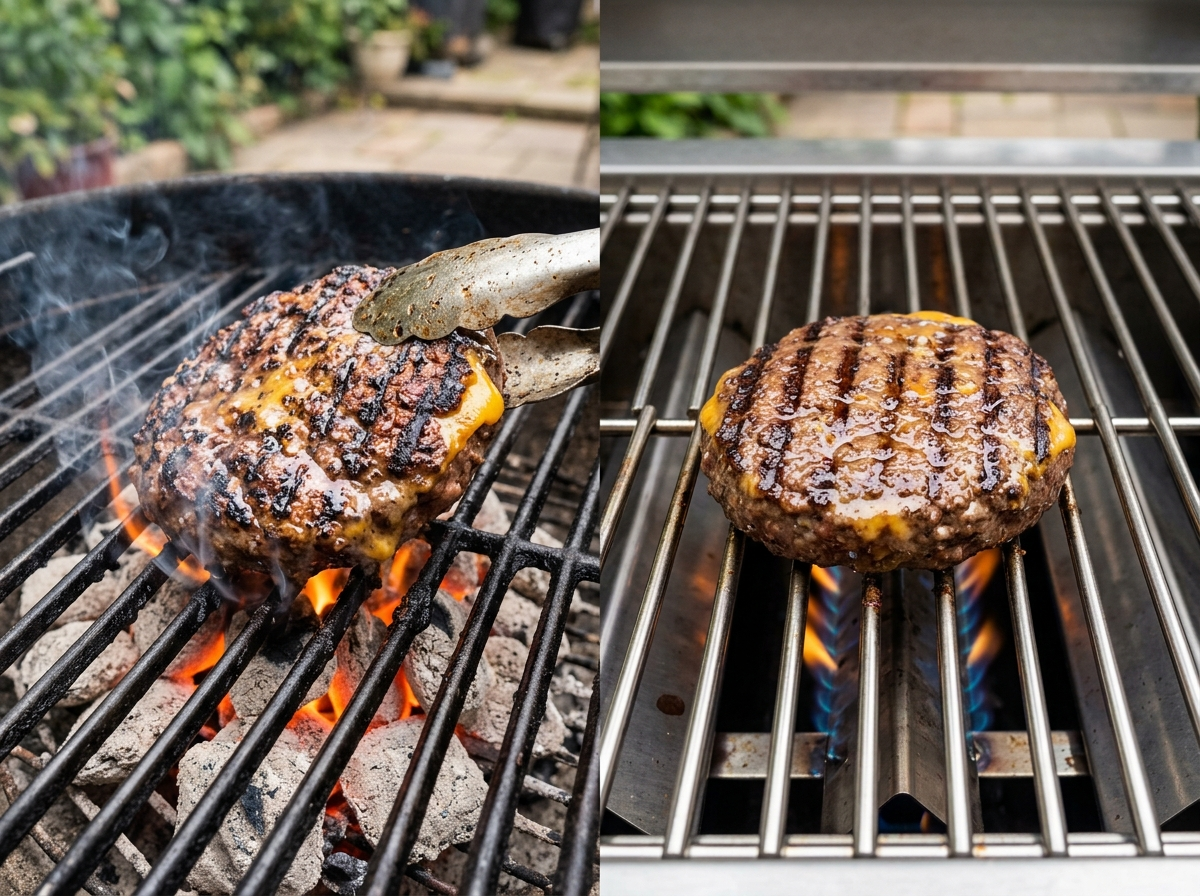
About 75% of American households own a grill, and roughly half of those owners will tell you their grill type is the “right” one. The charcoal loyalists swear by that smoky kiss on every patty. The gas grill crowd points at their thermometer and says, “I can cook burgers any night of the week without a 30-minute warmup.” And honestly? Both sides have a point.
If you’re standing in a home improvement store right now, staring at two grills and trying to figure out which one will make better burgers for your family, this is for you. We’re not here to pick a winner and declare the other worthless. The real answer depends on what kind of cook you are, what kind of flavor you’re chasing, and how much patience you’ve got on a Tuesday evening.
Let’s break this down — flavor, heat, convenience, cost, and everything else that actually matters when you’re grilling burgers.
The Flavor Question: Does Charcoal Really Taste Better?
This is the big one. It’s the reason charcoal fans get almost religious about their Weber Kettles. And there’s real science behind it.
When fat drips from a burger onto hot charcoal, it vaporizes and rises back up as flavorful smoke. These vaporized drippings contain compounds that create what food scientists call “char-flavor” — that distinct, slightly bitter, wonderfully smoky taste you associate with backyard cookouts. Charcoal itself also produces aromatic compounds during combustion that gas simply doesn’t.
Gas grills burn propane or natural gas, which produce mostly water vapor and carbon dioxide — both flavorless. So the base heat source on a gas grill isn’t contributing any flavor at all. You’re essentially cooking with a very hot, clean oven that happens to be outdoors.
But here’s where it gets interesting. That flavor difference is most noticeable on foods that spend a long time on the grill — whole chickens, ribs, brisket. Burgers? They cook in 8 to 12 minutes. That’s not a lot of time for smoke to penetrate the meat.
Does charcoal still taste different on a burger? Yes, a little. Is it a night-and-day difference? For most people, honestly, no. Especially once you load that patty with toppings, cheese, pickles, and a good sauce. The bun, condiments, and seasonings you use on the burger often matter more to final flavor than the heat source underneath.
Quick fact: A 2018 study from the Journal of Food Science found that trained taste testers could distinguish charcoal-grilled meat from gas-grilled meat about 60% of the time — barely above chance. Casual eaters? Even less reliable.
Heat and Temperature Control: Where Gas Takes the Lead
Here’s where the practical differences really start to show.
A gas grill gives you knobs. Turn them up, temperature goes up. Turn them down, it drops. You can create heat zones with precision — one burner on high for searing, another on low for holding patties that are done early. If you’re cooking for a crowd and need consistent results across a dozen burgers, gas makes your life significantly easier.
Getting your grill to the best temperature for burgers — typically around 400°F to 450°F — takes about 10 minutes on gas. Push a button, wait a bit, and you’re cooking.
Charcoal is a different animal. You’re managing a live fire. Temperature control means learning how to arrange coals, adjust vents, and read your grill’s behavior. A chimney starter gets briquettes ready in about 15 to 20 minutes, and lump charcoal can be ready a bit faster, but you’re still looking at a longer total prep time.
That said, charcoal can get significantly hotter than most residential gas grills. A well-loaded charcoal grill can reach 700°F or higher at grate level. Most gas grills top out around 500°F to 550°F. If you want an absolutely blistering sear on a smash burger, that extra heat from charcoal is a real advantage. The Maillard reaction — the chemical process that creates that beautiful brown crust — accelerates at higher temperatures, and charcoal delivers that intensity.
Pro Tip: If you’re making thick pub-style burgers that need to cook to a specific internal temperature without burning the outside, gas gives you much more control. For thin smash burgers that cook in 2 to 3 minutes per side, charcoal’s raw heat is actually ideal.
Convenience and Speed: The Weeknight Factor
Let’s be honest about something. The best grill isn’t just the one that makes the tastiest burger — it’s the one you’ll actually use.
A gas grill is ready to cook in 10 minutes. When you’re done, you turn it off, hit the grate with a brush, and walk away. Total time commitment beyond cooking? Maybe 15 minutes. That’s why gas grills dominate weeknight cooking. You get home from work, you want burgers, and you don’t want a project.
Charcoal requires more from you. You need to light it, wait for it to ash over, arrange the coals, and manage the fire. After cooking, you’ve got ash to deal with. The whole process — from “I want burgers” to “I’m eating burgers” — adds 20 to 30 minutes compared to gas. And cleanup takes longer, too.
This might sound like a small thing. It’s not. Plenty of people buy charcoal grills with great intentions, then find themselves reaching for the gas grill (or even a flat top griddle) three times out of four because it’s just easier on a busy night.
If you grill burgers once or twice a month for weekend cookouts, charcoal’s extra time is no big deal. If you want to grill three nights a week, gas removes the barrier that keeps people from actually doing it.
Cost Breakdown: What You’re Really Spending
The upfront cost difference between charcoal and gas grills is significant, and it goes both directions depending on what you’re buying.
A solid charcoal grill — like a 22-inch Weber Kettle — runs about $120 to $180 in 2025. That’s a proven design that’s been making great burgers for decades. You can go cheaper, but quality drops fast below the $100 mark.
Entry-level gas grills that are actually worth owning start around $300 to $400. A good mid-range gas grill with reliable burners, decent grates, and consistent performance sits in the $500 to $800 range. You can certainly spend more, but that’s where the sweet spot lives for most home grillers.
So charcoal wins on purchase price. But running costs tell a different story.
A 20-pound bag of quality charcoal briquettes costs $15 to $25 and lasts about 3 to 5 grilling sessions, depending on how much you use. Lump charcoal runs a bit more. Over a year of regular grilling — say 40 sessions — you might spend $200 to $350 on charcoal alone.
A standard 20-pound propane tank costs about $15 to $20 to refill and lasts roughly 18 to 20 hours of cooking time. For those same 40 sessions, you’d spend maybe $40 to $60 on propane.
Over 5 years, the total cost of ownership often evens out. The charcoal grill costs less upfront but more in fuel. The gas grill costs more upfront but pennies per cook in fuel. Your grilling frequency determines which one is actually cheaper for you.
The Burger Itself: How Each Grill Handles the Patty
Beyond flavor and convenience, the two grill types actually interact with burger patties differently, and this matters more than most articles mention.
Fat rendering and flare-ups: Burgers are fatty. A good burger blend runs 70/30 or 80/20 meat-to-fat, which means a lot of grease is dripping during cooking. On charcoal, those drippings hit the coals and can cause flare-ups — sudden bursts of flame that can char the outside of your burger before the inside is cooked. Experienced charcoal grillers learn to manage this by creating a two-zone fire (coals on one side, empty on the other) so they can move burgers away from flare-ups.
Gas grills handle this with metal heat shields or flavorizer bars that sit between the burners and the grate. Drippings hit these bars, vaporize (adding some flavor back), and rarely cause the kind of dramatic flare-ups you get with charcoal. It’s a more controlled environment.
Sear quality: If you want that dark, almost crunchy crust on your burger — the kind you see at a really good burger joint — high heat is your friend. Charcoal can deliver more radiant heat directly under the grate, which helps achieve this. Gas grills can get you there too, especially if your grill has cast iron grates that retain heat well, but it takes a bit more effort.
If you’re someone who pays close attention to how thick your burgers are and builds patties with the right meat blend, you’ll notice these differences. If you’re grabbing pre-formed patties from the store, the grill type matters less than getting the basics right.
Did you know? The reason restaurant burgers often taste better than backyard burgers has almost nothing to do with charcoal vs gas. It’s usually because restaurants use higher fat ratios, cook on extremely hot flat surfaces, and season aggressively. You can replicate those factors on either grill type.
Versatility Beyond Burgers
You’re shopping for a grill to make burgers, but you’re probably going to cook other things on it too. So versatility matters.
Charcoal grills are surprisingly versatile if you know what you’re doing. You can set up indirect heat for slow cooking, add wood chunks for real smoke flavor, and even turn a Weber Kettle into a passable smoker with the right technique. If you want to smoke ribs on Saturday and sear burgers on Sunday, charcoal handles both.
Gas grills excel at everything that benefits from predictable, adjustable heat. Vegetables, fish, chicken breasts — anything that can go from perfect to ruined in 60 seconds benefits from the control gas provides. Many gas grills also come with side burners, warming racks, and rotisserie attachments that expand what you can do.
If you throw a lot of football watch parties or cook for large groups, gas makes batch cooking much easier. You can keep one zone at high heat for searing while another zone holds finished burgers at a safe temperature. Doing that consistently on charcoal requires real skill and attention.
Who Should Choose Charcoal
Charcoal isn’t for everyone, but it’s perfect for a specific type of griller.
You’ll love charcoal if you enjoy the process of grilling as much as the eating. If lighting a fire, managing coals, and adjusting vents feels like a satisfying ritual rather than a chore, charcoal will reward you. The hands-on nature of it connects you to the cooking in a way that turning knobs simply doesn’t.
Charcoal is also the right call if you’re chasing maximum sear temperature, if you want the option to add real wood smoke flavor, or if you grill mainly on weekends when time pressure isn’t a factor. Budget-conscious buyers who want a high-quality grill without spending $500+ will also find excellent charcoal options in the $150 range.
And if you’re someone who grinds your own burger meat and treats burger night as an event, charcoal fits that mindset. You’re already putting in extra effort for quality — the grill should match that energy.
Who Should Choose Gas
Gas is for the person who wants great burgers without a production.
If you grill multiple times a week, if your Tuesday night dinner plan is “burgers in 20 minutes,” gas removes every obstacle between you and food. The learning curve is gentler, temperature management is straightforward, and cleanup is minimal.
Gas also makes sense if you’re frequently cooking for different preferences at the same time. When your kid wants a burger well done, your partner wants medium-rare, and your neighbor wants a meatless burger that needs careful temperature attention, having independent burner zones makes it all manageable.
Families with small kids, people who grill in business clothes after work, apartment dwellers with small balconies (where charcoal may be restricted by building codes) — gas simplifies things for all of these scenarios.
Can You Get Charcoal Flavor on a Gas Grill?
Sort of. Not perfectly, but closer than you might think.
Smoker boxes — small metal containers filled with wood chips that sit on your gas grill’s burners — add genuine smoke flavor to your cooking. They won’t replicate the exact taste of charcoal combustion, but they add a woody, smoky dimension that plain gas can’t provide. Hickory and mesquite chips are popular choices for burgers.
Some grillers place a small amount of lump charcoal in a foil pouch with holes poked in it, directly on the gas grill’s flavorizer bars. This is a bit of a hack, but it does introduce some charcoal-combustion flavor into the equation.
And don’t underestimate technique. A properly preheated gas grill with clean, oiled grates will give you solid grill marks and good crust development. Pair that with the right seasonings and you’re turning out burgers that most people would be thrilled to eat, smoke flavor or not.
What About Hybrid Grills?
The grill market has responded to this debate with hybrid models — grills that can burn both charcoal and gas. Brands like Char-Griller, Royal Gourmet, and Oklahoma Joe’s offer dual-fuel options, typically in the $300 to $600 range.
These can be a decent compromise, but they come with trade-offs. Hybrid grills tend to be larger and heavier. The charcoal side and gas side are each usually smaller than what you’d get with a dedicated grill. Build quality can be inconsistent at lower price points because the manufacturer is engineering two systems instead of perfecting one.
If space allows and your budget can handle it, some experienced grillers actually prefer owning one of each — a simple charcoal kettle for weekend cookouts and a gas grill for weeknight meals. That gives you the best of both worlds without the compromises of a hybrid.
The Grilling Technique That Matters More Than Fuel Type
Here’s something that might save you hours of deliberation: how you cook the burger matters more than what you cook it on.
A perfectly seasoned, properly handled, correctly temped burger cooked on a $30 gas grill will beat a poorly made patty on a $2,000 charcoal setup every single time. Every time.
The things that truly make or break a burger are:
Knowing when to flip — once, not twelve times. Using a good thermometer to nail your target doneness. Not pressing the patty down with a spatula and squeezing out all the juice (unless you’re making a smash burger, which is a different technique entirely). Knowing why burgers dry out and how to prevent it.
Master these fundamentals, and your burgers will be excellent on charcoal or gas. Skip them, and no amount of smoky charcoal flavor will save you.
FAQ
Does charcoal or gas make juicier burgers?
The fuel source doesn’t directly determine juiciness. What keeps burgers juicy is using the right fat content (aim for 80/20 or 70/30), not overcooking them, and minimizing how much you press or flip them. Both grill types can produce incredibly juicy burgers if you handle the meat well and cook to the correct internal temperature.
Is charcoal grilling bad for your health?
Charcoal grilling can produce higher levels of polycyclic aromatic hydrocarbons (PAHs) and heterocyclic amines (HCAs) — compounds linked to cancer risk in some studies. The risk increases with very high heat and heavy charring. Gas grilling produces somewhat lower levels. That said, the actual health risk from occasional grilling is considered quite low by most health organizations. Trimming excess fat and avoiding heavily charred meat reduces exposure with either fuel type.
Can I use charcoal on a gas grill?
It’s not recommended. Gas grills aren’t designed for the heat patterns and ash production of charcoal. Placing charcoal directly on gas burners can damage the burners, clog ports, and create unsafe conditions. If you want some charcoal character, use a smoker box with wood chips instead.
Which is better for beginners — charcoal or gas?
Gas is easier to learn on. Predictable heat, simple controls, and fewer variables make it more forgiving for new grillers. Charcoal has a steeper learning curve but can be mastered by anyone willing to practice. If you’re brand new to grilling and worried about overcooking your first batch of burgers, gas gives you more room for error.
How long does it take to grill burgers on charcoal vs gas?
Actual cooking time is similar — about 4 to 5 minutes per side for a standard ¾-inch patty at medium-high heat. The difference is in setup. A gas grill is ready in 10 minutes. Charcoal needs 15 to 25 minutes to light and reach cooking temperature. So total time from “I want burgers” to eating is about 20 to 25 minutes on gas and 35 to 45 minutes on charcoal.
Which One Gets Your Vote?
There’s no wrong answer here — just the answer that fits your life better.
If you want the ritual, the smoke, the primal satisfaction of cooking over a live fire, and you mainly grill on weekends when time isn’t tight, charcoal will make you very happy. If you want to grill burgers regularly, efficiently, and consistently without making it a whole event, gas earns its place on your patio.
And if someone tells you that one is objectively better than the other? They’re not talking about the grill. They’re talking about their own preference — which is fine, but it doesn’t have to be yours.
The burger you’ll remember isn’t the one cooked on the “right” grill. It’s the one made with good meat, seasoned properly, cooked to the doneness you love, and eaten with people you enjoy being around. Get that part right, and the fuel source becomes just a detail.