
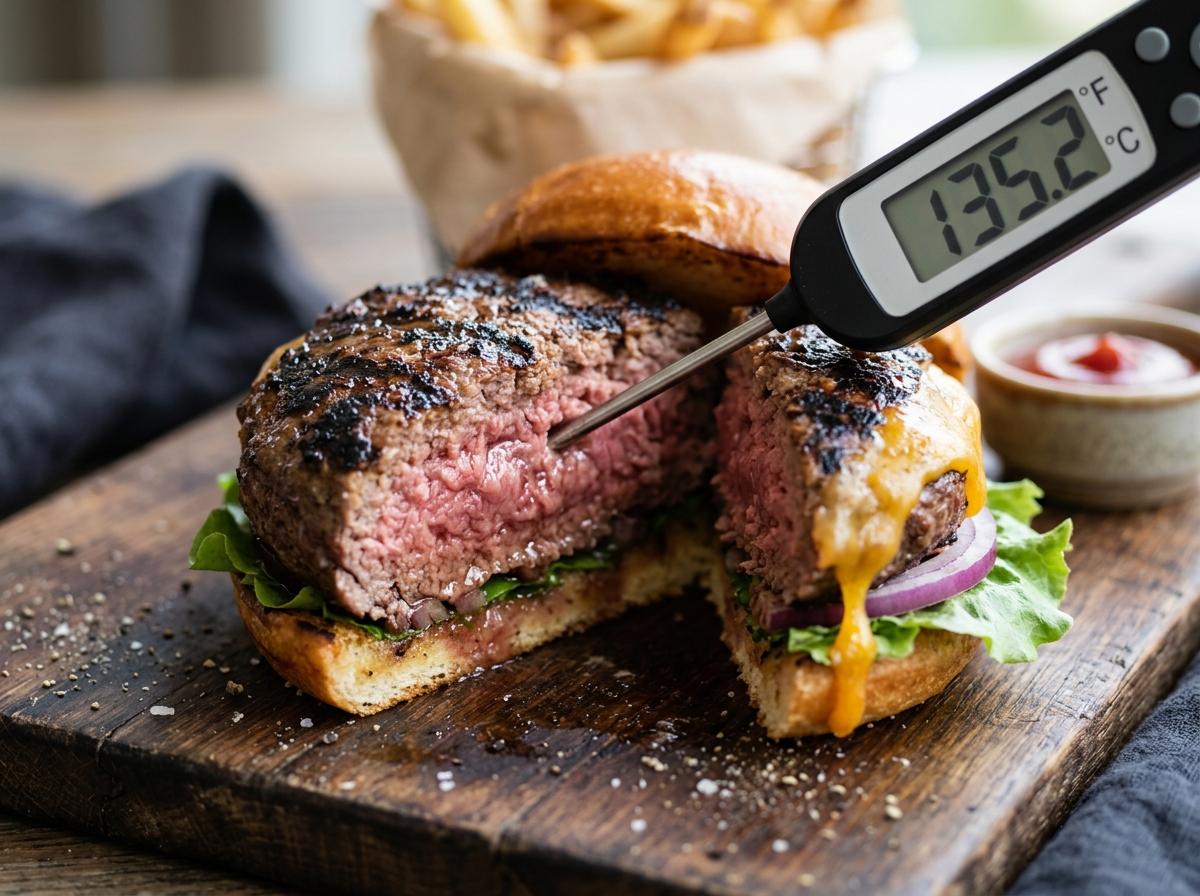
A perfectly cooked medium rare burger has a warm, pink center that practically melts on your tongue. It’s juicy. It’s flavorful. And honestly, once you’ve had one done right, every well-done patty starts to feel like chewing a hockey puck.
But here’s the thing — getting that ideal medium rare burger temperature isn’t just about taste. There’s a safety conversation that comes with it, and most people either ignore it completely or get so paranoid they overcook every patty they touch. Neither approach works.
So let’s talk about exactly what temperature you’re aiming for, how to hit it consistently, and what you actually need to know about safety when you’re cooking burgers below the USDA’s “official” recommendation. No guesswork. No food science jargon. Just straight, practical answers.
What Exactly Is Medium Rare for a Burger?
A medium rare burger sits at an internal temperature between 130°F and 135°F (54°C–57°C). At this range, the center of your patty is warm and distinctly pink — not cool or raw-looking, but not gray either. You’ll see a reddish-pink middle that fades into a brownish exterior, and when you press the patty gently, juices run clear with a slight pinkish tint.
The texture is where medium rare really shines. Your burger will be tender and moist throughout, with that satisfying resistance when you bite into it. Compare that to a well-done burger at 160°F+, where the proteins have tightened so much that moisture gets squeezed out. There’s a reason steakhouses default to medium rare — it’s the sweet spot where flavor and texture peak.
Now, here’s something worth understanding. A medium rare burger is not the same as a medium rare steak, at least from a food safety perspective. A steak is a whole muscle. Bacteria like E. coli and Salmonella live on the surface, so searing the outside kills them off even if the inside stays rare. Ground beef is different. The grinding process mixes surface bacteria throughout the meat. That’s why the USDA recommends cooking all ground beef to 160°F.
Does that mean you can’t eat a medium rare burger? Not necessarily. But it does mean you need to be smarter about it.
The USDA Guideline and Why It Exists
The USDA’s official recommendation is clear: cook all ground beef to an internal temperature of 160°F (71°C). At that temperature, harmful bacteria — specifically E. coli O157:H7 — are destroyed almost instantly.
This recommendation isn’t arbitrary. It exists because of real outbreaks. The infamous 1993 Jack in the Box E. coli outbreak, which sickened over 700 people and killed four children, was directly linked to undercooked burger patties. That incident changed food safety regulations across the entire restaurant industry.
So the 160°F guideline is about protecting the broadest possible population, including children, elderly people, pregnant women, and anyone with a compromised immune system. For these groups, eating a burger below 160°F carries real risk, and it’s not worth taking.
But millions of people — at restaurants and at home — eat burgers cooked below 160°F every single day without getting sick. How? It comes down to understanding risk and managing it properly.
How Restaurants Safely Serve Medium Rare Burgers
Ever wonder how your favorite burger joint serves you a pink-centered patty without getting shut down by the health department? They’re not just winging it. There are specific practices that make lower-temperature burgers significantly safer.
Sourcing matters more than anything. High-end burger restaurants typically buy whole cuts of beef — like chuck or brisket — and grind their meat in-house. This is a big deal. When you grind your own beef right before cooking, you dramatically reduce the window for bacteria to multiply. The meat goes from whole muscle to ground to grill in a short timeframe, and the grinder is cleaned and sanitized between uses.
Compare that to pre-ground beef from a supermarket. That meat might contain trimmings from dozens of different cows, processed hours or days before you buy it, and handled by multiple machines and workers along the way. The bacterial load is just higher by nature.
Some restaurants also use what’s called a “validated cooking process” under USDA guidelines, which allows them to cook below 160°F if they can demonstrate their sourcing and handling procedures adequately control risk. Others operate under state or local regulations that permit medium rare burgers with proper disclosure — you’ve probably seen those little asterisks on menus warning about consuming undercooked meat.
Cooking Medium Rare Burgers at Home — Doing It Right
If you want to cook medium rare burgers at home, you absolutely can. But you should take a few deliberate steps to minimize risk. Think of it like driving a car — there’s inherent risk involved, but wearing a seatbelt and following traffic rules makes it dramatically safer.
Start with the meat itself. Buy the freshest ground beef you can find, ideally from a butcher you trust. Better yet, buy a whole chuck roast and grind it yourself at home. A basic meat grinder attachment for a stand mixer costs around $30–$50, and it gives you total control over freshness and handling. You’ll also get a better-tasting burger because you can choose your own fat ratio — an 80/20 blend (80% lean, 20% fat) is ideal for medium rare because the fat keeps everything moist at lower cooking temperatures.
Keep the meat cold. Bacteria multiply fastest between 40°F and 140°F — what food safety experts call the “danger zone.” Keep your ground beef refrigerated at 40°F or below until you’re ready to form patties, and don’t let formed patties sit at room temperature for more than 30 minutes before they hit the heat.
Get a good instant-read thermometer. This is non-negotiable. You cannot eyeball a burger’s internal temperature. You can’t judge it by pressing with your thumb (despite what every backyard grill master claims). Even the color of the meat isn’t reliable — some burgers look pink at 160°F due to a reaction with myoglobin, while others look gray at 145°F. A quality instant-read thermometer removes all the guessing and takes about three seconds to give you an accurate reading.
Insert the thermometer probe into the thickest part of the patty from the side, pushing it toward the center. You want the tip sitting right in the middle of the burger. When it reads between 130°F and 135°F, pull the patty off the heat.
Account for carryover cooking. Your burger will continue cooking after you remove it from the grill or pan. The internal temperature typically rises another 3–5°F during resting. So if you want to land at 135°F, pull it at around 130°F–131°F. This is a detail that separates consistently good cooks from people who overshoot every time.
The Best Cooking Method for Medium Rare Burgers
You can achieve medium rare on a grill, a cast iron skillet, or a flat top griddle. Each has its strengths, and the right choice depends partly on what kind of burger you’re going for.
For a traditional grilled burger, set up a two-zone fire. On a charcoal grill, bank the coals to one side. On a gas grill, keep one burner on high and another on medium-low. Sear the patties over direct high heat for about 2–3 minutes per side to build a flavorful crust, then move them to the cooler side to gently finish cooking to your target temperature. This method gives you that classic charcoal-kissed flavor with a pink center.
If you’re working with a flat top or griddle, you get more even heat contact, which is great for a consistent sear. Preheat your surface to around 400°F–425°F. Place your patties down and let them cook undisturbed for 3–4 minutes on the first side. Flip once — timing your flip correctly makes a real difference — and cook for another 2–3 minutes on the second side, checking temperature as you go.
A cast iron skillet works similarly to a flat top and is probably the most accessible option for home cooks. Get the skillet ripping hot, add a small amount of oil with a high smoke point, and cook your patties. The heavy iron retains heat beautifully, giving you a deep, caramelized crust.
What about smash burgers? Here’s the thing — smash burgers are thin by design, usually around ¼ inch thick after pressing. They cook through in about 90 seconds per side. Getting a true medium rare center on a smash burger is nearly impossible because of how thin the patty is. If medium rare is your goal, you need a thicker patty — at least ¾ inch, ideally a full inch thick. Thicker patties give you the temperature gradient needed to have a well-seared outside and a pink, 130°F–135°F center.
Choosing the Right Meat for Medium Rare
Not all ground beef performs equally at medium rare temperatures. The type of meat and its fat content really matter here.
Fat content is your friend. At medium rare temperatures, fat hasn’t fully rendered yet — and that’s actually what gives you that rich, buttery mouthfeel. An 80/20 blend gives you plenty of fat to keep the burger succulent. Going leaner than 85/15 is risky for medium rare because you don’t have enough fat to compensate for the lower cooking temperature, and the result can be dry and crumbly despite being pink inside.
Chuck is the gold standard for burgers because of its beefy flavor and its fat content naturally sits around that 80/20 sweet spot. Some people blend chuck with short rib (for extra richness) or brisket (for deeper flavor). If you’re grinding at home, a 50/50 chuck and short rib blend cooked to medium rare is genuinely one of the best things you’ll ever eat.
Grass-fed beef tends to be leaner than grain-finished, so if you’re using grass-fed ground beef, be extra careful not to overcook it. Medium rare is actually the ideal doneness for grass-fed burgers because cooking it further dries it out faster than conventional beef.
A quick note on pre-formed frozen patties: cooking these to medium rare isn’t recommended. You don’t know exactly what’s in them, how they were processed, or how long ago. Stick with fresh-ground beef when you’re cooking below 160°F.
What Happens Inside Your Burger at Different Temperatures
Understanding what’s physically happening in the meat helps you appreciate why temperature matters so much. Here’s a simplified breakdown.
At 120°F–125°F (rare), the proteins in your beef have barely begun to change. The myoglobin — the protein that gives meat its red color — is still mostly intact. The center is cool and deep red. The meat is very soft and slippery. Most people find this too raw for a burger, and the safety risk is highest here.
At 130°F–135°F (medium rare), myoglobin starts to denature and shifts from red to pink. The proteins are just beginning to tighten, which gives the meat structure while keeping it tender. The fat is starting to soften but hasn’t fully liquefied. This is the magic zone — enough heat to develop flavor and a pleasant texture, but not so much that moisture gets squeezed out.
At 140°F–145°F (medium), you’ll see a smaller band of pink in the center. The meat is firmer, and more fat has rendered. Still a good burger — juicy, flavorful — but noticeably different from medium rare. If you’re nervous about safety but still want some pink, this is a solid compromise. You can check out a full burger doneness chart to compare all the levels side by side.
At 150°F–155°F (medium well), the pink is almost gone. The burger is firm throughout, and a significant amount of moisture has been lost. Some people prefer this, and that’s fine — but you’re past the point of what most would consider a “juicy” burger.
At 160°F+ (well done), the USDA-safe zone. No pink. The proteins have fully contracted, and a good chunk of the moisture is gone. If you’re cooking for children, elderly family members, or pregnant guests, this is where you should aim. You can still keep a well-done burger from drying out completely by using a higher fat content and not pressing the patty with your spatula (which squeezes out juice).
Seasoning and Handling Tips That Affect Your Results
How you handle your meat before it hits the heat directly impacts whether you’ll nail that medium rare target.
Don’t overwork the meat. When you form your patties, handle the ground beef as little as possible. The more you knead, press, and squeeze, the more you develop the myosin protein — the same protein that gives sausage its springy texture. A burger should be tender and loose, not bouncy. Gently form your patties and stop as soon as they hold their shape.
Season generously on the outside. Kosher salt and fresh-cracked black pepper on the exterior is all you need for a great burger. If you want to get more creative, the right seasoning blend can elevate things without overpowering the beef. Just don’t mix salt into the meat ahead of time — salt draws out moisture and changes the protein structure if it sits too long, which works against that juicy medium rare texture you’re after.
Make a dimple in the center of each patty before cooking. Burgers swell in the middle as they cook because the edges tighten faster than the center. A shallow thumbprint depression in the middle ensures your patty cooks flat instead of puffing up into a meatball. This matters for medium rare because a puffed-up burger has uneven thickness, making it nearly impossible to get uniform doneness.
Who Should Avoid Medium Rare Burgers
Let’s be straightforward about this. Medium rare burgers carry a higher risk of foodborne illness than fully cooked ones. For most healthy adults, that risk is quite small — especially if you’re using fresh, high-quality ground beef and cooking it properly. But certain groups should stick to 160°F.
Children under 5 have developing immune systems and are more vulnerable to severe complications from E. coli and Salmonella. Adults over 65 face similar risks because immune function naturally declines with age. Pregnant women should avoid undercooked ground beef because infections can affect fetal development. And anyone with a weakened immune system — whether from illness, medication, or medical treatment — should play it safe.
This isn’t fear-mongering. It’s just honest information. If you’re a healthy adult with no underlying conditions, eating a medium rare burger made from quality beef is a calculated risk that millions of people take daily without issue. But know who you’re cooking for, and adjust accordingly.
FAQ
Is 130°F safe for a burger?
The USDA doesn’t consider 130°F safe for ground beef — their recommended minimum is 160°F. That said, many restaurants serve burgers at 130°F–135°F using high-quality, freshly ground beef with controlled sourcing and handling. If you choose to eat a burger at this temperature, the key risk-reduction steps are using fresh meat from a trusted source (or grinding your own), keeping it cold until cooking, and using a reliable thermometer to hit your target accurately.
How long do you cook a burger for medium rare?
It depends on thickness and heat source. For a ¾-inch to 1-inch thick patty over high heat (around 400°F–450°F), you’re looking at roughly 3–4 minutes per side. But time is a rough guide — always use an instant-read thermometer to confirm. Pull the burger at 130°F and let carryover cooking bring it to 135°F during a 2–3 minute rest.
Can you tell if a burger is medium rare by color alone?
Not reliably. Some ground beef stays pink even at well-done temperatures because of a chemical reaction involving myoglobin and nitrites (naturally present in some vegetables mixed into burgers, or from certain processing methods). Other beef can look gray-brown at only 145°F. Color is a clue, not a conclusion. Temperature is the only accurate way to know.
What’s the difference between medium rare and medium for burgers?
Medium rare (130°F–135°F) gives you a warm, distinctly pink center that’s very juicy and tender. Medium (140°F–145°F) still has some pink, but the center is firmer, less juicy, and the band of pink is narrower. Both are solid choices — medium is a good option if you want some pink but feel more comfortable with a slightly higher temperature. You can see all the doneness levels broken down in a complete burger temperature guide.
Does resting a burger actually matter?
Yes. Resting for 2–3 minutes after cooking lets the juices redistribute throughout the patty instead of flooding out the moment you bite in. It also allows carryover cooking to bring the temperature up a few degrees. Don’t skip this step — it’s quick and makes a noticeable difference.
Your Next Burger Deserves Better
You’ve got the numbers now — 130°F to 135°F for a medium rare burger that’s warm, pink, and ridiculously juicy. You know why fat ratio matters, why a thermometer isn’t optional, and what steps actually reduce the safety risk. That’s all it takes — good meat, the right temperature, and a little bit of care.
Next time you fire up the grill or heat up that cast iron, give medium rare a real shot. Form your patties gently, don’t press them on the grill, and pull them a few degrees early to let carryover do its thing. You might just find it’s the best burger you’ve ever made at home. And if you want to keep your burgers juicy every single time, that link’s got you covered.