
Most people think seasoning a burger is just a quick sprinkle of salt and pepper before tossing the patty on the grill. And honestly? That approach isn’t terrible — but it leaves so much flavor on the table. The difference between a burger that tastes “fine” and one that makes people ask for your recipe usually comes down to how, when, and what you season with.
Here’s the thing: burger seasoning isn’t complicated. You don’t need a culinary degree or some secret spice blend from a Michelin-star chef. But there are a few small choices — timing, technique, the type of salt you use — that can completely change the outcome. And once you understand why those choices matter, you’ll never make a bland burger again.
Let’s break it all down.
Why Seasoning Matters More Than You Think
A great burger starts with good meat. But even the best meat for burgers won’t save you if the seasoning is off. Think about it this way: beef has a rich, deep flavor on its own, but it’s a blank canvas. Seasoning is what brings that flavor forward and makes it pop on your tongue.
Salt, specifically, does something fascinating to meat. It doesn’t just make things taste “salty.” It actually enhances the natural beefy flavor, suppresses bitterness, and helps your taste buds perceive other flavors more clearly. That’s why an unseasoned patty tastes flat even when the beef quality is excellent.
Pepper adds a subtle heat and warmth that rounds things out. And from there, you’ve got a whole universe of additional seasonings — garlic powder, onion powder, smoked paprika, cumin — that can take your burger in completely different directions depending on your mood.
But here’s where most people go wrong: they either season too little, season at the wrong time, or mix seasonings directly into the ground beef when they shouldn’t. Each of those mistakes creates a different problem, and they’re all easy to fix once you understand the reasoning behind proper technique.
The Great Debate: Season on the Outside or Mix It In?
This is the question that divides burger lovers more than anything else. Should you mix your seasonings into the ground meat before forming patties, or should you season the outside of already-formed patties?
The short answer? Season the outside.
Here’s why. When you work salt into raw ground beef and then mix it around, you activate the proteins — specifically myosin. Those proteins start bonding together, and you end up with a denser, tighter patty. The texture shifts from a loose, tender, beefy bite toward something closer to a sausage or meatloaf. It’s not awful, but it’s not what most people want from a burger.
If you’ve ever bitten into a homemade burger that felt rubbery or bouncy, there’s a good chance the seasoning was mixed in and the meat was overworked. That combination is the number one killer of burger texture.
Now, there’s a small exception to this rule. If you’re making smash burgers at home, you’re typically working with loosely packed balls of beef that get smashed thin on a hot surface. With smash burgers, you season the outside right after smashing — and because the patty is so thin, the seasoning penetrates quickly and evenly. No mixing needed.
For thicker, traditional patties, the same rule applies: form your patties gently, then season the outside generously. Both sides. That’s it.
Pro Tip: If you really want to add flavor inside the patty — say, garlic or Worcestershire sauce — the move is to add those flavors to your grinding blend before the meat is ground, not after. This distributes flavor without overworking the already-ground beef.
When Should You Season Your Burgers?
Timing is everything, and it’s one of the most overlooked aspects of burger seasoning.
The ideal time to salt your burgers is right before they hit the heat. We’re talking 30 seconds to a couple of minutes before cooking. Not 30 minutes. Not the night before.
Why does this matter? Because salt starts pulling moisture out of meat almost immediately. If you salt your patties and let them sit on the counter for 20 or 30 minutes, you’ll notice tiny beads of liquid forming on the surface. That moisture gets pulled out of the muscle fibers, and while some of it will eventually get reabsorbed (this is actually how dry brining works with larger cuts), burger patties are small and thin enough that you end up losing moisture you can’t afford to lose.
The result? A drier burger. And nobody wants that. If you’re looking for ways to keep burgers juicy, seasoning at the right time is one of the simplest changes you can make.
There’s one exception worth mentioning: if you’re salting and then immediately cooking (within about 60 seconds), the salt hasn’t had time to draw out significant moisture. You get the flavor benefits without the drying effect.
Pepper and other dry seasonings don’t have the same moisture-pulling effect as salt, so they’re more forgiving on timing. But for simplicity’s sake, just season everything at the same time — right before cooking — and you won’t go wrong.
What Seasonings Work Best on Burgers?
Let’s talk about the actual ingredients. The foundation of almost every great burger seasoning is dead simple: kosher salt and freshly ground black pepper. That’s the starting point, and honestly, for a really good patty made from quality beef with the right fat ratio, salt and pepper is all you need.
But if you want to build on that foundation, here’s how to think about it.
Salt — Get the Type Right
Not all salt works the same way on a burger patty. Fine table salt dissolves fast and can lead to over-salting because it packs densely into a measuring spoon. Kosher salt — the flaky kind, like Diamond Crystal or Morton’s — is the gold standard for seasoning meat. The larger crystals distribute more evenly, dissolve at a controlled rate, and make it easier to season by feel.
One thing to keep in mind: Diamond Crystal kosher salt is significantly less salty by volume than Morton’s kosher salt. If a recipe calls for a teaspoon of kosher salt without specifying the brand, you could end up with a noticeably different result depending on which one you grab. When seasoning burgers, the best move is to learn to season by eye and taste rather than by strict measurement.
How much salt per burger? A rough guide is about ¾ teaspoon of Diamond Crystal kosher salt per quarter-pound patty, or about ½ teaspoon of Morton’s. But the real answer is: enough to see a visible, even coating on both sides. It should look like you’ve been generous. Under-seasoning is far more common than over-seasoning.
Black Pepper — Fresh Matters
Pre-ground pepper from a can has already lost most of its volatile oils, which means it tastes dusty and one-dimensional. A pepper mill with whole peppercorns gives you a sharper, more complex flavor — slightly floral, slightly spicy. It makes a genuine difference, and it takes about three extra seconds.
Grind your pepper right onto the patty alongside the salt. A medium-coarse grind works best because it creates little bursts of pepper flavor in each bite rather than a uniform pepperiness.
Beyond Salt and Pepper
If you want to explore more adventurous burger seasonings, here are some ingredients that pair beautifully with beef — and why they work.
Garlic powder adds a sweet, roasted garlic flavor without the moisture problems that come with fresh minced garlic (which can burn on a hot grill and release water into the patty). A light dusting on the outside of each patty goes a long way.
Onion powder offers a mellow sweetness that rounds out the savoriness of beef. It works particularly well if you’re not topping your burger with raw or grilled onions.
Smoked paprika brings a subtle smokiness that’s especially useful if you’re cooking on a flat top instead of a grill, since you won’t be getting smoke flavor from charcoal or wood.
Cumin, used sparingly, adds an earthy warmth that plays really well with beef. Think Tex-Mex-inspired burgers with jalapeños and pepper jack cheese.
Worcestershire sauce is a classic. A few dashes on the outside of the patty (not mixed in) give you a hit of umami — that deep, savory, almost meaty flavor that makes everything taste more complex. Some people brush it on, others just give each patty a quick splash.
Did You Know? Worcestershire sauce contains anchovies, tamarind, molasses, and vinegar, among other ingredients. That’s why it adds so much depth — it hits salty, sweet, sour, and umami all at once.
The Right Way to Apply Seasoning
This sounds almost too basic to talk about, but the application matters. You’d be surprised how many people season unevenly and end up with one bite that’s perfectly flavored and the next that tastes like nothing.
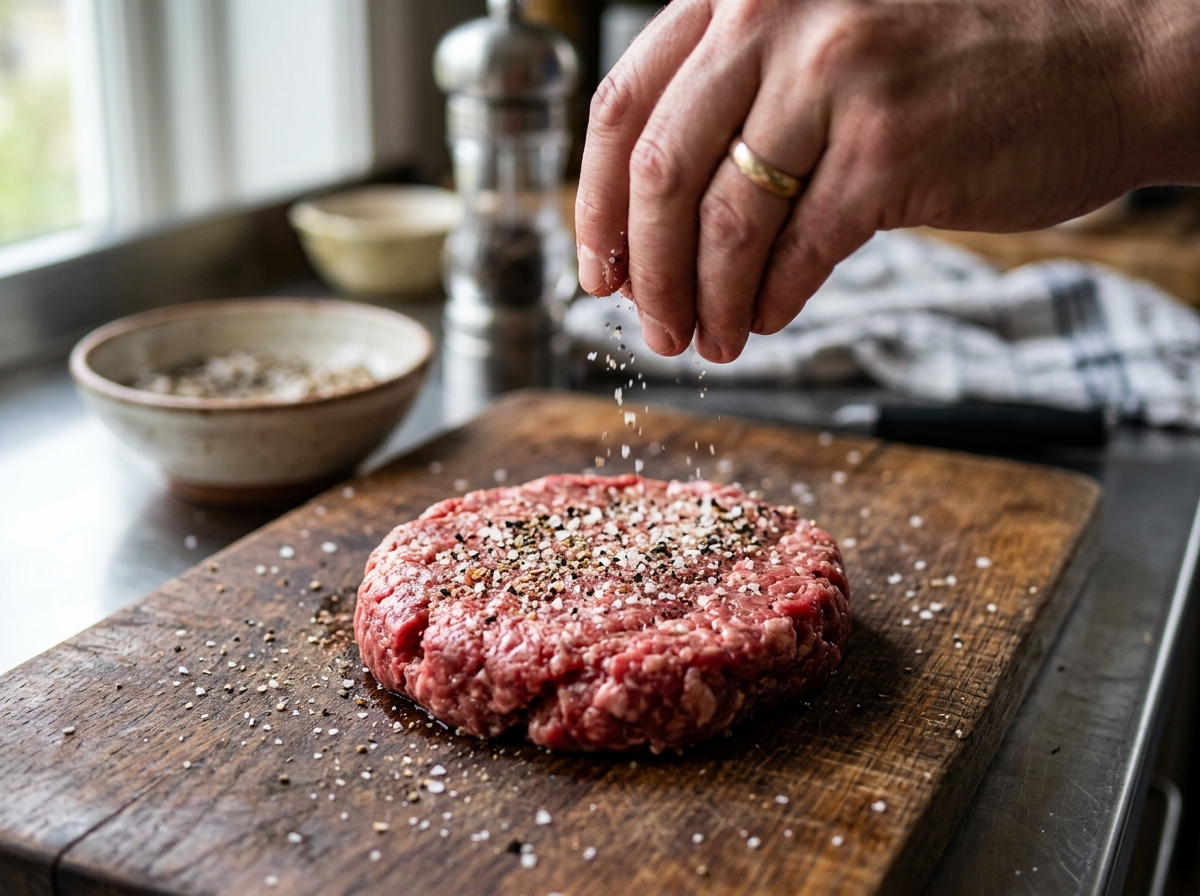
Here’s the technique. Set your formed patties on a cutting board or sheet pan. Hold your hand about 10 to 12 inches above the patties and let the salt and pepper fall from your fingertips in an even rain. The height gives the seasonings space to spread out rather than landing in a concentrated pile. Season one side, then flip and repeat on the other.
If you’re using additional dry seasonings (garlic powder, paprika, etc.), apply them the same way. The goal is a thin, even layer — not clumps.
For wet seasonings like Worcestershire sauce or even a thin brush of mustard (a surprisingly effective trick for creating a flavorful crust), apply them first and let the dry seasonings stick to the wet surface.
Warning: Don’t press the seasonings into the patty. You’ll compact the meat and affect the texture. Just let gravity do the work. The heat of the grill or griddle will do the rest.
Adjusting Seasoning Based on Your Cooking Method
The way you cook your burger actually influences how you should think about seasoning.
Grilling Over Charcoal or Gas
When you’re grilling burgers, you’re already getting flavor from the fire — especially with charcoal. The smoke and the high direct heat create a crust called the Maillard reaction (that brown, slightly caramelized exterior). Salt and pepper are often enough here because the grill itself contributes so much flavor.
One thing to watch: high heat can cause pepper to burn if your grill is extremely hot, which creates a bitter taste. If you’re cooking at very high temperatures (above 500°F), consider using a slightly coarser grind of pepper or adding it halfway through cooking.
Flat Top or Cast Iron Skillet
Cooking on a flat surface is where seasoning becomes even more important because you don’t have smoke doing part of the work. This is the classic smash burger approach. Season the ball of meat before smashing, or season right after — either works. The thin patty cooks so fast that the seasoning and the crust essentially form together.
On a flat top, you can also season the cooking surface with a thin layer of wagyu tallow or butter for added richness. That counts as a form of seasoning too — it adds flavor directly to the crust.
Oven-Finished or Reverse-Sear Burgers
If you’re cooking thicker patties (say, half-inch or thicker) and using a lower-heat method to bring them up to temperature before searing, you can actually afford to salt about five minutes before cooking. The slightly longer salt contact time won’t dry out a thick patty the way it would a thin one, and it gives the salt a bit more time to penetrate the surface.
Seasoning for Different Types of Burger Meat
Beef isn’t the only game in town. Different meats have different flavor profiles, and your seasoning should adapt accordingly.
Beef Burgers
Classic salt and pepper is king. Beef has enough natural flavor that you don’t need to overload it. The fat in your beef blend (aim for 80/20 or 75/25) carries a lot of flavor on its own, and salt brings it forward beautifully.
Turkey and Chicken Burgers
Poultry burgers are leaner and milder, which means they need more seasoning help. Salt and pepper alone will leave you with something pretty bland. This is where garlic powder, onion powder, a little smoked paprika, and even a pinch of dried herbs like thyme or sage really shine. Don’t be shy — poultry can handle bolder seasoning without losing its identity.
Pork Burgers
Ground pork has a natural sweetness that works beautifully with warm spices. Think fennel seed, sage, a tiny pinch of red pepper flakes. You’re essentially building a sausage-adjacent flavor profile, which makes sense — great sausage is really just well-seasoned ground pork.
Plant-Based and Meatless Burgers
Meatless burgers can absolutely taste great, but they need thoughtful seasoning because they don’t have the natural beefiness to fall back on. Smoked paprika, cumin, garlic powder, and a touch of soy sauce or liquid smoke can help bridge the gap. Salt is just as important here — maybe even more so, because it has to work harder to create the perception of depth.
A Simple Formula You Can Memorize
If you want a dead-simple seasoning approach that works every single time, here it is. For every pound of ground beef (which gives you roughly four quarter-pound patties):
Form your patties. Then, on each patty, apply a generous pinch of kosher salt (about ¾ teaspoon per side), a few cracks of fresh black pepper, and — if you want — a light dusting of garlic powder. Do this right before cooking. That’s the whole formula.
From there, you can layer on additional flavors through your toppings, cheese, sauces, and bun. Some of the most creative burgers out there start with nothing more than salt and pepper on the patty and build complexity through everything around it.
What About Seasoned Blends and Store-Bought Mixes?
Walk through the spice aisle and you’ll find a dozen pre-made “burger seasoning” packets. Are they any good?
Some are decent. Most are heavy on salt, garlic powder, and onion powder — which you could easily do yourself for a fraction of the cost. A few contain fillers like maltodextrin or anti-caking agents that don’t add anything to flavor.
The bigger issue is control. When you use a pre-mixed blend, you can’t adjust the salt level independently. You might end up with too much garlic or too little pepper. When you season from individual ingredients, you can dial each element exactly where you want it.
That said, if you find a blend you genuinely love, there’s no shame in using it. Just make sure you know how much salt is already in the blend so you don’t accidentally double-salt your burgers.
Quick-Reference: Common Seasoning Mistakes to Avoid
Mixing salt into the meat before forming patties. This activates myosin and gives you a dense, sausage-like texture instead of a tender burger bite.
Salting too early. Applying salt 20 to 30 minutes before cooking draws out moisture and leads to dry burgers. Season right before the patty hits the heat.
Under-seasoning. This is by far the most common mistake home cooks make. Restaurant burgers taste better largely because professional cooks aren’t afraid of salt. Your patty should have a visible, even coating.
Ignoring the second side. It sounds obvious, but in the rush of grilling, people sometimes forget to season the side that’s facing up. Both sides need equal attention.
Using fine table salt. It dissolves too quickly and distributes unevenly. Kosher salt gives you much better control and a more consistent result.
FAQ
Can I season burger patties the night before?
You can, but you probably shouldn’t if you want the best texture. Salting meat and letting it sit overnight essentially dry-brines the patty, which works great for thick steaks but can over-tighten a thin burger patty and make it less tender. If you want to prep ahead, form your patties the night before and store them unseasoned. Season right before cooking.
Do I need to season both sides of a burger?
Yes, absolutely. Each side of the patty contacts your tongue differently as you bite into the burger. If you only season one side, you’ll get uneven flavor — some bites will taste great, others will taste flat. It takes about five seconds to flip and season the other side. Don’t skip it.
What’s the best seasoning for a simple, classic burger?
Kosher salt and freshly cracked black pepper. That’s truly all you need for a great-tasting burger if you’re using quality beef with a good fat content. Garlic powder is a popular third addition, and a splash of Worcestershire sauce on the outside adds a nice umami boost. Start simple, and add complexity through your toppings, cheese, and sauce rather than overloading the patty itself.
Does the type of salt really make a difference?
It does. Kosher salt (especially Diamond Crystal) has a lighter, flakier texture that sticks to the surface of the meat evenly and dissolves at a controlled rate. Fine table salt is denser and saltier by volume, which makes it easy to over-season. Sea salt flakes work too, but they’re pricier and not necessary for cooking. Save the fancy finishing salt for the top of your bun if you want that crunch.
Should I add seasoning inside a stuffed burger?
If you’re making a stuffed burger (like a Juicy Lucy with cheese in the center), season the outside of the patty the same way you normally would. The stuffing — whether it’s cheese, peppers, or mushrooms — already has its own flavor, so you don’t need to add extra seasoning inside. Focus on a well-seasoned exterior and let the filling do its job.
Your Next Burger Will Be Better
You now know more about burger seasoning than most people who’ve been grilling for years. And the beautiful part is that none of this is difficult. You don’t need fancy ingredients or special tools. You need kosher salt, a pepper mill, good timing, and a light hand when forming patties.
Start with the basics — salt and pepper, outside of the patty, right before cooking — and build from there as you get comfortable. Pay attention to internal temperatures so your seasoning work isn’t wasted on an overcooked patty. Try one new spice or technique each time you cook.
The best burger you’ll ever eat probably won’t come from a restaurant. It’ll come from your own backyard, seasoned exactly the way you like it. Go make it happen.