
A scorned woman once tried to punish her cheating boyfriend with the spiciest fried chicken she could make. He loved it. And that petty act of revenge accidentally created one of America’s most iconic dishes — Nashville hot chicken.
That story, whether fully true or partly legend, captures something real about this dish. It wasn’t born in a test kitchen or designed by a restaurant chain. It came from a real kitchen, fueled by real emotion, somewhere in Nashville, Tennessee. And the fact that it’s now on menus from Brooklyn to Los Angeles tells you everything about how powerful good food can be.
But here’s the thing — a lot of people have tried Nashville hot chicken and walked away disappointed. Not because the dish itself is flawed, but because what they ate was just “spicy fried chicken” dressed up with the Nashville label. The real thing is different. It’s a specific preparation with a specific technique, and understanding that difference is what separates a forgettable meal from a life-changing one.
So let’s break it all down — where it came from, what actually makes it “Nashville hot,” how to get that perfect balance of heat and flavor, and how you can pull it off at home without burning your kitchen down (or your taste buds off).
The Origin Story: More Than Just Spicy Chicken
The most widely told origin story traces Nashville hot chicken back to Thornton Prince in the 1930s. Prince was, by most accounts, a man who enjoyed the company of women — perhaps a few too many at the same time. As the story goes, one of his girlfriends decided to teach him a lesson by loading up his beloved fried chicken with an absurd amount of cayenne pepper and spices.
The plan backfired beautifully. Prince didn’t just tolerate the fiery chicken — he became obsessed with it. He started tweaking the recipe, perfecting the spice blend, and eventually opened a restaurant with his brothers. That spot, originally called the BBQ Chicken Shack, eventually became Prince’s Hot Chicken Shack, which still operates in Nashville today under the care of his descendants.
For decades, Nashville hot chicken stayed almost entirely within the city’s Black community. It was a local treasure, the kind of food you’d drive across town for on a late Saturday night. The restaurants that served it were small, no-frills operations. You’d wait a while for your order because each piece was fried fresh. Nobody was in a rush.
The dish didn’t really break into mainstream awareness until the early 2000s. Food writers, travel shows, and eventually social media caught on. By the 2010s, Nashville hot chicken had gone fully national. Chains like Hattie B’s helped spread the word, and fast-food giants like KFC and Popeyes launched their own versions. The Music City Hot Chicken Festival, running annually since 2007, became a major event drawing thousands of visitors.
But even with all that national attention, the soul of the dish remains rooted in a handful of Nashville joints where the recipe hasn’t changed much in nearly a century.
What Actually Makes It “Nashville Hot”?
This is where a lot of people — and a lot of restaurants — get it wrong. Nashville hot chicken isn’t just fried chicken with hot sauce poured on top. It isn’t buffalo chicken. It isn’t chicken tossed in sriracha. The technique is very specific, and that technique is what creates the signature look, taste, and texture.
Here’s how the authentic version works:
You start with bone-in chicken pieces — traditionally dark meat like thighs and legs, though breasts and wings are common too. The chicken gets marinated or brined, often overnight, in a buttermilk mixture seasoned with salt, pepper, and sometimes a little cayenne. Then it’s dredged in seasoned flour and deep-fried until perfectly golden and crispy.
Now here’s the part that makes it Nashville hot. While the chicken fries, you prepare the spice paste. This is where the magic lives. You take a generous amount of cayenne pepper — and we’re talking tablespoons, not teaspoons — and mix it with other spices like paprika, garlic powder, brown sugar, and sometimes a pinch of dry mustard. That spice blend gets mixed with hot frying oil scooped right from the fryer. The oil and spices combine into a thick, fiery paste.
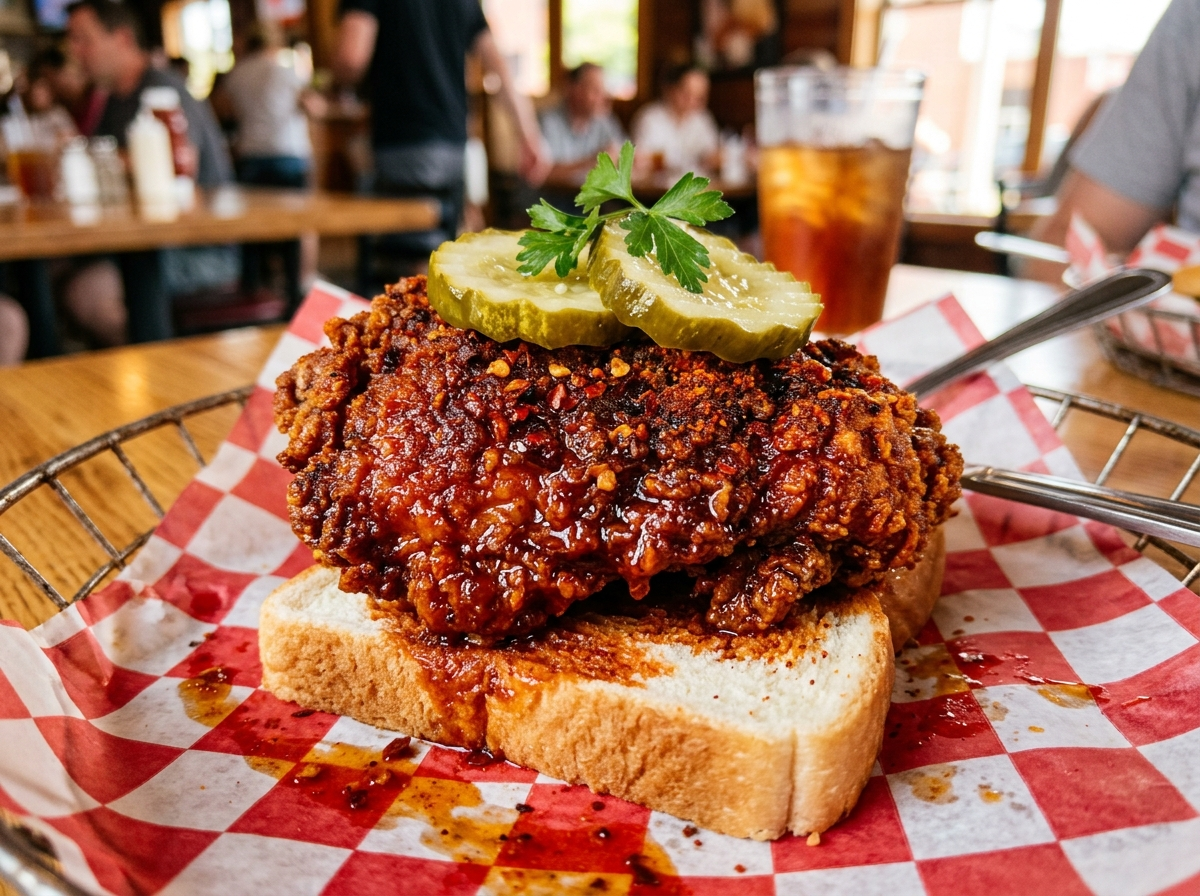
The moment the fried chicken comes out of the oil, you brush or slather that spice paste all over every piece. The hot oil in the paste clings to the crust, soaking into the crevices without making the chicken soggy. It creates that distinctive dark, reddish-brown appearance — almost lacquered-looking — that tells you a piece of Nashville hot chicken is the real deal.
The chicken then gets placed on top of white bread slices and served with dill pickle chips on the side. Those aren’t random choices. The bread soaks up the spicy, flavorful oil that drips off the chicken (and you absolutely eat that bread). The pickles cut through the richness and heat with their tangy crunch.
That’s it. That’s the authentic format. No fancy sauces, no elaborate sides. Just perfectly fried chicken baptized in a cayenne-oil paste, sitting on white bread with pickles. Simple doesn’t mean easy, though — the execution matters enormously.
The Heat Spectrum: Picking Your Level
One thing that makes Nashville hot chicken culture unique is the tiered heat system most restaurants use. You don’t just order “hot chicken.” You choose your pain level.
Most places offer something along these lines: mild (which still has more kick than your average fried chicken), medium (where the cayenne starts to assert itself), hot (a serious burn that builds with every bite), and extra hot or “shut the cluck up” level (which is genuinely not for everyone and can cause real physical discomfort).
At Prince’s Hot Chicken Shack, the heat levels go from plain to extra hot, and regular customers will tell you that even “medium” there hits harder than “hot” at most other spots. If you’re trying Nashville hot chicken for the first time, starting at medium is a smart move. You can always go up next time. You can’t undo a level that has you questioning your life choices three bites in.
The heat in authentic Nashville hot chicken comes primarily from cayenne pepper, not from extract-based hot sauces. That’s an important distinction. Cayenne gives you a burn that’s sharp but somewhat clean. Extract-based heat (the kind used in extreme challenge wings) creates a more chemical, lingering burn that overwhelms your taste buds. Good Nashville hot chicken should be intensely spicy, yes — but you should still be able to taste the chicken, the spices, the seasoned crust. If all you can taste is pain, something went wrong.
Pro Tip: If you’re building up your heat tolerance, eat slowly and have something dairy-based nearby — a glass of whole milk or a scoop of coleslaw with a creamy dressing. Water won’t help. Dairy proteins actually bind to the capsaicin molecules and wash them away. Water just spreads the fire around.
Making Nashville Hot Chicken at Home
You absolutely can make this at home, and it doesn’t require any special equipment beyond a heavy pot or Dutch oven and a good thermometer. The key is respecting the process and not trying to shortcut the steps that matter.
The Brine and Marinade
Start the night before. Take your chicken pieces — bone-in thighs and drumsticks work best for beginners — and submerge them in buttermilk seasoned with salt, a little cayenne, garlic powder, and a few dashes of hot sauce. Cover and refrigerate for at least 4 hours, though overnight is ideal. The buttermilk tenderizes the meat and adds flavor that goes all the way through.
If you’ve ever tried making crispy fried chicken at home, you know that a good soak makes all the difference between chicken that’s juicy inside and chicken that’s dry and sad.
The Dredge
When you’re ready to fry, pull the chicken out of the buttermilk and let the excess drip off. Your flour dredge should be simple: all-purpose flour, salt, black pepper, a little garlic powder, and a touch of paprika. Some cooks add a tablespoon or two of cayenne right into the flour for an extra layer of heat.
Press each piece firmly into the flour mixture. Then — and this is a trick worth knowing — let the dredged chicken sit on a wire rack for about 10 to 15 minutes before frying. That rest lets the coating hydrate slightly and bond with the buttermilk, which means it’ll stick better and fry up crispier. It’s the same principle that makes chicken fried steak so satisfyingly crunchy when done right.
The Fry
Heat your oil — peanut oil or vegetable oil both work great — to 325°F (163°C). That might sound lower than you’d expect, but bone-in chicken needs a gentler fry temperature so the inside cooks through before the crust burns. You’re looking at roughly 15 to 18 minutes for thighs and drumsticks, flipping once or twice.
Keep a thermometer in the oil and adjust your heat to maintain that 325°F. Temperature control is genuinely the most important factor in frying. Too hot and you get a dark, bitter crust with raw chicken inside. Too cool and the chicken absorbs oil and turns greasy. If you’re looking to get better at frying at home without a deep fryer, mastering temperature is where it all starts.
Your chicken is done when the internal temperature hits 165°F (74°C) at the thickest part. Use an instant-read thermometer — don’t guess.
The Spice Paste (This Is Everything)
While the chicken fries, make your spice paste in a heatproof bowl. Here’s a solid starting ratio:
Mix together 3 tablespoons cayenne pepper, 1 tablespoon brown sugar, 1 teaspoon paprika, 1 teaspoon garlic powder, half a teaspoon each of onion powder and black pepper, and a good pinch of salt. When the chicken is almost done, ladle about a quarter cup of the hot frying oil into the spice mixture. Stir it into a smooth, pourable paste.
The brown sugar is a detail that a lot of copycat recipes miss. It doesn’t make the chicken sweet — it balances the cayenne’s sharpness and helps create that slightly glossy, caramelized look on the surface.
As soon as each piece of chicken comes out of the fryer, brush or spoon the spice paste over every surface while the chicken is still screaming hot. The paste will sizzle slightly and meld into the crust. That’s exactly what you want.
The Serve
Lay white bread slices on your plate. Set the hot chicken on top. Add dill pickles on the side. That’s it. Resist the urge to get creative with your first attempt. Experience the original format before you start riffing on it.
Did you know? The white bread isn’t just a plate substitute. As the chicken sits, the spicy oil drips down and soaks into the bread, turning it into one of the best bites of the whole meal. Experienced Nashville hot chicken eaters actually fight over the bread.
Why Nashville Hot Chicken Went National
Something interesting happened between roughly 2012 and 2020. Nashville hot chicken went from a regional specialty to a full-blown national obsession. You can now find some version of it in every major American city, and several fast-food chains have permanent Nashville hot menu items.
A few things drove that explosion. Food media — especially shows like “Parts Unknown” with Anthony Bourdain and viral food content on Instagram and YouTube — put Nashville’s hot chicken joints in front of millions of people who’d never heard of them. Restaurants like Hattie B’s, Bolton’s Spicy Chicken & Fish, and of course Prince’s became pilgrimage destinations for food tourists.
Then the spicy food trend hit mainstream culture hard. Americans’ appetite for heat has been climbing steadily for years. According to the National Restaurant Association, spicy menu items have grown consistently in popularity, with younger diners especially seeking out higher heat levels. Nashville hot chicken fit perfectly into that wave.
The chicken sandwich wars of 2019 — kicked off by Popeyes’ viral chicken sandwich — further accelerated things. Suddenly every chain wanted a spicy chicken option, and Nashville hot became the default template. If you’ve ever wondered what goes into a great spicy chicken sandwich, that Nashville hot influence is a big part of the answer.
But here’s something worth noting. The explosion of Nashville hot chicken nationally has been a double-edged sword for the original Nashville restaurants, particularly the Black-owned establishments that created and preserved the tradition for decades. When chains and trendy new spots co-opt the style, they sometimes get the credit (and the revenue) while the originators remain comparatively unknown. Food journalists like Rachel Martin and organizations focused on culinary history have pushed back on this, emphasizing the importance of crediting and supporting the roots of the tradition.
Nashville Hot Chicken Tenders and Other Variations
While bone-in pieces are the traditional format, Nashville hot chicken has branched out considerably. Tenders have become hugely popular, especially for people who want the flavor and heat without navigating bones.
If you’re making Nashville hot chicken tenders at home, the process is nearly identical to bone-in pieces. The main difference is frying time — boneless tenders cook much faster, usually 6 to 8 minutes at 350°F. The spice paste application stays exactly the same.
You’ll also see Nashville hot applied to wings these days, which makes sense — wings are built for bold flavors and messy eating. Getting your wing frying temperatures right is crucial here, since undercooked wings are nobody’s friend.
Beyond chicken pieces, the Nashville hot treatment has been applied to fish sandwiches, cauliflower (for a vegetarian take), shrimp, and even tofu. Some purists cringe at this, but honestly, the spice paste technique works on almost any fried protein. The cayenne-oil paste is versatile enough that you could even use it on homemade chicken tenders for a weeknight dinner that feels way more exciting than usual.
The Sides That Make It Complete
Nashville hot chicken joints traditionally keep the sides simple, but the right pairing makes a real difference, especially when you’re dealing with serious heat levels.
Coleslaw is probably the single best side. A cool, creamy slaw with a vinegar tang acts like a fire extinguisher between bites. Mac and cheese is another classic — rich and starchy enough to absorb some of the heat. Baked beans, crinkle-cut fries, and collard greens round out most menus.
If you’re serving Nashville hot chicken at a gathering — say, a football watch party — consider pairing it with sides that can cool people down. Creamy dips, fresh vegetable sticks, and plenty of cold drinks help balance the experience. You might even build a whole spread around it with other southern comfort foods for a game day menu.
Quick tip on drinks: Beer works well with Nashville hot chicken, especially lighter styles like lagers or wheat beers. Sweet tea is the traditional Nashville pairing. Avoid anything carbonated and acidic (like cola) if you’re eating at higher heat levels — it can intensify the burn rather than calm it.
Common Mistakes People Make
Even experienced home cooks sometimes stumble with Nashville hot chicken. A few pitfalls to watch out for:
Using hot sauce instead of a cayenne paste. Dousing fried chicken in Frank’s Red Hot or Tabasco isn’t the same thing. The hot oil paste technique is the entire point — it creates a different flavor profile and texture than a vinegar-based hot sauce.
Frying at too high a temperature. If your oil is at 375°F or above, your bone-in chicken will burn on the outside before the inside cooks through. Stick to that 325°F sweet spot for bone-in, 350°F for boneless.
Skipping the rest time after dredging. That 10 to 15 minute rest makes a huge difference in how well the crust adheres. Skip it, and you’ll watch your flour coating fall off in the fryer.
Being afraid of the cayenne. Three tablespoons sounds like a lot, but remember — it’s getting diluted in hot oil and spread across multiple pieces of chicken. Start with the full amount. You can always scale back next time, but chances are you won’t want to.
Serving it on a fancy bun with elaborate toppings right away. Nashville hot chicken on a sandwich is great, and there’s a time for loading it up. But try it the traditional way first — on white bread with pickles. That format exists for a reason, and you’ll appreciate what the simplicity brings to the experience.
FAQ
What makes Nashville hot chicken different from buffalo wings?
The difference comes down to technique and flavor. Buffalo wings are fried and then tossed in a butter-based hot sauce (typically Frank’s Red Hot mixed with melted butter). Nashville hot chicken gets coated with a paste made from cayenne pepper mixed with hot frying oil, which creates a deeper, more complex spice flavor that penetrates the crust. Buffalo sauce sits on the surface; Nashville hot spice paste bonds with it.
How spicy is Nashville hot chicken, really?
It depends entirely on the heat level you choose. Mild Nashville hot chicken is roughly comparable to a spicy wing from a typical restaurant. Medium brings noticeable, sustained heat. Hot will make most people sweat and reach for milk. Extra hot — the kind served at places like Prince’s — is legitimately intense and can cause stomach discomfort for people not accustomed to extreme spice. Start at medium if it’s your first time.
Can I make Nashville hot chicken in an air fryer?
Technically, yes — you can air fry the chicken and still apply the cayenne spice paste afterward. The paste just needs a little oil mixed in, which you can heat separately on the stove. The chicken won’t have quite the same deep-fried crust texture, but the flavor can get pretty close. It’s a solid option if you’re trying to cut back on oil.
What cut of chicken is best for Nashville hot chicken?
Dark meat — thighs and drumsticks — is traditional and generally more forgiving. Dark meat stays juicier at higher internal temperatures and stands up better to the aggressive spice paste. Breasts can dry out more easily, though they work fine if you brine them properly and don’t overcook them. Tenders and wings are also popular options.
Is Nashville hot chicken gluten-free?
The traditional version is not, since it uses an all-purpose flour dredge. You can substitute a gluten-free flour blend, though the texture of the crust will be slightly different. The spice paste itself is naturally gluten-free — it’s just cayenne, spices, sugar, and oil.
Your Next Move
Nashville hot chicken is one of those dishes that sounds intimidating until you actually break it down. Good fried chicken technique plus a simple cayenne-oil paste — that’s really the whole formula. The rest is just fine-tuning to your taste.
If you’re new to this, start with bone-in thighs, keep your oil at 325°F, don’t be shy with the cayenne, and serve it the classic way on white bread with pickles. You’ll know you’ve nailed it when that first bite hits you with crunch, juice, and a slow-building heat that makes you immediately reach for another piece instead of a glass of water.
And if you’re already a fan just looking to get your home version closer to what you’ve had in Nashville — pay attention to the paste. That’s where all the personality lives. Experiment with your brown sugar ratio, try adding a little smoked paprika, or throw in a tiny bit of honey for depth. The original recipes varied from cook to cook, and yours should too.
Now go fry something.