
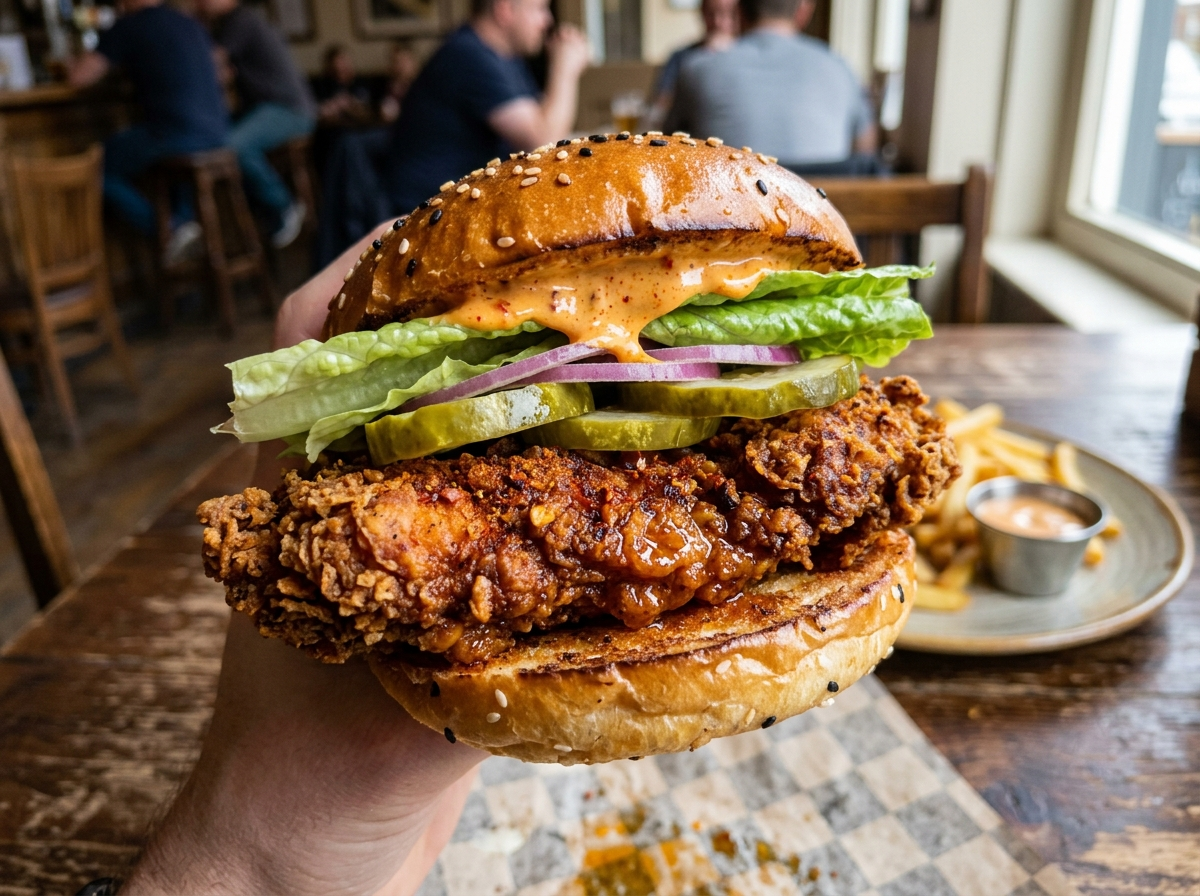
Popeyes sold so many spicy chicken sandwiches in 2019 that they ran out nationwide within two weeks. Two weeks. That single moment turned a humble fried chicken sandwich into a cultural obsession worth billions across the fast-food industry. Chick-fil-A responded. McDonald’s jumped in. Even Burger King tried its hand. But here’s what nobody talks about — you can build a spicy chicken sandwich at home that’s better than all of them, and you don’t need a commercial kitchen to do it.
The real magic behind a great spicy chicken sandwich isn’t some secret corporate recipe. It’s understanding a handful of techniques: the brine, the breading, the fry, and the heat. Get those four things right, and you’ll wonder why you ever sat in a drive-through line for one.
Let’s break the whole thing down — from picking the right chicken to layering your toppings so every bite actually works.
Why the Spicy Chicken Sandwich Became a Phenomenon
There’s a reason this sandwich took over and didn’t let go. It hits every craving at once — salty, crunchy, spicy, and rich. That’s a combination your brain is basically hardwired to love.
The fast-food chicken sandwich wars kicked off in August 2019, and by 2024, the spicy chicken sandwich category was generating over $8 billion annually in the U.S. alone. Chains kept one-upping each other with spicier sauces, thicker fillets, and crunchier coatings. But underneath all that marketing noise, the formula stayed the same: crispy fried chicken, a soft bun, pickles, and some kind of spicy sauce.
What most people don’t realize is that this sandwich has roots much deeper than Popeyes. Spicy fried chicken sandwiches have been a staple in the South for decades. Nashville hot chicken culture influenced a lot of what we see on menus today — that cayenne-forward heat, the buttermilk brine, the way the spice oil soaks into the breading. The fast-food version is really just a toned-down, mass-produced echo of something people in Tennessee have been perfecting since the 1930s.
The point is, you’re not reinventing the wheel here. You’re just learning how the wheel was built before it got factory-made.
Choosing the Right Chicken (It Matters More Than You Think)
Most recipes just say “chicken breast” and move on. That’s a mistake, because the cut you choose changes everything about your sandwich.
Boneless, skinless chicken breast is the standard pick, and it works fine — but only if you handle it correctly. Chicken breasts are thick and uneven, which means one end overcooks while the other stays underdone. The fix is simple: butterfly the breast or pound it to an even thickness, roughly ¾ inch. This gives you uniform cooking and a better chicken-to-breading ratio in every bite.
Boneless, skinless chicken thighs are the underrated choice. They’re more forgiving, juicier, and have more natural flavor. Thigh meat has a higher fat content, so it stays moist even if you overshoot your fry time by a minute. The trade-off? Thighs are slightly irregular in shape, so your sandwich might not look as “restaurant perfect.” But it’ll taste better. That’s a trade worth making.
Here’s a practical tip: whether you go with breast or thigh, look for pieces that weigh around 6 to 8 ounces. That’s the sweet spot for fitting on a standard sandwich bun without overwhelming it. If your chicken piece hangs two inches past the bread on every side, the structural integrity of your sandwich falls apart by the third bite.
If you’ve worked with fried chicken before — maybe you’ve made homemade chicken tenders or even tackled crispy fried chicken for a crowd — you already know the basics. A spicy chicken sandwich just applies those same principles to a single, well-sized piece.
The Brine: Where Your Flavor Actually Starts
Skipping the brine is the single biggest mistake home cooks make with fried chicken sandwiches. You can have the best breading in the world, but if the chicken itself is bland and dry, no amount of spicy sauce will save it.
A buttermilk brine does two things at once. The acid in the buttermilk gently breaks down the surface proteins of the chicken, making it more tender. And the liquid adds moisture that stays locked in during frying. Think of it as insurance against dry, chalky chicken.
A solid spicy buttermilk brine looks like this:
Take about 2 cups of buttermilk and mix in 1 tablespoon of hot sauce (something vinegar-based like Frank’s or Crystal works great here), 1 teaspoon of cayenne pepper, 1 teaspoon of garlic powder, 1 teaspoon of smoked paprika, and 1 teaspoon of salt. Submerge your chicken pieces completely, cover the bowl, and refrigerate for at least 4 hours. Overnight is even better — 12 to 24 hours is the sweet spot.
Why hot sauce in the brine? The vinegar in hot sauce works alongside the buttermilk’s acidity to tenderize the meat, while the pepper solids start building flavor from the inside out. By the time your chicken hits the fryer, it already has heat baked into its DNA. That’s what separates a good spicy chicken sandwich from one where the “spicy” is just a layer of sauce on top.
⚠️ Quick Warning: Don’t brine for more than 24 hours. Beyond that, the acid starts to break down the meat too much, and you’ll end up with a mushy texture. Nobody wants that.
Building the Perfect Breading
The breading is your crunch layer — and crunch is non-negotiable on a spicy chicken sandwich. A soggy or thin coating defeats the entire purpose.
The best approach is a seasoned flour dredge, not a batter. Batters (like you’d use for fish and chips) create a puffy shell that can separate from the meat. A flour dredge grips the chicken directly and creates those craggy, textured bits that shatter when you bite through.
Here’s how to build your seasoned flour mix:
Combine 1½ cups of all-purpose flour with 2 tablespoons of cornstarch (this is the secret — cornstarch keeps the coating crispy even after the chicken sits for a few minutes), 1 tablespoon of cayenne pepper, 1 tablespoon of smoked paprika, 1 teaspoon of garlic powder, 1 teaspoon of onion powder, 1 teaspoon of black pepper, ½ teaspoon of salt, and — if you really want to push the heat — ½ teaspoon of ground white pepper. White pepper adds a sharper, more lingering burn that cayenne alone doesn’t deliver.
The dredging technique matters too. Pull your chicken from the buttermilk brine and let the excess drip off for a few seconds. Don’t shake it dry — you want a thin layer of buttermilk clinging to the surface. Press the chicken firmly into the flour mixture, flip it, and press again. Now here’s the trick: drizzle a tablespoon of the buttermilk brine into the flour bowl and toss it with a fork. Those little clumps of wet flour are what create the extra-craggy, extra-crunchy bits you see on the best fried chicken. Press those clumps onto the chicken surface.
Let the breaded chicken rest on a wire rack for 10 to 15 minutes before frying. This lets the coating set and bond with the meat, which prevents it from sliding off in the oil.
If you’ve ever struggled with getting that golden, non-greasy texture on fried chicken, this resting step is probably what you were missing.
Frying: Temperature Is Everything
You can nail the brine and the breading, but if your oil temperature is wrong, it all falls apart. Too low, and the chicken absorbs oil like a sponge — heavy, greasy, and sad. Too high, and the outside burns before the inside cooks through.
The target temperature is 350°F (175°C). Use a deep-fry thermometer or a probe thermometer clipped to the side of your pot. Don’t guess. Seriously, don’t.
Use a heavy-bottomed pot or a Dutch oven filled with about 3 inches of oil. Peanut oil is the gold standard for frying chicken — it has a high smoke point (around 450°F) and a neutral flavor that doesn’t compete with your seasoning. Vegetable oil and canola oil work fine too. If you’re curious about which oils work best for different frying situations, the guide on choosing the best frying oil breaks it all down.
Frying time depends on thickness, but for a ¾-inch-thick chicken breast or thigh, you’re looking at about 6 to 8 minutes total. Flip the piece once, roughly halfway through. The internal temperature of the chicken needs to hit 165°F (74°C) — check it with an instant-read thermometer inserted into the thickest part.
Pro Tip: Don’t crowd the pot. Frying more than two pieces at a time drops the oil temperature dramatically, which leads to uneven cooking and greasy results. Fry in batches if you’re making sandwiches for a group.
Once the chicken comes out of the oil, set it on a wire rack — not paper towels. Paper towels trap steam against the bottom of the chicken and make the crust soggy within minutes. A wire rack lets air circulate underneath, keeping all sides crispy.
And if you don’t want to deal with deep frying at all? You’ve got options. Pan frying and shallow frying can produce surprisingly crispy results with way less oil and mess.
Controlling the Heat Level
Here’s where you get to make the sandwich yours. “Spicy” means different things to different people. Your uncle who douses everything in habanero sauce has a very different tolerance than your friend who thinks black pepper is adventurous.
The heat in a great spicy chicken sandwich comes from three layers — the brine, the breading, and the finishing sauce. You can dial each one up or down depending on your preference.
For mild heat, stick with cayenne pepper in the brine and breading at the amounts listed above, and use a mayo-based sauce with a few dashes of hot sauce stirred in. You’ll get warmth without any real burn.
For medium heat, increase the cayenne to 2 tablespoons total across brine and breading, add a pinch of ground habanero powder to the flour, and use a spicy mayo made with sriracha or gochujang (Korean chili paste). Gochujang is a fantastic option here — it brings heat plus a sweet, fermented depth that regular hot sauce doesn’t have.
For serious heat, you’re stepping into Nashville hot chicken territory. After frying, brush the chicken with a hot oil mixture: melt 2 tablespoons of lard or use the frying oil, stir in 2 tablespoons of cayenne, 1 teaspoon of brown sugar, and ½ teaspoon of ghost pepper powder. Paint this onto the chicken right before assembling. Fair warning — ghost pepper is roughly 400 times hotter than a jalapeño. A little goes a long way.
Did You Know? Capsaicin, the compound that makes peppers hot, actually triggers your brain to release endorphins. That’s why spicy food can feel almost addictive — your body is literally giving you a tiny reward every time you eat it.
The Bun Situation
Don’t overthink it, but don’t ignore it either. The bun is the structural foundation of your sandwich, and the wrong choice can ruin even perfect chicken.
A brioche bun is the most popular option for good reason. It’s soft, slightly sweet, and sturdy enough to hold up against a juicy piece of fried chicken without disintegrating. Toast it. Always toast it. A quick 30 seconds face-down in a buttered skillet gives you a golden, slightly firm surface that acts as a moisture barrier. Untoasted buns soak up sauce and chicken juices within minutes, turning into a soggy mess.
Potato rolls are another solid pick — they’re a bit denser than brioche, with a subtle sweetness and excellent structural integrity. Martin’s potato rolls are practically the industry standard for fast-food-style sandwiches.
Avoid anything too crusty or chewy, like ciabatta or sourdough. You want the bun to compress easily when you bite down. If you’re fighting the bread to get through to the chicken, the whole eating experience becomes a chore instead of a pleasure.
Assembling the Sandwich: Order Matters
You might think layering a sandwich is common sense. It mostly is — but the order you stack things in genuinely affects how the sandwich eats.
Start with the bottom bun, toasted side up. Spread your spicy sauce directly on the bun. This creates a flavor-and-moisture layer that the bread partially absorbs, which is actually a good thing here — it keeps the sauce from sliding around.
Place the fried chicken directly on the sauced bottom bun. If you’re doing a Nashville hot oil brush, apply it to the chicken now, right on the sandwich.
Next, add your pickles. Dill pickle chips are the classic choice, and they’re classic for a reason. The acidity and crunch of pickles cut through the richness of the fried chicken and the fat in the sauce. It’s the same principle behind why vinegar-based coleslaw works so well on pulled pork sandwiches — acid balances fat.
If you want lettuce, use a crunchy variety like shredded iceberg. Place it on top of the pickles so it doesn’t wilt from the hot chicken’s steam. Some people add a slice of pepper jack cheese directly on the chicken while it’s still hot so it melts slightly. That’s a power move.
Top bun goes on last, toasted side down. Press gently — just enough to compact everything without squeezing sauce out the sides.
The Spicy Sauce: Three Versions Worth Making
The sauce ties everything together. Here are three options, from simple to slightly more involved.
Spicy Mayo (2 minutes, zero effort): Mix ½ cup of mayonnaise with 2 tablespoons of sriracha, a squeeze of lime juice, and a pinch of garlic powder. That’s it. This is what most fast-food chains use as their base, just with different ratios.
Comeback Sauce (Southern-style): Blend ½ cup of mayo with 2 tablespoons of ketchup, 1 tablespoon of hot sauce, 1 teaspoon of Worcestershire sauce, 1 teaspoon of yellow mustard, ½ teaspoon of garlic powder, ½ teaspoon of onion powder, and a pinch of cayenne. Let it sit in the fridge for at least 30 minutes so the flavors meld. Comeback sauce originated in Mississippi, and it’s one of the South’s most underrated condiments.
Gochujang Aioli (for something different): Whisk together ½ cup of mayo, 1 tablespoon of gochujang, 1 teaspoon of sesame oil, 1 teaspoon of rice vinegar, and ½ teaspoon of honey. This one brings a slightly sweet, slightly funky heat that pairs incredibly well with fried chicken. If you’ve never tried Korean-style flavors on a chicken sandwich, this will change how you think about the whole concept.
Sides That Actually Pair Well
A great sandwich deserves sides that complement it instead of competing with it. You want something that either contrasts the richness or matches the energy.
Fries are the obvious call. If you’re already frying chicken, your oil is hot and ready. Cut some potatoes and make a batch of golden crisp french fries alongside your sandwich. Or go all-in with game day chili cheese fries if you’re feeding a crowd.
Coleslaw is the underrated hero here. A simple vinegar slaw — shredded cabbage, a splash of apple cider vinegar, a pinch of sugar, salt, and pepper — provides acidity and crunch that refreshes your palate between bites of heavy, spicy chicken.
Pickle spears on the side give you extra acid without cluttering the sandwich itself. And if you’re making this for a game day spread, it fits right alongside other finger foods for football parties.
Common Mistakes That Ruin Spicy Chicken Sandwiches
Even experienced cooks trip up on a few things when making these at home. Here’s what to watch for.
Not seasoning the chicken itself. If your only source of flavor is the breading and the sauce, the actual meat in the center tastes like nothing. The brine fixes this. Don’t skip it.
Using pre-ground spices that are too old. Ground cayenne pepper loses potency after about six months. If that jar in your pantry has been there since 2022, your “spicy” sandwich won’t be spicy at all. Buy fresh spices, or at least taste-test them before committing.
Cutting into the chicken to check doneness. Every cut releases juices. Use a thermometer instead. You want 165°F internal, and you want the juices to stay inside the meat — not run out onto your cutting board.
Assembling too early. A fried chicken sandwich that sits for 15 minutes before being eaten is a different (worse) sandwich than one eaten within 5 minutes of assembly. Steam from the hot chicken gets trapped by the bun and turns everything soggy. Build it right before you eat it.
FAQ
What’s the best chicken cut for a spicy chicken sandwich?
Boneless, skinless chicken thighs are the best choice for flavor and juiciness. They’re more forgiving during frying and have a richer taste than chicken breasts. If you prefer breast meat, butterfly it or pound it to ¾ inch thickness so it cooks evenly.
How do you make a spicy chicken sandwich without deep frying?
You can pan-fry in about an inch of oil in a cast iron skillet. Heat the oil to 350°F, cook the chicken for about 3 to 4 minutes per side, and check for an internal temperature of 165°F. The crust won’t be quite as uniform as deep frying, but it’ll still be crispy and delicious.
What makes a spicy chicken sandwich spicy?
The heat comes from multiple layers — cayenne pepper and hot sauce in the buttermilk brine, cayenne and other chili powders in the breading, and a spicy sauce on the bun. Building heat from multiple sources creates a more complex, satisfying spiciness than just dumping hot sauce on plain fried chicken.
Can you make the chicken ahead of time?
You can brine the chicken up to 24 hours ahead and bread it a few hours before frying. But the actual frying should happen right before you eat. Reheating fried chicken in the oven works okay for eating it plain, but it won’t hold up well inside a sandwich where moisture from the bun and toppings will soften the crust.
What’s the difference between a spicy chicken sandwich and Nashville hot chicken?
Nashville hot chicken uses a post-fry spice paste — typically a mix of cayenne, lard or frying oil, and brown sugar — brushed directly onto the fried chicken. A standard spicy chicken sandwich usually builds its heat into the brine and breading instead. Nashville hot tends to be significantly spicier and has a distinct oily, cayenne-forward flavor profile. You can read more about Nashville hot chicken and its history to see how the two styles differ.
Your Next Sandwich Is the Best One
Making a spicy chicken sandwich at home sounds like more work than pulling into a drive-through. And honestly? It is. But the difference in quality isn’t small — it’s enormous. You control the spice level, the freshness of the chicken, the crunch of the coating, and every single ingredient that goes into it. No heat lamps. No chicken that’s been sitting in a warmer for 40 minutes.
Start with the brine tonight. Just get the chicken into that buttermilk mixture before you go to bed. Tomorrow, you’re 20 minutes of active cooking away from a sandwich that’ll make you genuinely annoyed at every fast-food version you’ve ever paid for.
And once you’ve nailed the spicy chicken sandwich, try making Nashville hot chicken tenders with the same brine and breading technique. Same principles, different format — and equally worth your time.