
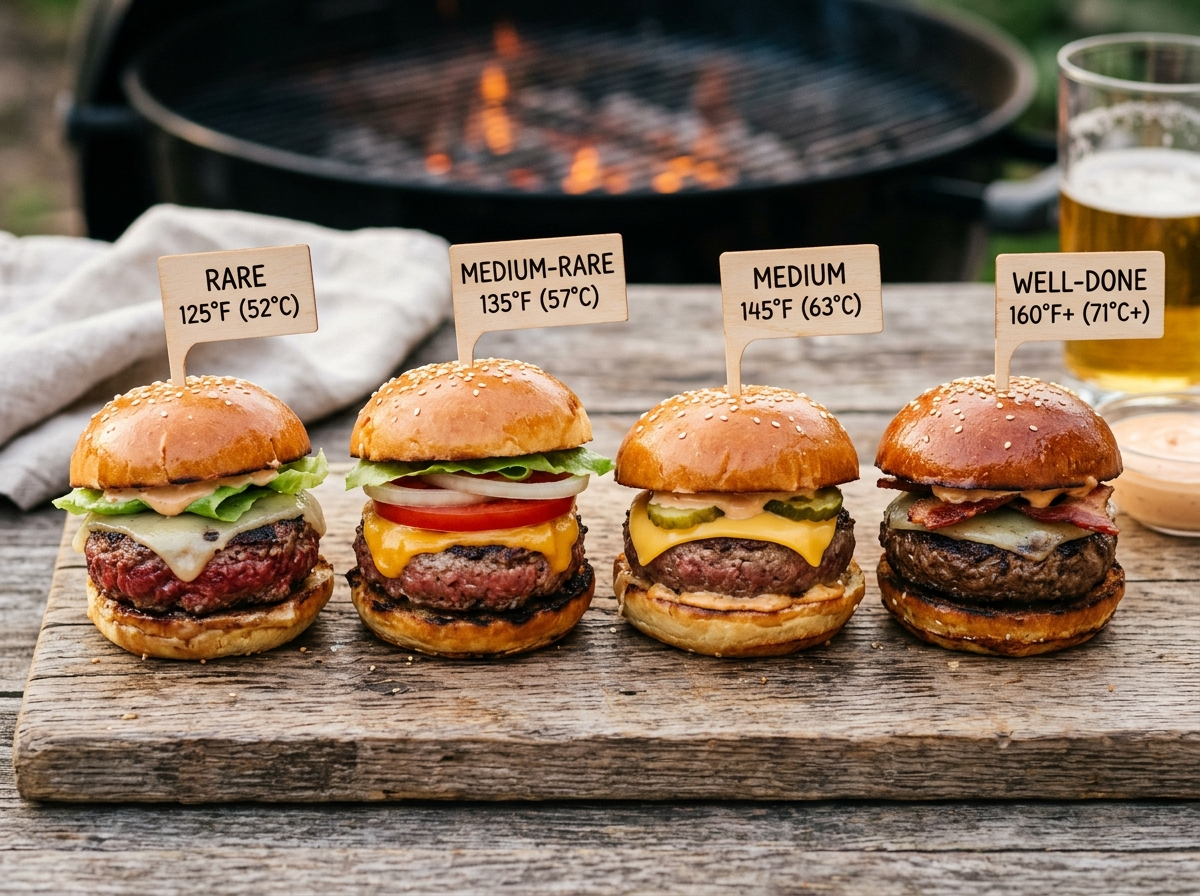
There’s a moment at every backyard cookout where someone says, “Just cut it open and check.” And every time, that person is wrong — not because they’re bad at grilling, but because cutting a burger open is one of the fastest ways to lose all the juices you just spent 10 minutes building. A good thermometer and knowing your target temperatures? That’s what actually separates a great burger from a dry, disappointing one.
Whether you like a rosy pink center or a fully cooked patty that’s still somehow moist, temperature is the one thing that puts you in control. Not cook time. Not color. Temperature.
Why Temperature Matters More Than Time or Color
Color is the most misleading thing about cooking burgers. A patty can turn brown all the way through at 140°F, while another one might still look pink at 165°F — depending on the fat content, grinding method, and even the pH of the meat. The USDA itself has acknowledged that color alone isn’t a reliable indicator of doneness or safety.
Cook time is even less reliable. A half-inch patty and a one-inch patty cook at completely different rates. A cold patty pulled straight from the fridge takes longer than one that’s been resting at room temperature. Wind, grill type, and flame intensity all change the equation too.
Temperature doesn’t lie. It tells you exactly where your burger is and exactly where you want it to go. If you’re serious about burgers — and the fact that you’re reading this says you are — a quality instant-read thermometer is non-negotiable. Check out this guide to the best thermometers for burgers to find one worth keeping near your grill.
The Burger Temperature Chart: Every Doneness Level Explained
Here’s a straightforward breakdown of every doneness level, what the internal temp should be, and what you can actually expect on your plate.
Rare — 120°F to 125°F
A rare burger has a deep red, almost cool center. The texture is very soft — almost like raw meat with a warm outer crust. Most restaurants won’t serve this, and for good reason: ground beef carries a higher bacterial risk than a whole steak because the surface (where bacteria live) gets mixed throughout during grinding.
Some people love it. If you’re grinding your own beef fresh from whole muscle cuts and cooking it immediately, the risk drops significantly. But if you’re working with store-bought ground beef, rare is genuinely risky territory.
Medium Rare — 130°F to 135°F
This is the sweet spot for a lot of serious burger people. The center is warm, bright pink, and the texture has just enough give to feel juicy without being mushy. The fat has started rendering, which means flavor is fully alive at this point.
The same safety caveat applies here. Medium rare from freshly ground, high-quality beef at home is a very different conversation than medium rare from a pre-formed grocery store patty. If you want to understand this doneness level in depth — including when it’s reasonable and when it’s not — the medium rare burger temperature breakdown covers it well.
Pro Tip: If you’re cooking smash burgers, medium rare isn’t really achievable because of how thin the patty gets. Smash burgers cook fast and hot. Learn more about the smash burgers at home technique and why thickness changes everything.
Medium — 140°F to 145°F
Medium is where a lot of home cooks land without even trying. The center is light pink, the texture is firm but still moist, and the fat has rendered enough to keep things juicy. You get good flavor without significant safety concerns — though the USDA still recommends cooking ground beef to 160°F.
For most people cooking for a mixed group — family cookout, friends over — medium hits the balance between safety and flavor that everyone can live with. It’s also where the patty starts showing more structural integrity, which means it holds up better inside a bun.
Medium Well — 150°F to 155°F
The pink is almost gone at this point. You might see a faint blush in the very center, but the rest of the patty is fully cooked through. The texture is noticeably firmer. This is the point where your burger’s fat content and meat quality start mattering most — a lean 90/10 grind at medium well is going to feel dry, while an 80/20 will still have some moisture.
If you’re cooking for someone who wants “no pink” but you still want to give them a burger worth eating, medium well is your target. Don’t push past it without good reason.
Well Done — 160°F and above
This is the USDA’s official safe temperature for ground beef. All pink is gone, the texture is firm throughout, and — let’s be honest — most burgers start getting dry at this level. The key to a well-done burger that doesn’t taste like a hockey puck is fat content and moisture retention during cooking.
An 80/20 grind (80% lean, 20% fat) is the minimum for well-done burgers. Some people go 75/25. The extra fat compensates for moisture loss. You might also add a slice of cheese early enough to melt fully, which adds perceived richness. Knowing your best fat ratio for burgers makes a real difference at this doneness level.
How Thickness Affects the Temperature Game
A thin patty and a thick patty don’t just cook at different speeds — they cook differently. A thin patty loses moisture faster because the heat reaches the center before the outside has time to develop properly. A thick patty gives you more control, more time to build a crust, and more room to nail a specific internal temperature.
If you’re aiming for medium rare or medium, a patty that’s at least ¾ inch to 1 inch thick gives you the best window to hit that temperature before the outside overcooks. Thinner patties — like smash burgers — are designed for high heat and full contact with the cooking surface, so they follow different rules entirely.
The how thick burgers should be guide gets into the specifics of how thickness interacts with doneness, which is worth reading before you start shaping patties.
Resting Your Burger: The Step Most People Skip
You pull the burger off the grill, it reads 145°F, and you immediately put it in a bun and take a bite. All that juice you just saw in the pan? Half of it is now soaking into the bottom bun or running down your hand.
Resting lets the muscle fibers relax and reabsorb moisture. Even two minutes of rest makes a meaningful difference. During that rest, the internal temperature also continues to rise slightly — usually 3°F to 5°F — because the outer layers are still holding heat. This is called carryover cooking, and if you’re not accounting for it, you’re probably overcooking your burger.
Pull a burger meant for medium (145°F) off the heat at around 140°F to 142°F. Let it rest two minutes. It’ll land right where you want it.
Cooking Surface Matters More Than You Think
The temperature you’re aiming for inside the burger is fixed. But how fast you get there depends heavily on your cooking surface. A cast iron flat top holds heat differently than a grill grate. Charcoal runs hotter and with more variation than gas. All of these affect how your crust forms and how quickly the center heats up.
On a flat top or cast iron skillet, you get direct contact with the entire surface of the patty, which means faster, more even cooking. On a grill grate, you get less surface contact but more airflow and smoke. Neither is wrong — they just produce different results, and your temperature approach stays the same either way.
If you’ve been debating which surface works best for your setup, flat top vs grill for burgers breaks down the actual differences in a way that’ll help you decide.
A Word on Safety Without the Lecture
Here’s the honest version: the USDA recommends 160°F for ground beef because that temperature kills E. coli O157:H7 and other common pathogens reliably. That’s a fact. It’s also a fact that millions of people eat medium and medium-rare burgers every year without getting sick.
The risk factors that actually matter are:
- Was the beef ground fresh, or has it been sitting?
- Is it store-bought pre-ground or freshly ground from whole cuts?
- How was it stored and handled before cooking?
Freshly ground beef from a trusted butcher or from your own kitchen carries a much lower risk at lower temperatures than pre-formed patties that have been processed, packaged, and sitting in a retail case. If you’re interested in the grinding side of things, how to grind your own hamburgers is a genuinely useful read.
For plant-based patties, the temperature rules are different — and yes, they still matter. The meatless burgers temperature matters article covers what you need to know if you’re cooking Beyond Meat, Impossible, or other alternatives.
Quick Reference: Burger Temperature Summary
| Doneness | Internal Temp | Center Color | Texture |
|---|---|---|---|
| Rare | 120–125°F | Deep red | Very soft |
| Medium Rare | 130–135°F | Bright pink | Soft, juicy |
| Medium | 140–145°F | Light pink | Firm, moist |
| Medium Well | 150–155°F | Faint blush | Firm |
| Well Done | 160°F+ | No pink | Fully firm |
FAQ
Q: Can I eat a burger at medium rare safely?
It depends on the meat. Ground beef mixes the surface of the meat — where bacteria like E. coli live — throughout the entire patty during grinding. So unlike a steak, where bacteria only exist on the outside, a burger patty carries that risk all the way to the center. Freshly ground beef from whole muscle cuts has a significantly lower risk than store-bought pre-ground. If you’re buying from a quality butcher and grinding fresh, medium rare is a risk many informed people choose to take. If you’re working with retail ground beef, cooking to at least 155°F to 160°F is the safer call.
Q: What’s the best internal temperature for a juicy burger?
Most people who care about flavor land between 140°F and 150°F — the medium to medium-well range. This is where the fat has rendered properly, the juices are still mostly in the patty, and the texture is satisfying without being dry. Fat content in the grind matters just as much as temperature here. An 80/20 blend gives you far more forgiveness than a lean 90/10.
Q: Does carryover cooking really change burger temperature that much?
Yes, more than most people expect. Burgers — especially thick ones — can rise 3°F to 7°F after being pulled off the heat, depending on how hot your cooking surface was and how thick the patty is. If you’re targeting 145°F, pulling the burger off at 140°F and letting it rest for two minutes gets you right there. Skipping this step is one of the most common reasons people end up with overcooked burgers even when they were watching the temperature.
Q: Why does my burger look done but still feel undercooked?
Color is unreliable because several factors affect it — the pH of the meat, the fat content, the age of the grind, and even the presence of certain gases can all cause ground beef to brown prematurely or stay pink longer than expected. This is exactly why a thermometer is the only tool you can actually trust. Don’t cook by color. Cook by temperature.
The Takeaway
Temperature isn’t just a food safety checkbox — it’s the single biggest lever you have over the final texture, juiciness, and eating experience of every burger you make. Get a reliable thermometer, know your target, and account for carryover cooking before you pull the patty. Everything else — the grind, the seasoning, the cooking surface — builds on that foundation.
Once you know where you’re going temperature-wise, you can start making smarter choices about the meat you use, how thick you shape the patties, and whether you’re cooking on a flat top or over charcoal. The burger doneness chart explained is a good companion if you want a deeper reference to keep nearby during your next cook.
The best burger you’ve ever made is probably one cook away — and now you know exactly what temperature it needs to be.