
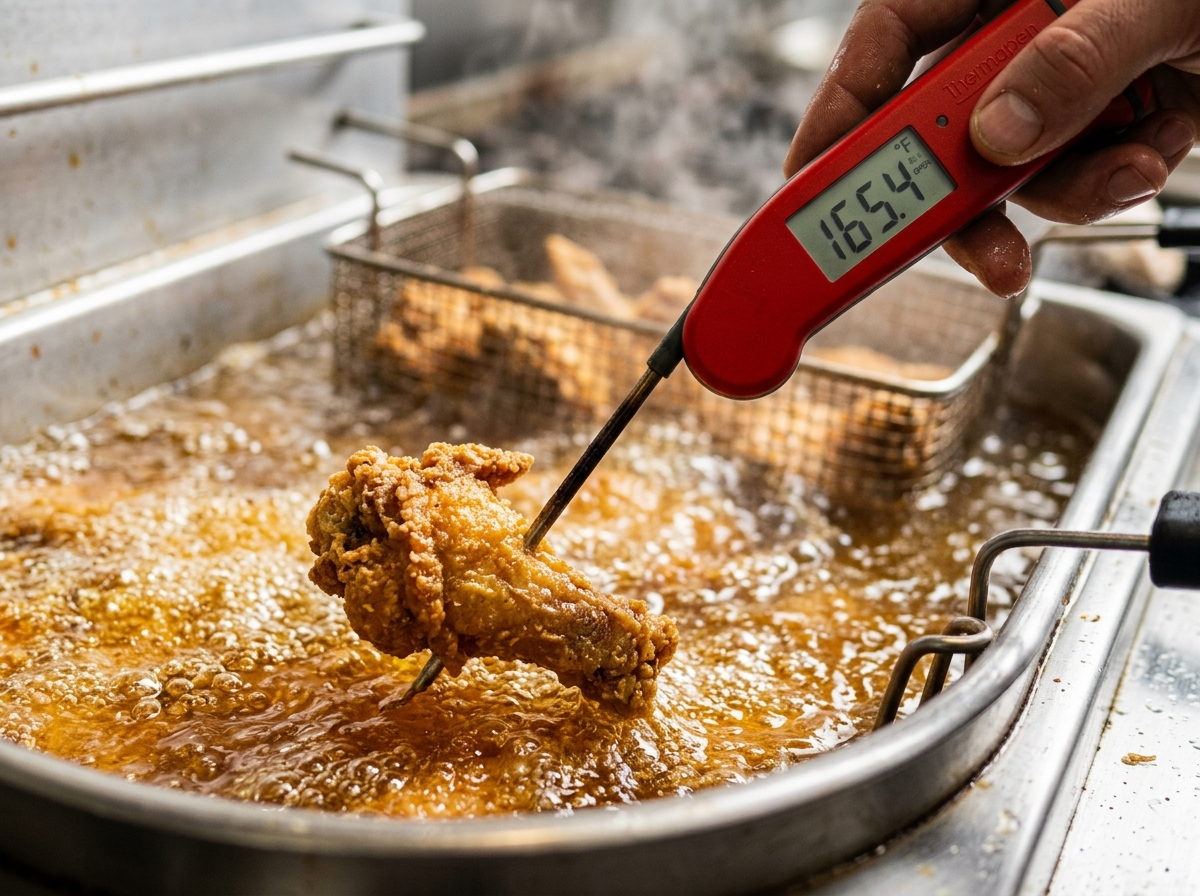
Most people who fry chicken wings at home end up with one of two problems — either the outside burns before the inside cooks through, or the wings come out pale and soggy with an oily coating that makes the skin feel like wet cardboard. The fix for both problems is the same thing: getting your oil temperature right.
You’d be surprised how many batches of wings get ruined not because of bad seasoning or the wrong recipe, but simply because the oil was too hot or too cold. Temperature controls everything — how the skin crisps up, how the fat renders under that skin, how juicy the meat stays, and whether your wings absorb a ton of grease or stay clean and golden.
This article breaks down the exact fry temperatures you need for chicken wings, why those numbers matter, and how to keep your oil steady from the first wing to the last. Whether you’re frying for a weeknight dinner or gearing up for game day with a crowd, this is the guide that’ll help you nail it.
Why Oil Temperature Matters More Than You Think
Here’s something that’ll click once you hear it. Frying isn’t just about cooking food in hot oil. It’s actually about moisture leaving the food and oil staying out of it. When you drop a chicken wing into properly heated oil, the surface moisture instantly starts turning to steam. That steam creates an outward pressure that literally pushes oil away from the food. That’s why properly fried wings aren’t greasy — the steam barrier keeps the oil out while the heat crisps the exterior.
Now, if your oil is too cool — say, around 300°F — there’s not enough energy to create that steam barrier. The oil seeps into the breading or the skin, and you get a limp, greasy wing. If you’ve ever bitten into a wing that felt heavy and oily, this is almost always what happened.
On the flip side, oil that’s too hot — over 400°F — will char the outside fast, leaving the meat near the bone raw. Chicken wings are thick near the joint and have bones running through them, so they need adequate time for heat to reach the center. Burned outside, raw inside. Nobody wants that.
Temperature isn’t just a suggestion in frying. It’s the foundation that everything else — crispiness, juiciness, safety — depends on.
The Ideal Temperature for Frying Chicken Wings
Let’s get straight to the numbers.
For most chicken wing frying, you want your oil between 350°F and 375°F (175°C to 190°C).
That’s the sweet spot where the outside gets golden and crunchy while the inside cooks all the way through without drying out. The USDA recommends chicken reach an internal temperature of 165°F (74°C) for safe consumption, and this oil range gets you there in about 10 to 12 minutes depending on wing size.
If you want to get more specific, here’s how the range breaks down in practice. At 350°F, you get a slightly slower cook — great for larger wings or if you’re using a thick coating that needs time to set and crisp without burning. At 375°F, the cook is faster and you get a more aggressive crunch on the exterior. Both work, but the approach changes a bit depending on what style of wing you’re after.
Pro Tip: Always use an instant-read thermometer or a deep-fry thermometer. Don’t guess. Don’t rely on the “drop a piece of bread in and see if it sizzles” trick. That test tells you the oil is hot, but it doesn’t tell you if it’s 340°F or 390°F — and that 50-degree difference changes your outcome completely.
The Double-Fry Method: Why Two Temperatures Work Better Than One
If you’ve ever wondered how restaurants and wing shops get that incredible shatter-crisp skin while the meat inside stays impossibly juicy, there’s a good chance they’re using a double-fry technique. It’s one of the best-kept secrets in the fried wing world, and it’s surprisingly easy to do at home.
Here’s how it works.
First fry: 250°F to 275°F for about 15 to 20 minutes. This low-temperature fry gently cooks the wings all the way through and starts rendering the fat under the skin. You’re not looking for color here. The wings will come out looking pale and honestly kind of unappetizing. That’s fine. Pull them out, let them rest on a wire rack for at least 10 minutes (you can even refrigerate them for a few hours or overnight at this stage).
Second fry: 375°F to 400°F for about 3 to 5 minutes. This high-heat blast is purely about the exterior. The skin, which has already had its fat partially rendered in the first fry, now crisps up beautifully. The moisture has been reduced, so you get that crackling, shattering texture that stays crispy even after you toss the wings in sauce.
The science behind this is straightforward. The first low fry cooks the meat and softens the skin’s connective tissue. The rest period lets surface moisture evaporate. The second high fry then dehydrates the outer layer rapidly, creating a crisp shell. It’s the same principle behind why twice-fried French fries — like these golden crisp ones — have a better crunch than single-fried ones.
Is the double-fry worth the extra effort? If you’re making wings for yourself on a Tuesday night, single frying at 350°F to 375°F is totally fine. But if you’re cooking for a group or you really want that restaurant-quality crunch — especially for a football watch party — the double fry is worth every extra minute.
How to Maintain Consistent Oil Temperature
Getting your oil to the right temperature is half the battle. Keeping it there is the other half, and it’s where most home cooks run into trouble.
Every time you drop a batch of wings into hot oil, the temperature drops. How much it drops depends on three things: how much oil you’re using, how many wings you’re adding, and whether the wings are cold from the fridge. A big pot with 3 quarts of oil might only drop 15 to 20 degrees when you add 8 wings. A small pot with barely enough oil to cover the wings could plummet 40 to 50 degrees — and suddenly you’re frying at 310°F instead of 360°F.
That temperature crash is the #1 reason home-fried wings turn out greasy and soft. The oil recovers eventually, but by the time it does, the damage is done. The wings have been sitting in lukewarm oil, soaking up grease instead of crisping.
Here’s how to avoid it:
Use more oil than you think you need. A larger volume of oil holds more thermal energy, which means it recovers faster after you add cold food. For wings, you want at least 2 to 3 inches of oil in your pot, ideally in a heavy Dutch oven or a deep cast iron skillet. If you’re looking into frying technique at home without a commercial deep fryer, this guide on frying at home has some really practical advice.
Don’t crowd the pot. Fry in batches. Six to eight wings at a time for a standard Dutch oven is a good rule. Yes, it takes longer. But trying to rush it by cramming in 15 wings at once will give you a pot of steamed, soggy chicken.
Preheat your oil slowly. Crank the heat to medium or medium-high and let the oil come up to temperature gradually. This gives you more control and reduces the chance of overshooting into the danger zone above 400°F, where oil can start to smoke and degrade.
Monitor constantly. Clip a deep-fry thermometer to the side of your pot and check it before every batch. Adjust your burner between batches as needed. Between batches, the residual heat from the burner often pushes the oil hotter than your target, so you may need to lower the flame after removing wings and raise it again right before adding the next batch.
Best Oils for Frying Chicken Wings (and Their Smoke Points)
Not every cooking oil is right for deep frying. You need an oil with a high smoke point, meaning it can handle the 350°F to 400°F range without breaking down, smoking, or giving off bad flavors. You also want a neutral flavor so the oil doesn’t compete with your wing seasoning.
Peanut oil is the gold standard for frying wings and fried chicken in general. It has a smoke point around 450°F, handles high heat like a champ, and adds a very subtle richness that complements poultry perfectly. This is what a lot of Southern cooks and restaurants use. The downside? Cost. And allergies — if anyone eating has a peanut allergy, this one’s off the table.
Vegetable oil and canola oil are the workhorse options. Both have smoke points around 400°F to 430°F, they’re affordable, widely available, and have virtually no flavor of their own. For most home cooks frying wings, either of these is a solid choice.
Sunflower oil is another strong performer with a smoke point near 440°F. It’s light, clean, and works great for frying. If you’ve been exploring the best oils for frying at home, you already know how much oil choice affects the final product.
Avoid olive oil for deep frying wings. Regular olive oil has a smoke point around 375°F — right at the upper end of your fry temperature — and extra virgin olive oil smokes even lower. It also imparts a flavor that doesn’t pair well with traditional wing seasoning. Save it for salads and sautéing.
Avoid butter, coconut oil, and sesame oil for deep frying as well. Butter burns fast. Coconut oil has a strong flavor and a relatively low smoke point (unless refined). Sesame oil is intensely flavored and best used as a finishing drizzle, not a frying medium.
Quick Fact: Oil degrades every time you use it. After frying, let it cool completely, strain it through a fine-mesh sieve or cheesecloth to remove crumbs, and store it in a sealed container. You can typically reuse frying oil 3 to 4 times before it starts tasting off or smoking at lower temperatures than it should.
How Long to Fry Chicken Wings at the Right Temperature
Cook time and temperature work together. You can’t talk about one without the other.
At 350°F, whole chicken wings (not separated into flats and drumettes) take about 12 to 14 minutes. Separated flats and drumettes are smaller and cook faster — roughly 10 to 12 minutes. Party-style wingettes and drumettes, which are what most people buy at the store, fall right in that 10 to 12 minute window.
At 375°F, you’ll shave a minute or two off those times. Separated pieces might be done in 8 to 10 minutes.
But here’s the thing — these are guidelines, not guarantees. Wing size varies wildly. A jumbo wing from a larger bird takes longer than a small wing from a younger chicken. The only way to be sure your wings are done is to check the internal temperature. Pull a wing out, stick an instant-read thermometer into the thickest part of the meat (not touching bone), and look for 165°F.
Warning: Bone-in chicken can look done on the outside — beautiful golden brown — and still be pink or undercooked near the bone. This is especially true with drumettes, where the meat is thicker. Don’t rely on color alone. Temperature is the only reliable indicator.
If you cut into a wing and see red or pink liquid pooling around the bone, it needs more time. Put it back in and give it another 2 to 3 minutes, then check again.
Dry Wings Before Frying — This Step Changes Everything
There’s a simple step that most recipes gloss over, and skipping it costs you a lot of crispiness. Pat your wings bone-dry before they go anywhere near hot oil.
Surface moisture is the enemy of crisp skin. When wet wings hit hot oil, all that water has to boil off before the skin can start browning. During that boiling phase, the wings are basically steaming, not frying. More moisture means a longer steam phase, which means softer skin and more oil absorption.
Pull your wings out of the package, lay them on a sheet tray lined with paper towels, and pat each one thoroughly with more paper towels. Better yet, let them sit uncovered in the fridge for a few hours — or overnight if you can plan ahead. The dry air in your fridge wicks moisture off the surface, and you’ll notice a visible difference in how the skin feels. It should feel slightly tacky and dry to the touch.
This is the same technique that makes oven-roasted and fried chicken incredibly crispy — the drier the surface, the better the crust.
If you’re applying a breading or coating, dry wings also help the flour or batter stick better. Wet skin under a coating creates a slippery layer that causes breading to slide off in the oil — those loose floaty bits that burn and make your oil dirty.
Naked Wings vs. Breaded Wings: Does Temperature Change?
Yes, slightly. The style of wing you’re frying should influence where you set your temperature within that 350°F to 375°F range.
Naked wings (no coating) do well at the higher end — 375°F. Since there’s no breading to protect the skin, you want fast, aggressive heat to render the subcutaneous fat and crisp the skin quickly. Lower temperatures on naked wings often result in rubbery, chewy skin because the fat doesn’t render fast enough.
Breaded or battered wings benefit from 350°F to 360°F. A coating needs time to set and cook through. Too hot, and the breading browns and burns before the chicken inside is done. A slightly lower temperature gives the coating time to develop that even golden crust while the meat catches up.
Korean-style double-fried wings — which use a thin coating of cornstarch and sometimes rice flour — work beautifully with the double-fry method mentioned earlier. The first fry at 250°F to 275°F cooks the meat, and the second fry at 375°F to 400°F crisps the starchy coating into a glass-like shell. If you’ve ever had Korean fried chicken and wondered why the coating shatters like a cracker, this is why.
Regardless of the style, the internal temperature target stays the same: 165°F. The coating changes how you manage heat, but it doesn’t change the safety standard.
What Happens When You Fry at the Wrong Temperature
Let’s paint a clear picture of what goes wrong at specific temperatures so you can troubleshoot if your wings aren’t turning out right.
Below 325°F: The wings are essentially soaking in warm oil. The Maillard reaction — the chemical process responsible for browning and flavor development — barely happens below 300°F to 310°F. Your wings will be pale, greasy, and the skin will be limp. The breading (if any) will absorb oil like a sponge and taste heavy.
325°F to 340°F: You’ll get some browning, but it’ll be slow and uneven. Wings spend too long in the oil, which means they lose more moisture from the meat, leaving them dry inside while the outside is still not very crispy. It’s the worst of both worlds.
350°F to 375°F: The sweet spot. Browning happens at a good pace, the skin crisps, moisture stays locked inside the meat, and oil absorption is minimized. This is where you want to be for standard single-fry wings.
375°F to 400°F: Great for the second fry in a double-fry method, or for very quick frying of pre-cooked or small pieces. At this range, breading can burn quickly, so you need to watch your wings closely. Naked wings can handle this heat well for short bursts.
Above 400°F: You’re in the danger zone. Most cooking oils start approaching their smoke point here. The exterior of the wings will darken rapidly — sometimes going from golden to blackened in under a minute. The interior won’t have time to cook through. Plus, oil at this temperature can be a serious safety hazard. Oil that reaches its smoke point is also releasing harmful compounds, and it doesn’t taste good.
This kind of temperature awareness applies to all frying, by the way. Whether you’re making homemade corn dogs, mozzarella sticks, or chicken tenders, the same principles of oil management apply.
Safety Tips for Deep Frying Wings at Home
Deep frying involves very hot oil, and it deserves respect. A few practical safety points that matter:
Never fill your pot more than halfway with oil. When you add food, the oil level rises and it bubbles vigorously. An overfilled pot can overflow onto your burner, and that’s how kitchen fires start. This is the same reason deep frying a turkey requires such careful planning — volume management is critical.
Keep a lid nearby. If oil does catch fire, the worst thing you can do is throw water on it. Water explodes on contact with burning oil and spreads the fire instantly. Instead, slide a tight-fitting lid over the pot to cut off the oxygen. You can also use a fire extinguisher rated for grease fires (Class B or Class K). Never try to carry a pot of burning oil.
Use long tongs or a spider strainer to lower wings into the oil gently. Don’t drop them from above — that causes splashing. Lower them in slowly, one or two at a time, away from your body.
Fry on a stable, flat surface. Not near the edge of the counter. Not on a wobbly burner grate. And definitely keep kids and pets away from the area while you’re working with hot oil.
FAQ
What temperature should I fry chicken wings at?
Fry chicken wings at 350°F to 375°F for the best results. This range crisps the skin, cooks the meat through to a safe internal temperature of 165°F, and keeps oil absorption low. If you’re using a double-fry method, start at 250°F to 275°F for the first fry and finish at 375°F to 400°F for the second.
How long does it take to fry chicken wings?
At 350°F to 375°F, chicken wings take about 10 to 14 minutes depending on their size and whether they’re whole or separated into flats and drumettes. Always verify doneness with an instant-read thermometer — you’re looking for 165°F at the thickest part of the meat, away from the bone.
Can I fry frozen chicken wings?
You can, but it’s not recommended. Frozen wings carry a lot of ice crystals, which cause violent splattering when they hit hot oil. This is a burn hazard. Frozen wings also drop the oil temperature dramatically, leading to longer cook times and greasier results. Thaw your wings completely in the refrigerator overnight, then pat them dry before frying.
Why are my fried chicken wings not crispy?
The most common reasons are oil that isn’t hot enough, wings that weren’t dried properly before frying, or overcrowding the pot. All three lead to excess moisture around the wings during cooking, which prevents the skin from crisping. Make sure your oil is at 350°F to 375°F, pat your wings dry, and fry in small batches.
What oil is best for frying chicken wings?
Peanut oil is the top choice for flavor and heat tolerance. Vegetable oil and canola oil are great budget-friendly alternatives. All three have high smoke points and neutral flavors that let your wing seasoning come through. Avoid olive oil, butter, and coconut oil for deep frying.
Your Wings Are Only as Good as Your Temperature Control
Everything about frying chicken wings — the crunch, the juiciness, the color, even the safety — ties back to oil temperature. Get it right, and you’re rewarded with wings that rival any restaurant. Get it wrong, and no amount of seasoning or sauce can save them.
Grab a good thermometer if you don’t have one. It doesn’t need to be expensive — a basic clip-on deep-fry thermometer costs less than a bag of wings. Set your temperature to 350°F to 375°F for a standard fry, or try the double-fry at 275°F then 375°F when you want to really impress. Dry your wings, don’t crowd the pot, and check that internal temp before you serve.
Once you’ve got this dialed in, you won’t want to order wings out again. And if you’re building a bigger spread, crispy fried chicken for a crowd uses a lot of these same principles at a larger scale. Same fundamentals, same great results.
Now go heat up some oil — the right way.