
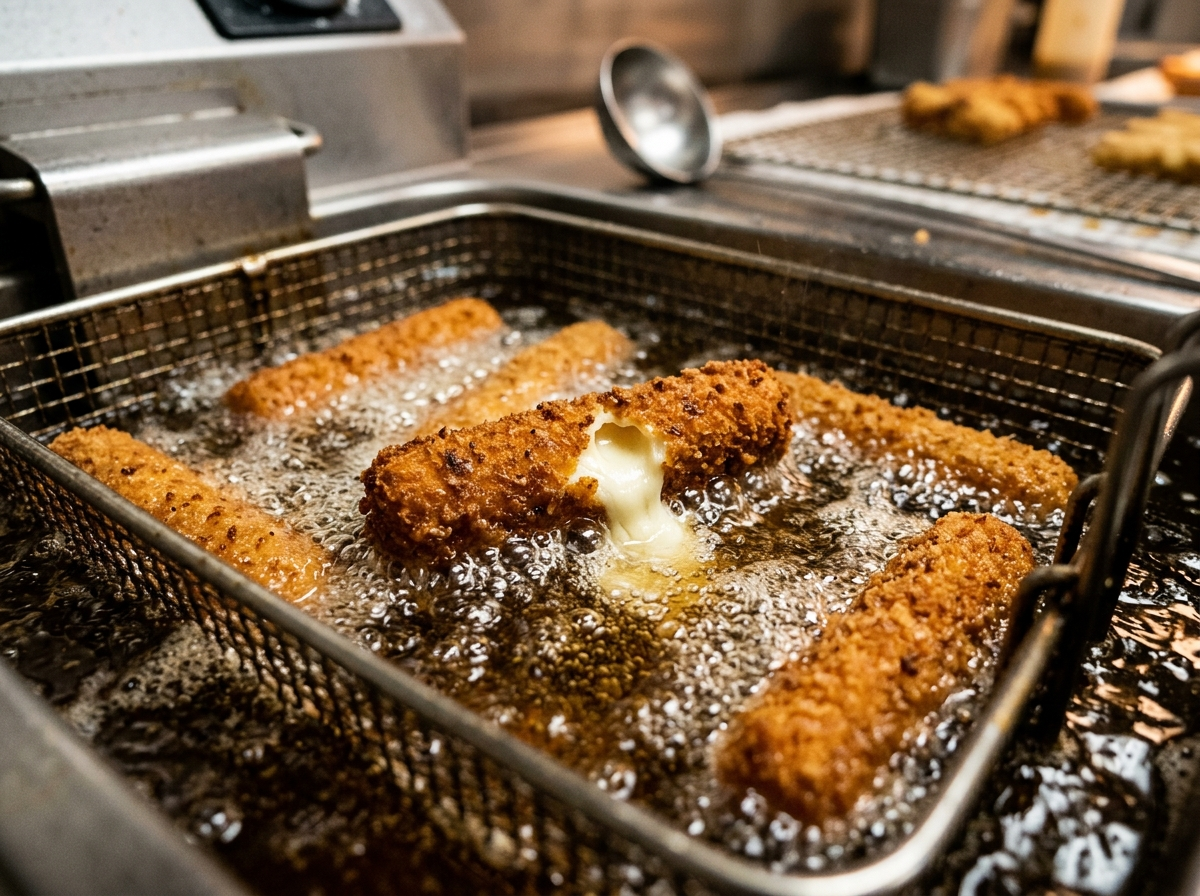
A perfectly fried mozzarella stick holds a small miracle inside — golden, crunchy breading on the outside, stretchy molten cheese on the inside, and not a single leak in sight. But here’s the frustrating reality most home cooks know too well: you drop those sticks into hot oil, and within seconds the breading cracks open, cheese oozes out, and you’re left with greasy, deflated shells floating in a pool of wasted mozzarella.
The problem almost always comes down to one thing — frying accuracy. Not just the oil temperature, but a chain of small decisions around freezing, breading, timing, and recovery heat that determine whether you end up with appetizer-menu-worthy mozzarella sticks or a deep fryer full of regret.
This guide breaks down every variable that matters, so you can fry mozzarella sticks at home with the same precision you’d expect from a restaurant kitchen.
Why Mozzarella Sticks Are Harder to Fry Than You Think
Most fried foods are forgiving. You can drop a batch of french fries into oil that’s 15 degrees off-target, and they’ll still turn out decent. Mozzarella sticks don’t give you that margin.
The reason is simple: you’re racing against physics. The breading needs enough time in hot oil to turn golden and crispy. But the cheese inside is actively melting and expanding during that same window. If the breading doesn’t set fast enough, the cheese wins — it pushes through weak spots, bursts out, and your stick is done.
That’s why frying accuracy matters more here than with almost any other fried food. You’re managing two competing timelines at once: crust formation on the outside and cheese melt on the inside. Get the balance right, and every stick comes out intact. Get it wrong by even a small margin, and you’ll see blowouts.
If you’ve ever struggled with keeping fried coatings crispy on other foods, the principles overlap quite a bit. But mozzarella sticks add an extra layer of challenge because the filling is literally trying to escape.
The Right Oil Temperature (And Why a Few Degrees Matter)
Let’s settle the temperature question right away: 350°F (177°C) is the sweet spot for deep frying mozzarella sticks.
Some recipes suggest 375°F. Others say 325°F. Both can work under specific conditions, but 350°F gives you the best balance between browning speed and cheese containment for most setups.
Here’s what happens at different temperatures:
Below 340°F — The breading absorbs too much oil before it crisps. Sticks come out soggy and greasy. The longer cook time also means more heat reaches the cheese, increasing blowout risk.
340°F to 355°F — The ideal range. Breading sets quickly, creating a sealed shell before the cheese inside fully liquefies. You get a crisp exterior in about 90 seconds to 2 minutes.
Above 365°F — The outside browns too fast. You might pull sticks out thinking they’re done, but the interior breading layer hasn’t fully cooked. Or worse, the extreme heat causes rapid steam buildup inside, and the cheese explodes through the coating.
Pro Tip: Don’t trust your fryer’s built-in thermometer blindly. Many home deep fryers and especially stovetop setups can be off by 10–20 degrees. Use a separate clip-on deep fry thermometer or an instant-read probe to verify. The same principle applies when choosing the right oil and monitoring temperature for fries — your thermometer is your most important tool.
Oil Temperature Recovery: The Hidden Variable
Here’s something most recipes never mention, and it’s the single biggest reason home-fried mozzarella sticks fail: temperature drop when you add food to the oil.
Every time you lower cold (or frozen) mozzarella sticks into hot oil, the temperature plunges. Depending on how much food you add and how much oil you’re working with, that drop can be 25 to 50 degrees. If you started at 350°F and dropped to 300°F, you’re now frying in the soggy, greasy danger zone.
The fix involves two things.
Use enough oil. You want at least 2–3 inches of oil in your pot or fryer. More oil means more thermal mass, which means the temperature recovers faster after you add food. A small saucepan with an inch of oil will crash in temperature the moment frozen sticks hit it.
Fry in small batches. Four to six sticks at a time is the maximum for most home fryers. Yes, it takes longer. But crowding the fryer drops the temperature too much and also creates another problem — sticks touching each other, which causes the breading to tear and cheese to leak at contact points.
If you’ve ever fried corn dogs at home, you already know how much batch size affects results. The same rules apply here, just with higher stakes because cheese is less forgiving than a hot dog.
Freezing Isn’t Optional — It’s the Whole Strategy
You might be tempted to bread your mozzarella sticks and fry them right away. Don’t. This is the single fastest path to blowouts.
Freezing serves a critical function: it buys you time. When a frozen mozzarella stick hits 350°F oil, the outside starts cooking immediately, but the frozen cheese core takes longer to reach its melting point (around 130–140°F for mozzarella). That delay is exactly what you need. It gives the breading time to set into a firm, sealed shell before the cheese liquefies and starts pushing outward.
For store-bought frozen sticks, keep them in the freezer right up until the moment you fry. Don’t let them sit on the counter and start thawing — even 10 minutes of thawing can make a difference.
For homemade sticks, the process looks like this. Cut your mozzarella string cheese or block cheese into sticks about 3–4 inches long and roughly ¾ inch thick. Bread them (more on that below), then place them on a parchment-lined baking sheet and freeze for at least 2 hours. Overnight is even better. You want them frozen solid, not just cold.
Some experienced home cooks freeze them twice — once after the first breading layer, then again after the second coat. This creates a thicker, more resilient shell and nearly eliminates blowouts.
Quick Fact: Mozzarella’s melting behavior is different from most cheeses. It doesn’t just liquify — it becomes stretchy and elastic because of its protein structure (specifically the way casein proteins align during the pasta filata stretching process). That stretch is what you want inside the stick. But it also means the cheese expands as it heats, which creates internal pressure. The only thing holding that pressure back is your breading. This is why a strong, double-coated breading on a well-frozen stick is non-negotiable.
The Breading Method That Actually Holds Up
Not all breading techniques are equal, and for mozzarella sticks, you need the strongest seal you can build. A single dredge in flour and breadcrumbs won’t cut it.
The method that works best is a double-dip technique.
Start by setting up your breading station: one dish of all-purpose flour, one dish of beaten eggs (with a splash of water or milk to thin them slightly), and one dish of breadcrumbs. Italian-seasoned breadcrumbs add flavor, but plain works fine too. Panko breadcrumbs give extra crunch but can leave small gaps between the flakes — if you use panko, press them firmly onto the cheese.
Take your cheese stick, roll it in flour, shake off the excess, dip it in egg, let the excess drip off, then roll it in breadcrumbs. That’s your first coat.
Now here’s the step that makes the difference: dip it back into the egg, and roll it through the breadcrumbs a second time. This double layer creates a significantly stronger shell. It’s thicker, it seals more completely, and it resists cracking under the pressure of melting cheese.
After double-coating, freeze the sticks. Don’t skip this. The freezing firms up the breading, bonds the layers together, and creates that critical head start you need during frying.
Warning: Don’t use wet mozzarella (like fresh mozzarella packed in water). It contains too much moisture. When it heats up, that moisture turns to steam inside the breading shell, and the explosion risk goes way up. Low-moisture mozzarella — the kind you buy in blocks or as string cheese — is what you want. It melts cleanly, stretches beautifully, and produces far less steam.
Timing the Fry: How Long Is Long Enough?
Once your oil is at 350°F and your sticks are frozen solid, the actual frying is the fastest part of the process. Most mozzarella sticks need 90 seconds to 2 minutes in the oil. That’s it.
The visual cue you’re looking for is a deep golden-brown color all over. Not light tan — that means the breading hasn’t fully set. And not dark brown — that means you’ve gone too long and the cheese inside is probably already leaking or about to.
Here’s a timing breakdown that works well in practice:
For store-bought frozen sticks (like the popular brands from Farm Rich or TGI Friday’s), 1 minute and 30 seconds to 2 minutes at 350°F is usually perfect. They’re designed with specific breading thickness calibrated for that window.
For homemade double-breaded sticks from a hard freeze, 2 minutes is a safe target. The extra breading layer takes a few more seconds to fully crisp.
Pull them out with a slotted spoon or spider strainer, transfer to a wire rack (not paper towels — a rack lets oil drip away without steaming the bottom), and let them rest for about 30 to 45 seconds before eating. This brief rest allows the cheese inside to settle slightly from a full liquid back to that ideal stretchy consistency.
Did You Know? The same principle of managing fry time based on coating thickness applies to fried chicken too. Thicker coatings need slightly longer, but pushing past the ideal window always causes problems — greasiness in chicken, blowouts in mozzarella sticks.
Choosing the Right Oil
Not every cooking oil works well for deep frying mozzarella sticks. You need an oil with a high smoke point and a neutral flavor that won’t compete with the cheese and breading.
Peanut oil is a top choice. It has a smoke point around 450°F, stays stable during frying, and adds a very subtle nutty undertone that complements fried foods well. It’s what many restaurants use.
Canola oil and vegetable oil are the most accessible and affordable options. Smoke points hover around 400°F, which gives you plenty of headroom above your 350°F target. Flavor is neutral.
Avocado oil has the highest smoke point of common cooking oils (around 520°F) and works beautifully, but it’s expensive. For a batch of mozzarella sticks, it might not be worth the cost unless you’re already using it for other cooking.
Avoid olive oil for deep frying. Extra virgin olive oil has a low smoke point and a strong flavor. Even regular olive oil isn’t ideal at sustained deep frying temperatures. Save it for dipping sauces.
If you’re curious about oil selection for different fried foods, the guide on choosing oil for homemade fries covers the science behind smoke points and flavor transfer in detail.
Home Fryer vs. Stovetop: Which Setup Works Better?
Both methods can produce great mozzarella sticks, but they have different strengths and weaknesses.
Dedicated deep fryers (like the T-fal or Presto models popular in home kitchens) offer built-in temperature control, a thermostat that automatically adjusts the heating element, and a contained frying environment. They’re convenient and consistent. The downside? Most home fryers hold a limited amount of oil, so temperature recovery after adding food can still be slow. And those built-in thermostats aren’t always accurate — verify with a separate thermometer.
Stovetop frying in a heavy-bottomed pot (Dutch oven, cast iron pot, or heavy stainless steel) gives you more control over heat output. Gas stoves respond faster to adjustments, which helps with temperature recovery. The trade-off is that you’re managing everything manually — temperature monitoring, batch size, timing. It demands more attention.
If you go the stovetop route, a Dutch oven is your best bet. Its thick walls hold heat well, which reduces temperature drops when you add food. Clip a deep-fry thermometer to the side, keep the oil between 345°F and 355°F, and adjust your burner as needed.
What About Air Frying?
Air fryers have become wildly popular, and yes, you can make mozzarella sticks in one. But let’s be honest about the results — they’re different from deep-fried sticks, not better or worse, just different.
Air-fried mozzarella sticks tend to have a drier, crunchier texture on the outside. The cheese inside melts the same way, but because there’s no oil bath sealing the breading from all sides simultaneously, you’re more likely to see small leaks. The breading also doesn’t set as uniformly because hot air doesn’t transfer heat as evenly as oil does.
If you go the air fryer route, spray the sticks lightly with cooking oil before frying. Set the temperature to 390°F and cook for 6–8 minutes, flipping halfway through. Frozen sticks are a must — don’t try air-frying fresh ones. And don’t overcrowd the basket. Single layer, with space between each stick.
For those who want to explore frying alternatives beyond deep frying, air frying is a solid option. Just adjust your expectations for texture.
Troubleshooting the Most Common Failures
Even with the right temperature and technique, things can go wrong. Here’s what typically causes problems and how to fix them.
Cheese leaking out during frying. This is almost always a freezing or breading issue. Either the sticks weren’t frozen solid enough, or the breading had weak spots (usually from a single-coat application). Fix: double-bread and freeze overnight. Also check your oil temp — if it’s too low, the extended cook time gives cheese more opportunity to break through.
Breading falls off in the oil. The egg wash didn’t adhere properly, or excess flour created a barrier between layers. Fix: shake off all excess flour before dipping in egg. Make sure the egg wash coats every surface completely. The breading needs to stick to the egg, not float on loose flour.
Sticks are golden outside but cold inside. Your oil was too hot. The exterior cooked before heat could penetrate to the center. Fix: lower the temperature to 350°F and don’t pull sticks out until the full 90-second minimum has passed. A cold center on a mozzarella stick also means the cheese won’t stretch — it’ll just feel like biting into a regular piece of cheese.
Sticks are greasy and soggy. Oil temperature was too low, or sticks sat in the oil too long. Low-temperature frying lets oil absorb into the breading instead of staying on the surface. Fix: make sure oil is at 350°F before adding sticks, and pull them at the 2-minute mark. Drain on a wire rack, not paper towels.
Breading tastes raw or doughy. This happens with thick homemade breading that doesn’t cook through. You might need to adjust your breadcrumb choice — finer crumbs cook faster than coarse ones. Or try a slightly higher temperature (355°F) and add 10–15 seconds of cook time.
Making Them for a Crowd
Mozzarella sticks are a perfect game day appetizer, but scaling up introduces new challenges. You can’t just dump 30 sticks into a fryer and expect good results.
The key to frying for a group is assembly-line thinking. Freeze a large batch ahead of time — they’ll keep for weeks in the freezer in an airtight container or zip-lock bag. When it’s time to cook, set up your fryer or pot, get the oil to 350°F, and fry in batches of 4–6.
Between batches, give the oil 60–90 seconds to recover back to temperature. Use a thermometer to confirm. Rushing the next batch in before the oil is ready is the most common mistake people make when cooking for a crowd.
Keep finished sticks warm on a wire rack set inside a baking sheet in a 200°F oven. They’ll hold for 15–20 minutes without getting soggy. This way you can have a full platter ready by the time your last batch comes out of the oil.
Pair them with a solid lineup of other finger foods and you’ve got a spread that covers all the bases.
Dipping Sauces That Actually Complement the Cheese
Marinara is the classic pairing — warm, slightly acidic tomato sauce cuts through the richness of the fried cheese. You can use store-bought or make a quick version by simmering crushed tomatoes with garlic, a pinch of red pepper flakes, basil, and a tiny bit of sugar for 15 minutes.
But don’t stop at marinara. Ranch dressing works surprisingly well, especially if you add a little garlic powder and fresh dill. Garlic aioli — just mayo, minced garlic, lemon juice, and salt — brings a creamy, savory element that pairs with the mild mozzarella.
For something with a kick, try a spicy honey drizzle. Mix honey with a few dashes of hot sauce (Frank’s RedHot or similar). The sweet heat against the salty, crispy breading is genuinely addictive. If you enjoy heat, you might appreciate the same flavor philosophy behind Nashville hot chicken — spice, fat, and crunch working together.
FAQ
What temperature do you deep fry mozzarella sticks at?
The ideal deep frying temperature for mozzarella sticks is 350°F (177°C). This gives the breading enough time to turn golden and crispy while keeping the cheese from melting so fast that it bursts through the coating. Always verify your oil temperature with a thermometer rather than relying on visual cues alone.
Why do my mozzarella sticks always explode in the fryer?
Cheese explosions happen when the internal pressure from melting and expanding cheese exceeds what the breading can contain. The most common causes are sticks that weren’t frozen solid enough, breading that was too thin (only one coat), or oil that was too hot. Double-bread your sticks, freeze them for at least 2 hours, and fry at 350°F to prevent blowouts.
Can you deep fry mozzarella sticks from the refrigerator instead of the freezer?
You can, but the results won’t be as good. Refrigerated sticks haven’t built up enough of a temperature buffer. The cheese will start melting almost immediately when it hits hot oil, giving the breading very little time to set. For the best results, always fry mozzarella sticks from a fully frozen state.
How do you keep mozzarella sticks crispy after frying?
Place fried sticks on a wire rack rather than paper towels. A wire rack allows air circulation underneath, preventing steam from softening the bottom. If you need to hold them for a few minutes before serving, keep them in a 200°F oven on the wire rack. Avoid covering them or stacking them — trapped moisture is the enemy of crispy breading.
What kind of mozzarella works best for homemade mozzarella sticks?
Low-moisture mozzarella is the best choice. It melts cleanly, stretches well, and doesn’t release excess steam that could blow out the breading. String cheese is a convenient option because it’s already portioned in stick shapes. Avoid fresh mozzarella (the soft kind packed in water) — it has too much moisture content for deep frying.
Your Next Batch Will Be Different
Mozzarella sticks seem like they should be simple, and honestly, they are — once you understand the handful of variables that actually matter. Get your oil to 350°F and keep it there. Double-bread your sticks. Freeze them solid. Fry in small batches. Pull them at the right time.
None of these steps are difficult on their own. The trick is doing all of them together, consistently, every time you fry. That’s where accuracy lives — not in one single adjustment, but in the chain of small decisions that add up to a perfect result.
So the next time you pull a batch of golden, intact, perfectly sealed mozzarella sticks out of hot oil and watch that cheese stretch when you break one open, you’ll know exactly why it worked. And you’ll be able to do it again tomorrow.