
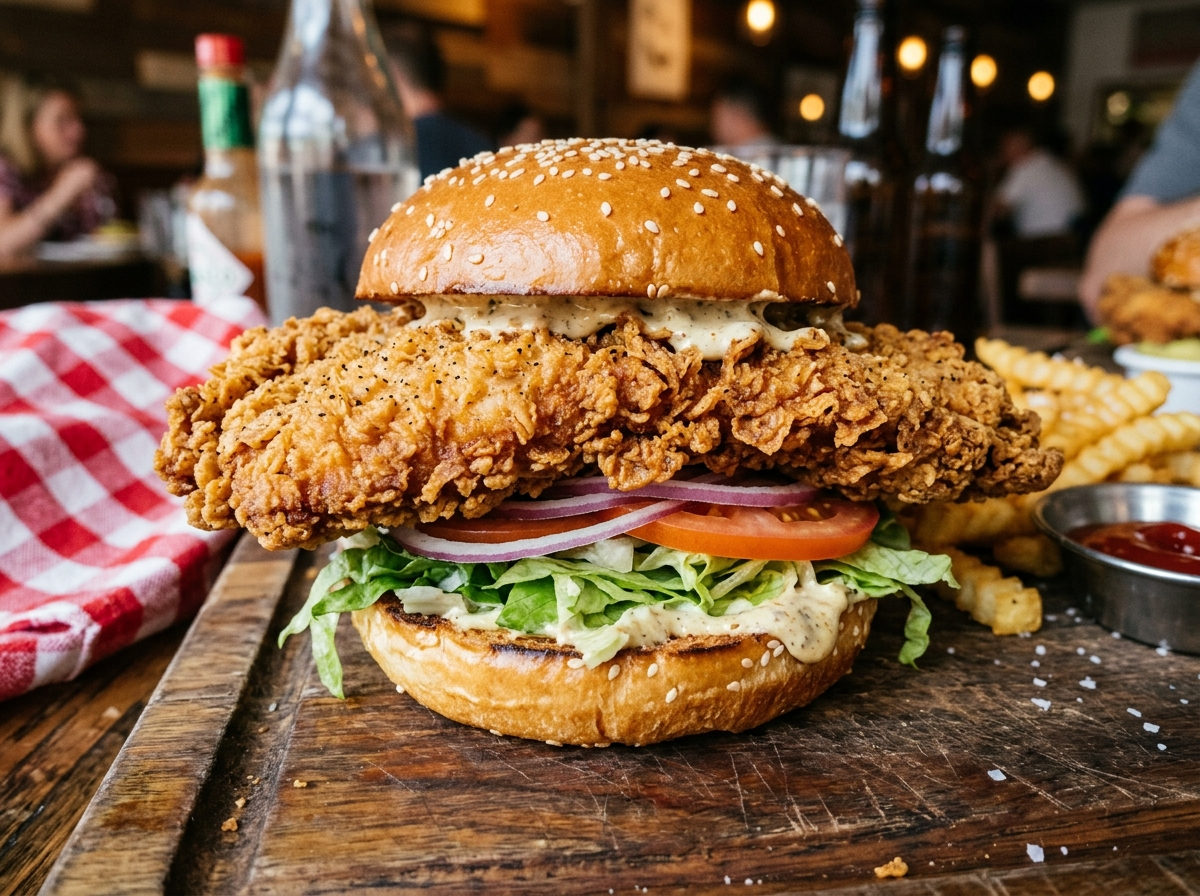
In Indiana, a sandwich isn’t measured by what fits between the bun — it’s measured by how far the meat hangs over the bun. The fried pork tenderloin sandwich is the unofficial state sandwich of Indiana, and across the Midwest, it’s treated with the same reverence that Texas gives its brisket or Philly gives its cheesesteak. A slab of pork, pounded impossibly thin, breaded, fried golden, and served on a modest bun that looks almost comically small underneath — that’s the whole idea.
If you’ve never had one, you’re about to understand what millions of Midwesterners already know. And if you’ve had one at a county fair or roadside diner and want to recreate it at home, you’re in the right place. Let’s walk through everything: the history, the technique, the little details that separate a forgettable sandwich from one that makes you close your eyes and just chew in happiness.
Where the Fried Pork Tenderloin Sandwich Actually Comes From
You can’t talk about this sandwich without talking about Indiana. Specifically, the city of Huntington, Indiana, where a man named Nick Freienstein is widely credited with creating the fried pork tenderloin sandwich around 1904 at Nick’s Kitchen. The restaurant still operates today, and people drive hours just to eat there.
But the sandwich didn’t stay in Huntington. It spread across Indiana, Iowa, Illinois, Ohio, and Missouri. Small-town diners, gas station grills, county fairs, and church suppers all adopted it. By the mid-20th century, it had become a Midwest staple — the kind of food people argue about (“My town’s version is better than yours”) with genuine passion.
Iowa has its own strong claim to tenderloin sandwich fame, with places like the Goldie’s Ice Cream Shoppe in Prairie City and Joensy’s in Solon drawing devoted fans. The Iowa Pork Producers Association even runs a tenderloin trail to help people find the best versions across the state.
Quick Fact: Indiana tried to make the fried pork tenderloin sandwich the official state sandwich in 2003. The bill didn’t pass, but nobody in Indiana seems to care — they treat it like the official sandwich anyway.
What makes this sandwich culturally fascinating is its blue-collar simplicity. It’s not fussy. It’s not trying to impress food critics. It’s a working person’s lunch that happens to be deeply satisfying. And that honest, unpretentious quality is exactly why it’s endured for over a century.
Why This Sandwich Is All About the Pork — And How to Pick the Right Cut
The name tells you what cut to use: pork tenderloin. But here’s where things get interesting, because there’s a real difference between getting this right and getting it wrong.
Pork tenderloin is the long, narrow muscle that runs along the backbone of the pig. It’s the most tender cut on the animal — lean, mild in flavor, and naturally soft. That tenderness is exactly why it works so well here. When you pound it thin and fry it, you get a piece of meat that practically melts against the crunch of the breading.
Don’t confuse pork tenderloin with pork loin. They come from different parts of the pig. Pork loin is a larger, wider roast from the back. Pork tenderloin is smaller, narrower, and much more tender. Using pork loin won’t ruin your sandwich, but it won’t have the same buttery texture.
When you’re buying tenderloin, look for pieces that are pinkish-red with minimal visible fat. A whole tenderloin typically weighs about 1 to 1.5 pounds, which gives you enough for roughly 4 sandwiches depending on how thick you slice. You’ll want to trim off the silverskin — that thin, silvery membrane on the surface. It doesn’t break down during cooking and turns chewy, so peel it off with a sharp knife before you do anything else.
Pro Tip: Ask your butcher for center-cut tenderloin pieces if you want consistent thickness. The tapered ends of a whole tenderloin are thinner and can overcook before the rest is done.
Pounding the Meat: The Step Most People Underestimate
Here’s the truth — the pounding is where this sandwich is won or lost. You want that tenderloin pounded thin. We’re talking about a quarter-inch thick, maybe even a little less. The goal is a piece of meat that’s significantly larger than the bun it’ll sit on. That overhang isn’t just tradition; it’s the whole visual identity of the sandwich.
Start by cutting your trimmed tenderloin into pieces about 1 to 1.5 inches thick. Place each piece between two sheets of plastic wrap or inside a zip-top bag. Then grab a meat mallet, a rolling pin, or even the bottom of a heavy skillet.
Pound from the center outward, using firm but controlled strikes. You’re not trying to destroy the meat — you’re coaxing it to spread evenly. Rotate the piece as you go so it expands in all directions rather than stretching into a long strip.
You’ll know you’re done when the piece is roughly 6 to 8 inches across and uniformly thin. If you hold it up, you should almost be able to see light through the thinnest spots. That might sound excessive, but trust the process. Those ultra-thin areas fry up into the crispiest, most satisfying bites.
One thing to watch: don’t pound so aggressively that you tear the meat. If you see holes forming, you’ve gone too hard. Back off the force a little and let the mallet do the work with gentle, repeated taps.
If you’ve ever struggled with getting fried coatings to stay crispy on other proteins, the technique principles are similar — and understanding why breading sometimes fails can save you a lot of frustration here too.
The Breading: Cracker Crumbs, Flour, or Breadcrumbs?
This is where regional loyalties get fierce. The breading style defines the sandwich’s character, and people have strong opinions.
The three main schools of thought:
Flour-based breading is the simplest approach. Seasoned flour, an egg wash, and back into the flour. You get a relatively thin, tight crust that lets the pork flavor come through. This is closer to what you’d find in a traditional chicken fried steak preparation. The coating clings well, fries evenly, and stays crispy for a decent amount of time. If you enjoy the technique behind a good chicken fried steak, this style will feel very familiar.
Cracker-crumb breading uses crushed saltine crackers (or Ritz crackers, depending on who you ask). This produces a rougher, more textured crust with a slightly salty, buttery flavor. Many Indiana diners use this method, and a lot of competition-winning recipes rely on it. The cracker crumbs create little peaks and ridges that fry up extra crunchy.
Breadcrumb or panko breading gives you the most dramatic crunch. Panko, especially, creates an airy, shatteringly crisp coating. It’s not the most traditional choice, but it’s popular with home cooks who want maximum texture contrast.
My honest recommendation? For your first try, go with the cracker-crumb method. It’s the most authentic Midwest approach and gives you that perfect balance of flavor and crunch.
Here’s a straightforward breading process that works regardless of your coating choice:
Set up three shallow dishes. First dish: seasoned flour (all-purpose flour with salt, black pepper, garlic powder, and a pinch of cayenne if you like a little warmth). Second dish: beaten eggs with a splash of buttermilk. Third dish: your cracker crumbs, breadcrumbs, or more seasoned flour for a double-dip.
Dredge each pounded cutlet in flour, shake off the excess, dip into the egg wash, and press firmly into the crumb coating. Make sure every surface is covered. Set the breaded cutlets on a wire rack and let them rest for 10 to 15 minutes before frying. That resting period helps the coating bond to the meat so it doesn’t slide off in the oil.
Did You Know? Some old-school Indiana recipes add a tablespoon of yellow mustard to the egg wash. It doesn’t make the sandwich taste like mustard — it adds a subtle tang that enhances the pork’s natural flavor.
Frying: Temperature, Oil, and Timing
Getting the frying right is non-negotiable. Too hot and the breading burns before the pork cooks through. Too cool and the coating absorbs oil and turns soggy. You’re aiming for 350°F to 365°F — that’s the sweet spot.
Choosing your oil: Peanut oil is the gold standard for frying pork tenderloin. It has a high smoke point (around 450°F), a clean neutral flavor, and produces a beautiful golden color. Vegetable oil and canola oil are solid alternatives. Avoid olive oil — its smoke point is too low for this kind of frying, and the flavor competes with the pork. If you want a deeper breakdown on oil selection, choosing the right frying oil makes a big difference in your results.
You’ll need enough oil to submerge the cutlets at least halfway — about an inch to an inch and a half in a cast-iron skillet or heavy Dutch oven. A deep cast-iron skillet is ideal because it holds temperature better than thinner pans. When you drop cold, breaded meat into hot oil, the temperature dips. Cast iron recovers faster and keeps the frying consistent.
Use a clip-on thermometer or an instant-read thermometer to monitor your oil temperature. Don’t guess. Seriously — guessing is how you end up with a greasy, pale, disappointing sandwich.
Frying time: Because you pounded the meat so thin, cooking is fast. You’re looking at about 3 to 4 minutes per side. The breading should be deep golden brown, and the internal temperature of the pork should hit 145°F (per USDA guidelines updated in 2011, which lowered the safe temp from 160°F for whole cuts of pork).
Fry one or two cutlets at a time. Overcrowding the pan drops the oil temperature dramatically and steams the coating instead of crisping it. If you’re cooking for a crowd, keep finished cutlets on a wire rack set over a baking sheet in a 200°F oven while you fry the rest.
And here’s something a lot of recipes skip: let the finished cutlet rest on the wire rack for about 2 minutes before building the sandwich. That brief rest lets residual steam escape and keeps the breading from getting soggy against the bun. The same principle applies to getting non-greasy fried chicken — draining on a rack beats paper towels every time.
Can You Skip the Deep Frying?
Maybe you don’t love the idea of heating a quart of oil in your kitchen. Fair enough. You’ve got options.
Pan frying with less oil works well for pork tenderloin sandwiches because the cutlets are so thin. Use about half an inch of oil in a heavy skillet, and flip once. You’ll get a slightly different texture — one side might be a touch crispier than the other — but the sandwich will still be excellent. If you’re curious about low-oil frying methods for other foods too, frying at home without deep frying covers techniques that apply here.
Air frying is the other popular alternative. Spray your breaded cutlets with a light coat of cooking spray and air fry at 400°F for about 5 to 6 minutes per side. The result won’t have the same richness as oil-fried, but the crunch is surprisingly good. The biggest challenge with air frying is that the cutlets are large — you might need to trim them to fit, which sacrifices that iconic overhang.
Oven “frying” on a preheated baking sheet at 425°F works too, but honestly, it’s the weakest option for this particular sandwich. The coating doesn’t get as uniformly crispy, and the texture leans more toward baked than fried.
My take? If you’re making a fried pork tenderloin sandwich, fry it. The “fried” part isn’t just a cooking method — it’s the identity of the sandwich. But if health concerns or convenience push you toward an alternative, pan frying with modest oil is the best compromise.
Building the Sandwich: Bun, Toppings, and the Art of Restraint
The sandwich construction is deceptively simple, but there’s a philosophy behind it.
The bun: A soft, plain hamburger bun is traditional. Not a brioche bun. Not a pretzel roll. Not a ciabatta. A basic, soft, white hamburger bun — the kind that costs $2 for a pack of eight. The bun is intentionally modest. It’s a platform, not a co-star. The entire point is that the fried tenderloin dwarfs the bun, hanging over the edges by a couple inches on every side.
Some people lightly toast the bun. That’s a personal call. Toasting adds a slight structural integrity that helps the bun hold up against the weight of the cutlet without getting soggy from any residual oil. I’d recommend it, but plenty of purists skip it.
Toppings — and this is where restraint matters. The classic Midwest tenderloin sandwich keeps things minimal. You’ll typically see some combination of yellow mustard, dill pickle slices, and raw onion. That’s it. Maybe a leaf of lettuce and a slice of tomato if you’re feeling fancy.
The reasoning is sound: you spent all that effort pounding, breading, and frying a beautiful cutlet. Burying it under six toppings and three sauces defeats the purpose. The pork and the breading should be what you taste first, with the toppings playing a supporting role — the acidity of the pickles cuts the richness, the mustard adds a sharp bite, and the onion gives a little crunch and sharpness.
That said, some people like mayo instead of mustard. Some add hot sauce. A few adventurous souls go with pepper jack cheese melted on top. These aren’t traditional, but they’re not wrong either. The beauty of a sandwich is that it’s yours once it’s on your plate.
⚠️ Warning: Don’t use a bun that’s too thick or crusty. A Kaiser roll or artisan bread fights against the delicate texture of the pounded tenderloin. You want the bread to yield to your bite, not compete with it.
A Complete Recipe to Follow
Here’s a straightforward recipe that pulls together everything we’ve covered. This makes 4 sandwiches.
What you need:
One whole pork tenderloin (about 1.25 pounds), trimmed of silverskin and cut into 4 equal portions. One cup all-purpose flour. Two eggs beaten with 2 tablespoons buttermilk. One and a half cups finely crushed saltine crackers (about one full sleeve). One teaspoon salt. Half a teaspoon black pepper. Half a teaspoon garlic powder. Quarter teaspoon cayenne pepper (optional). Peanut or vegetable oil for frying. Four soft hamburger buns. Pickles, mustard, and onion for serving.
How to make it:
Pound each portion of tenderloin between plastic wrap until it’s roughly a quarter-inch thick and about 6 to 8 inches across. Don’t rush this — even, consistent thickness is what you’re after.
Mix the flour with salt, pepper, garlic powder, and cayenne in a shallow dish. Beat the eggs and buttermilk together in a second dish. Put the crushed crackers in a third dish.
Dredge each cutlet in the seasoned flour, shaking off any excess. Dip into the egg wash, letting the extra drip off. Press into the cracker crumbs firmly on both sides. Place breaded cutlets on a wire rack and let them sit for 10 to 15 minutes.
Heat about an inch of oil in a large cast-iron skillet or Dutch oven to 360°F. Fry each cutlet for 3 to 4 minutes per side until deep golden brown and the pork reaches 145°F internally. Don’t crowd the pan — one or two at a time.
Transfer finished cutlets to a clean wire rack. Let them rest for a couple minutes. Place each cutlet on a bun (toasted if you like), add pickles, mustard, and a thin slice of onion, and serve immediately.
That’s it. No exotic ingredients. No complicated techniques. Just good pork, proper preparation, and hot oil.
Sides That Actually Work With This Sandwich
A fried pork tenderloin sandwich doesn’t need much next to it, but the right side dish turns a great sandwich into a full meal.
Classic french fries are the obvious choice, and if you’re making them from scratch, getting them golden and crisp is worth the effort. The salty crunch of a good fry alongside the breaded pork is a perfect pairing.
Coleslaw is another natural match. A tangy, vinegar-based slaw cuts through the richness of the fried pork better than a creamy version does, though both work. The cool crunch of the cabbage provides a nice contrast to the hot, crispy sandwich.
Onion rings, potato chips — especially homemade ones — or even a simple cup of soup all work here. If you’re hosting a game day gathering, a platter of tenderloin sandwiches alongside some comfort food favorites makes for a spread that’ll disappear fast.
Mistakes That’ll Ruin Your Sandwich
Even a simple sandwich has pitfalls. Here are the ones that trip people up most often.
Not pounding thin enough. If your cutlet is still half an inch thick, it’ll take too long to cook through, and the breading will darken too much before the center is done. Commit to pounding it properly. A quarter-inch. Maybe less.
Skipping the rest after breading. That 10-to-15-minute wait while the breading sets isn’t optional. Without it, your beautiful coating slides off in the oil, and you’re left with naked pork and a pan full of floating crumbs.
Frying at the wrong temperature. Below 340°F, the coating soaks up oil. Above 375°F, it browns too fast. Use a thermometer. Always.
Overcrowding the pan. Frying four cutlets at once in a standard skillet is a recipe for steamed, soggy breading. Cook in batches. Take your time.
Using the wrong bun. An oversized or crusty bun changes the ratio of bread to meat and messes with the texture experience. Keep it simple. Soft, white, standard-sized.
FAQ
What’s the difference between a fried pork tenderloin sandwich and a schnitzel?
They’re cousins. Both involve pounding meat thin, breading it, and frying it. A traditional Wiener schnitzel uses veal, and a pork schnitzel (Schweineschnitzel) uses pork loin rather than tenderloin. The Midwest tenderloin sandwich specifically uses pork tenderloin, often with a cracker-based breading, and serves it on a hamburger bun with American-style toppings. Schnitzel is typically plated with a squeeze of lemon. The technique is very similar, but the presentation, toppings, and cultural context are different.
Can I bread the cutlets ahead of time?
Yes, but with a limit. You can bread them up to 2 hours ahead and store them on a wire rack in the fridge, uncovered. The fridge air actually helps the breading dry and adhere better. Don’t go beyond 2 hours, though — the moisture from the meat starts breaking down the coating. And never stack breaded cutlets on top of each other, or the breading on the bottom piece will get smashed and soggy.
What if I don’t have pork tenderloin? Can I use a different cut?
Boneless pork chops are your best substitute. Choose thin-cut chops (about half an inch) and pound them to a quarter-inch. The texture won’t be quite as tender as actual tenderloin, but the flavor is close, and the sandwich will still be very good. Pork loin sliced into cutlets also works in a pinch.
How do I reheat a fried pork tenderloin sandwich?
The oven is your best friend here. Preheat to 375°F, place the cutlet (without the bun) directly on an oven rack with a baking sheet below to catch drips, and heat for about 8 to 10 minutes. This re-crisps the coating without making it tough. Microwaving will make the breading rubbery — avoid it if you can.
Is the fried pork tenderloin sandwich only a Midwest thing?
Primarily, yes. It’s most popular in Indiana, Iowa, Illinois, Ohio, and parts of Missouri and Nebraska. You’ll occasionally find it in other states, but it doesn’t have the same cultural weight outside the Midwest. Chains like Culver’s have helped introduce it to a wider audience, and food trucks are starting to carry it in unexpected places, but it remains a proudly regional specialty.
Your Next Move
The fried pork tenderloin sandwich isn’t trying to be complicated. It’s a pounded, breaded, fried piece of pork on a bun — and somehow, that simplicity is exactly what makes it special. The technique matters more than fancy ingredients. The pounding, the breading, the oil temperature — nail those three things, and you’ll produce a sandwich that hangs off the edges of the bun and makes everyone at the table reach for one.
If you’ve never made one before, this weekend is a good time to start. Grab a tenderloin, pull out the meat mallet, and give yourself an hour. You’ll spend most of that time wondering why you didn’t try this sooner.