
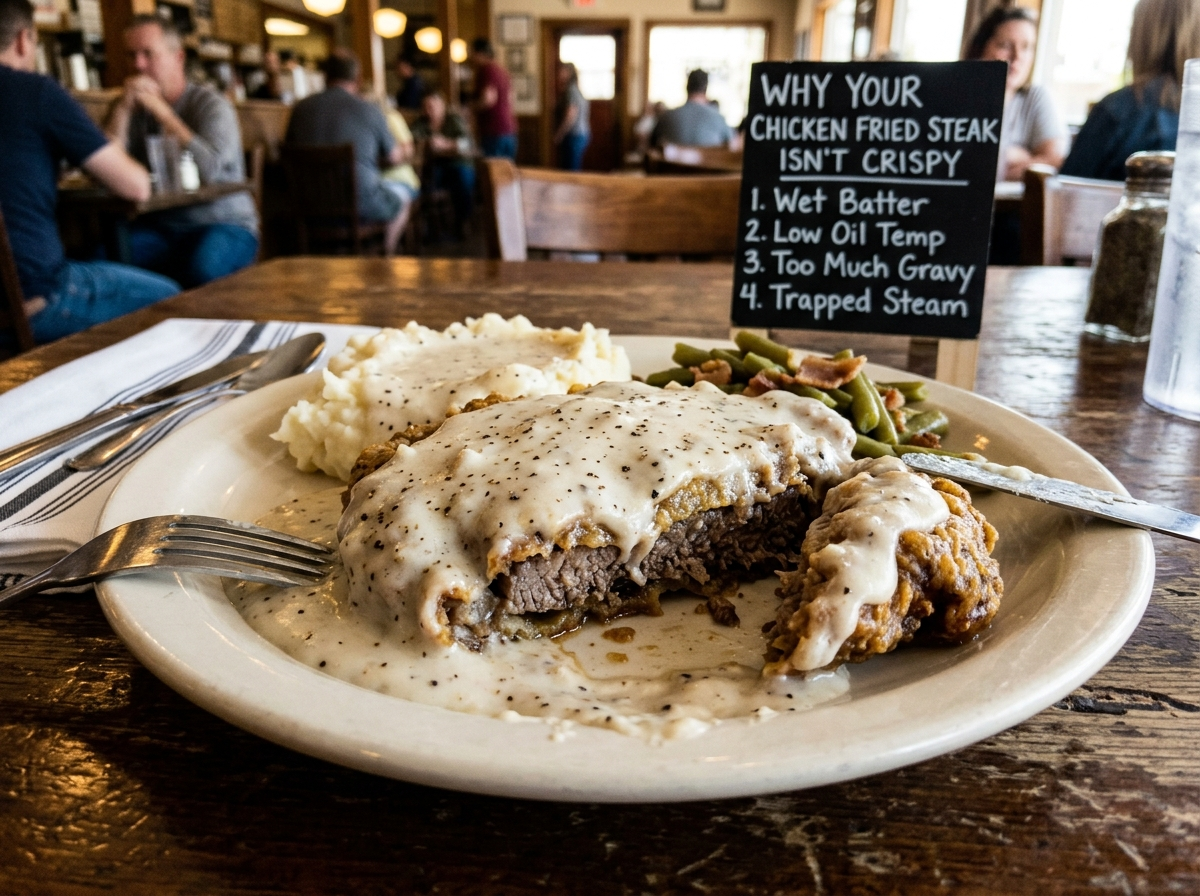
You pull your chicken fried steak from the pan, and instead of a rough, crunchy crust, you get a pale coating that feels soft or greasy. Annoying, right? If your chicken fried steak isn’t crispy, the problem usually comes down to three things: too much moisture, weak breading, or oil that isn’t staying hot enough. The good news is that all three are easy to fix once you know where the crust goes wrong.
What crispy chicken fried steak should actually be like
A good chicken fried steak doesn’t need to shatter like a potato chip. That’s not the goal.
What you want is a crust that feels dry, craggy, and firm, with little ridges and bumps that stay crisp even after a few minutes on the plate. The inside should stay tender, and the coating should cling to the steak instead of sliding off in one sad sheet.
That matters because a lot of home cooks think “crispy” just means dark brown. It doesn’t. You can get a deep color and still end up with a soft crust. Real crispness comes from moisture leaving the coating fast enough while the oil sets the breading in place.
If you want a quick refresher on the dish itself, this guide on what chicken fried steak is helps clear up the basics. And if you’re aiming for a more regional style, it’s worth seeing what makes Texas chicken fried steak different, because texture expectations can shift a little from one version to another.
Why your chicken fried steak isn’t crispy
Surface moisture is working against you
Moisture is the biggest troublemaker here.
Cube steak often comes packed with surface moisture. Buttermilk adds more. Egg wash adds more. Then the steak itself gives off steam as soon as it hits the oil. If your coating starts too wet, that steam gets trapped and turns the crust soft before it has a chance to firm up.
Think of breading like paint on a wall. A dry wall holds paint. A wet wall makes it slide and bubble. Your steak works the same way.
Pat the meat dry before you season it. Not casually dry. Really dry. Paper towels should come away mostly dry when you’re done.
Your breading may not have enough structure
Plain flour can work, but it doesn’t always give you the best crunch on its own.
A better crust usually comes from a flour mix that has a little cornstarch in it. Cornstarch helps the coating fry up lighter and crispier because it cuts down on gluten and creates a more brittle texture. That’s the kind of texture that holds up better under gravy.
You also want enough seasoning in the flour. Bland breading often makes people overcook the steak to chase a “fried” flavor. That extra time can darken the coating without making it crisp.
You skipped the resting step
This one gets ignored all the time.
A lot of people bread the steak and drop it straight into the pan. That can work, but it often leads to patchy coating or soft spots. When you let the breaded steak rest for 10 to 15 minutes, the flour hydrates, the coating sticks better, and the outside fries more evenly.
That short rest is one of the simplest fixes for chicken fried steak that won’t stay crispy.
Your oil temperature is off
Oil that’s too cool makes the coating absorb oil before it crisps. Oil that’s too hot browns the outside too fast and can leave the crust dark but still not properly crunchy.
The sweet spot for most chicken fried steak is around 350°F. A little swing above or below is normal, but you don’t want wild drops after each piece goes in.
This is why restaurants rely on thermometers. Guessing by sight works until it doesn’t.
The same rule shows up in other fried foods too. If you’ve ever wondered why some fried food turns heavy instead of crisp, the logic is similar to what you’ll see in the secret to golden, non-greasy fried chicken.
The pan gets crowded
Every piece of cold steak you add drops the oil temperature.
Crowding also traps steam above the oil, and that steam softens the crust while it cooks. So even if the coating looked fine at first, the pan can sabotage it.
A skillet that looks “big enough” often isn’t. Give each steak room. You want bubbles around the edges, not a packed pan that looks like a traffic jam.
Steam ruins the crust after frying
Here’s the part that frustrates people most: sometimes the steak comes out crisp, then goes soft on the counter.
That’s a steam problem.
If you set fried steak on paper towels, cover it with foil, or stack pieces on top of each other, trapped heat starts softening the crust right away. You worked hard for that texture. Don’t let steam steal it in two minutes.
And yes, gravy can do the same thing. More on that in a minute.
Fix the crust before you fry
Start with the right steak and prep it well
Chicken fried steak is usually made from cube steak, which is already tenderized. That makes it perfect for quick frying, but it also means the surface can be rough and damp.
Pat each piece dry, then season it lightly with salt and pepper. If the steak is unevenly thick, give the thick parts a gentle pound so the whole piece cooks at the same speed. A thin, even steak fries more cleanly and keeps the crust from overbrowning before the meat is done.
Don’t soak it forever in buttermilk. A short dip is enough. Long soaking adds more moisture than you need for this style of breading.
Build a dredge that can actually crisp
A solid coating starts with a simple three-part setup: seasoned flour, a wet mixture, then seasoned flour again.
For the dry mix, plain flour is fine as a base, but adding some cornstarch helps a lot. A good home ratio is about 1 cup flour to 1/4 cup cornstarch. Add salt, black pepper, paprika, and a little garlic powder. Some cooks like a small pinch of cayenne. That works too.
For the wet mix, beaten eggs with buttermilk or milk do the job. You don’t need a thick batter. You want something light enough to coat the steak, not drown it.
Here’s where people go wrong: they keep dipping back and forth until the steak carries a heavy paste. That thick layer looks promising, but it often fries up bready, uneven, or loose. One dry-wet-dry pass is usually enough.
Press the final flour layer onto the steak with your hands. Don’t just toss and shake. Pressing gives the coating the little flaky ridges that turn beautifully crisp in the oil.
Let the coating rest before frying
Set the breaded steaks on a wire rack or tray and leave them alone for 10 to 15 minutes.
That short wait helps the coating hydrate and bond to the surface. You’ll notice the flour goes from dusty to slightly damp-looking. That’s exactly what you want. It means the crust is settling into place instead of floating off in the oil.
Quick fact: the breading should feel attached before frying. If it still looks loose and powdery, it probably won’t hold well.
Fry it the right way
Keep the oil around 350°F
For most home skillets, 350°F is the sweet spot.
At that temperature, the coating starts crisping fast, and the steak cooks through before the crust burns. Use a neutral oil with a reasonably high smoke point, like canola, peanut, or vegetable oil.
Oil choice does matter more than people think. If you want a helpful breakdown of frying oils, take a look at choosing the best oil for homemade French fries. The same smoke point and flavor rules apply here.
No thermometer? You can still fry, but you’ll be guessing. A thermometer makes your results repeatable, and repeatable is what you want.
Use enough oil, but not a deep pool
You don’t need a deep fryer for crisp chicken fried steak.
A heavy skillet with about 1/2 inch of oil usually works well. Cast iron is especially useful because it holds heat better than thin pans. That means less temperature drop when the steak goes in.
If you want more help with skillet frying, this article on how to fry at home without deep frying fits this cooking style really well.
Give the steak room and let the oil recover
Fry in batches if you need to. Two pieces in a pan may be perfect. Four may be too many. The pan decides, not the recipe card.
After each batch, let the oil come back to temperature before you add the next piece. That short wait can be the difference between crisp and greasy.
You’ll hear cooks say, “Don’t crowd the pan,” and it can sound like generic advice. Here, it’s real. Crowding lowers heat, creates steam, and softens the coating from all sides.
Drain on a wire rack, not paper towels
Paper towels pull away some surface oil, but they also trap steam under the crust.
A wire rack set over a sheet pan is better because air can move around the whole piece. That helps the bottom stay crisp instead of turning soggy where it touches the surface.
If you need to hold the steaks for a few minutes, put the rack in a 200°F oven. Don’t cover them.
Why your crust gets soggy after frying
Gravy too early is a texture killer
Chicken fried steak and cream gravy belong together. No argument there.
But if you pour hot gravy over the whole steak the second it leaves the pan, the crust starts softening right away. A crisp crust can handle some gravy, but only for so long.
The easy fix is to serve the gravy on the side, or spoon it over just before eating. If you love that classic look with gravy on top, keep the layer light and leave some crust exposed.
Covering hot fried food traps steam
A loose tent of foil seems harmless. It isn’t.
Hot food gives off steam. Once that steam gets trapped, it lands right back on the crust and softens it. Same problem if you stack fried steaks on a plate.
Let the crust breathe. That’s the whole game after frying.
Holding too long will always cost you something
Even perfect fried food loses some crispness over time. That’s normal.
You can slow it down with a rack and a warm oven, but you can’t keep fried crust at its peak forever. So if you’re cooking for a group, plan the timing. Make the gravy first. Set the table. Fry the steak close to serving time.
That’s one reason restaurant fried foods hit different. They move from fryer to plate fast.
A simple method that works every time
Step 1: Dry, season, and bread the steak
Pat your cube steak very dry. Season both sides lightly.
Set up three shallow dishes. In the first, mix flour, cornstarch, salt, pepper, paprika, and garlic powder. In the second, whisk egg with buttermilk. In the third, add more of the flour mixture.
Coat the steak in the first flour dish, then the wet mixture, then the final flour. Press that last layer on well so you build craggy bits. Set the breaded steak on a rack and let it rest for 10 to 15 minutes.
If you enjoy this kind of breaded cutlet texture, you’ll notice some of the same crisping rules in a fried pork tenderloin sandwich, even though the meat is different.
Step 2: Fry in steady heat
Heat about 1/2 inch of neutral oil in a heavy skillet to 350°F.
Lay the steak in gently, away from you, so the oil doesn’t splash. Fry until the bottom turns deep golden, then flip and finish the other side. Because cube steak is thin, it usually cooks pretty quickly. The coating should look golden brown and feel firm.
Food-safety note: cube steak is often mechanically tenderized beef. Cook it thoroughly and follow current USDA guidance for beef handling and safe temperatures. Hot oil can also cause serious burns, so use long tongs and don’t leave the pan unattended.
Step 3: Rest on a rack and add gravy last
Move the fried steak to a wire rack, not a flat plate lined with paper towels. Give it a minute or two to settle.
Then serve with gravy on the side or spooned on at the table. You’ll keep more crunch that way.
Want to test your crust? Tap the edge lightly with a fork. It should sound a little hollow and feel firm, not soft or damp.
Trouble signs and quick fixes
Pale, soft, and limp
Your oil was likely too cool, or the coating went in too wet.
Next time, dry the steak better, rest the breading before frying, and watch the oil temperature more closely.
Dark brown but still not crisp
That usually means the outside browned before enough moisture cooked off.
The oil may have been too hot, or the breading may have been too thick. Use a lighter wet mix, avoid piling on extra flour paste, and stay near 350°F instead of pushing much higher.
Crust falls off in sheets
The steak was probably too wet, or you skipped the resting step. Rough handling during flipping can also pull the crust off.
Press the coating on well, let it rest, and use tongs gently. A fish spatula or thin turner can help support the steak from underneath.
Greasy texture
Greasy fried steak almost always points to low oil temperature or overcrowding.
The coating soaked up oil instead of crisping quickly. Give the pan fewer pieces, let the oil recover, and drain on a rack.
Crispy at first, soggy after five minutes
That’s steam or early gravy.
Keep the steaks uncovered, off paper towels, and away from heavy sauce until serving.
4. FAQ Section
Why isn’t my chicken fried steak crispy even though it looks brown?
Brown color and crisp texture are not the same thing. Your coating can brown fast if the oil is too hot, but still stay soft if too much moisture is trapped inside. A crisp crust needs dry meat, a good flour coating, a short resting time before frying, and oil around 350°F.
What temperature should I fry chicken fried steak?
Aim for 350°F. That temperature helps the coating crisp without burning before the steak cooks through. If the oil drops much lower, the breading can turn greasy. If it climbs too high, the outside may get dark before the crust fully dries out.
Why does the breading fall off my chicken fried steak?
Breading usually falls off because the steak is too wet, the flour wasn’t pressed on, or the coated steak went straight into the oil without resting. Start with dry meat, use a dry-wet-dry breading method, press on the final flour layer, and let it sit for 10 to 15 minutes before frying.
Can I make crispy chicken fried steak without a deep fryer?
Yes. A heavy skillet works very well. Use about 1/2 inch of oil, keep the temperature steady, and avoid crowding the pan. In fact, many home cooks get better results in cast iron than in a small countertop fryer because the wide surface makes flipping and draining easier.
Does gravy always make chicken fried steak soggy?
Not always, but it will soften the crust over time. If you want the best texture, serve gravy on the side or spoon it on right before eating. A light layer keeps more crunch than covering the whole steak early.
5. Conclusion
If your chicken fried steak isn’t crispy, don’t blame the whole recipe yet. Most of the time, the fix is simple: dry the steak better, build a stronger coating, let it rest, and fry at a steady 350°F. Then keep steam and gravy from sitting on the crust too soon.
Try those four changes on your next batch, and you’ll notice the difference fast. That golden crunch you’re after usually isn’t about fancy tricks. It’s about timing, heat, and a little patience.