
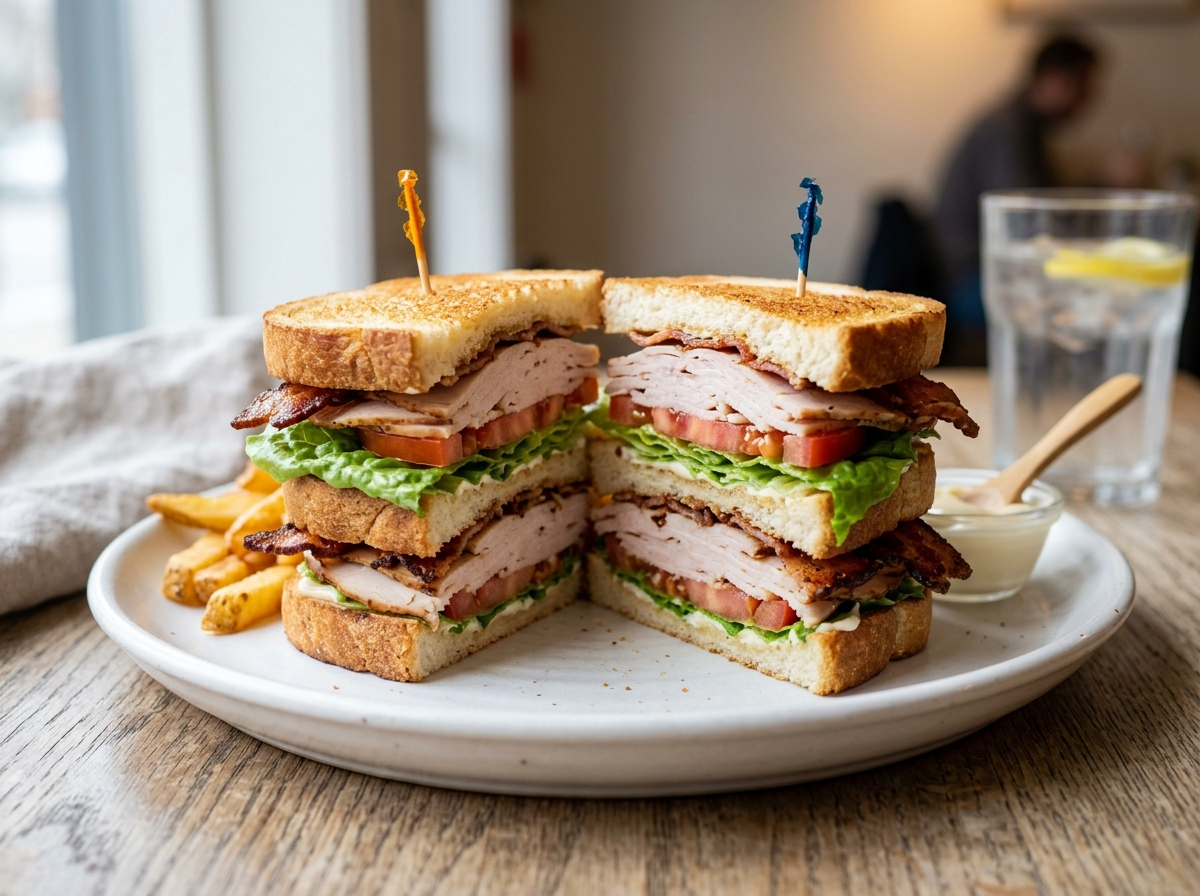
Most homemade turkey clubs end up as a sliding mess. The bacon falls out the side, the tomato soaks through the bread, and you’re left eating a pile of ingredients with a fork. The fix isn’t some secret technique — it’s about layering order, toast level, and a couple of small choices that most recipes skip over entirely. This turkey club sandwich recipe walks you through every step so your sandwich actually stays together and tastes like something you’d order at a good diner. Here’s exactly how to build one.
What Makes a Turkey Club a “Club” Anyway?
A turkey club is a triple-decker sandwich — three slices of toasted bread, two layers of filling, cut into quarters, and held together with toothpicks or frilly sandwich picks. That structure is what separates it from a regular turkey sandwich. If you’re stacking turkey on two slices of bread, you’ve made a turkey sandwich. A perfectly fine one, but not a club.
The classic club sandwich has been around since the late 1800s. Food historians generally trace it to upscale clubhouses and resort dining rooms on the East Coast, where it showed up on menus as a “clubhouse sandwich.” The name eventually shortened to “club,” and the recipe standardized around turkey (or chicken), bacon, lettuce, tomato, and mayonnaise on toasted white bread.
The triple-decker format isn’t just for looks. That middle slice of bread gives the sandwich structural support and creates two distinct layers of filling, which means you get a better ratio of ingredients in every bite. It also makes the sandwich tall enough to justify those dramatic toothpick skewers.
If you want to dig deeper into the broader club sandwich family beyond just the turkey version, this guide to the classic club sandwich breaks down the full history and variations.
Turkey Club Sandwich Ingredients (and Why Each One Matters)
A classic turkey club doesn’t have a long ingredient list. But because there are so few components, each one carries a lot of weight. Here’s what you need and what to look for.
The Bread
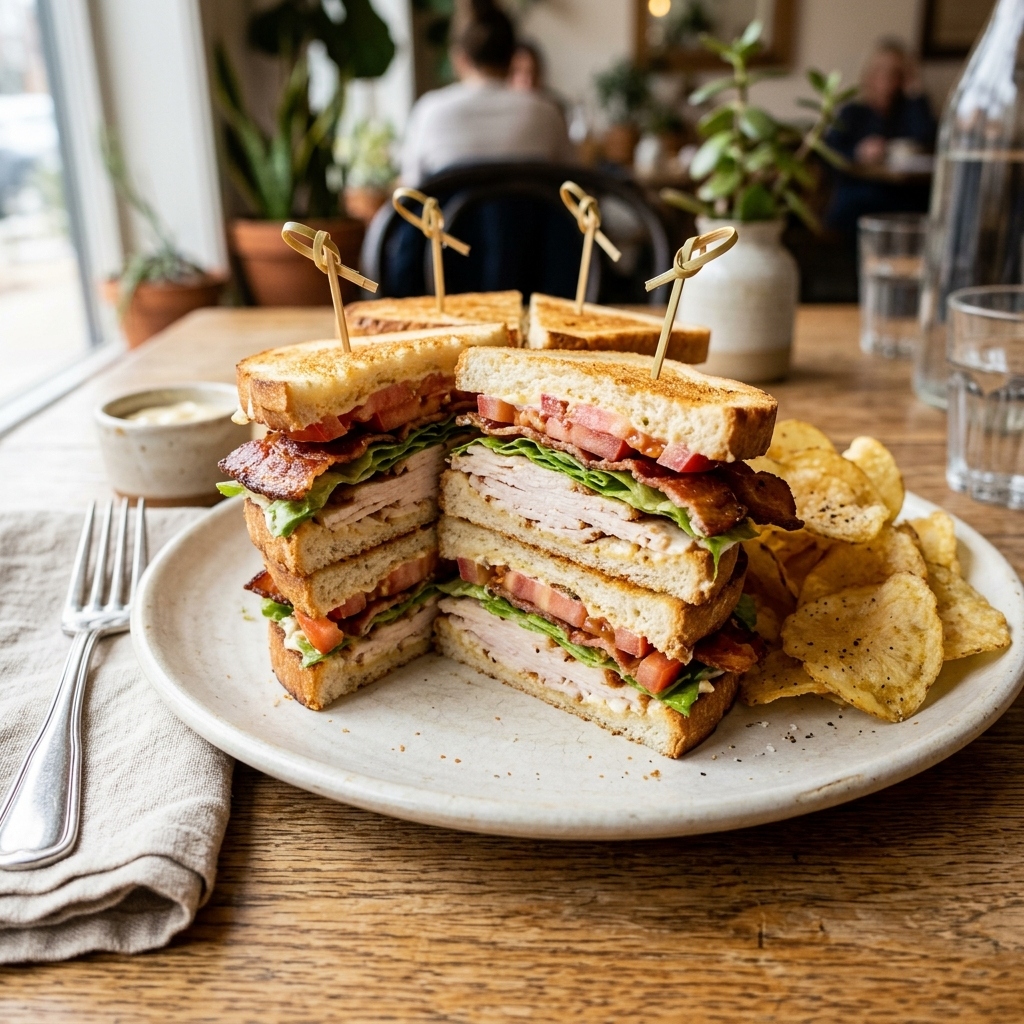
You want three slices of white sandwich bread — the soft, square, grocery-store kind. Sourdough, wheat, and rye all taste great in other sandwiches, but the traditional turkey club uses white bread because it toasts up crisp on the outside while staying soft enough inside that it doesn’t fight the fillings. Thick-cut Texas toast is too heavy and throws off the ratio. Thin sandwich bread works best.
The Turkey
You have two solid options here. Deli-sliced roasted turkey breast is the easiest and what most people use at home. Get it sliced medium-thin — not shaved paper-thin like you’d want for an Italian sub, and not thick-carved like a Thanksgiving leftover. Medium-thin slices fold and layer better without creating bulky spots.
The other option is leftover roasted turkey from a whole bird, sliced thin against the grain. This gives you deeper flavor and better texture, but it’s obviously only practical when you actually have a roasted turkey on hand.
Food safety note: Deli turkey is a perishable product that can harbor Listeria if stored too long or at improper temperatures. The USDA recommends consuming opened deli meats within 3 to 5 days and keeping your refrigerator at or below 40°F. If your turkey smells off, feels slimy, or has been sitting in the fridge for a week, toss it. This is general food safety information and not a substitute for professional medical or dietary advice.
For more detail on how long your deli meats actually last once you bring them home, check out this breakdown of deli meat fridge life.
The Bacon
Use standard-cut bacon, not thick-cut. Thick-cut bacon is delicious on a burger, but in a club sandwich it creates rigid planks that push the layers apart and make the whole thing harder to bite through. Cook it until it’s crispy but not shattered — you want it to snap when you bend it, not crumble into bits.
The Lettuce and Tomato
Iceberg lettuce is the right call here. It’s crisp, it’s mild, and it doesn’t wilt the second it touches warm bacon or mayo the way delicate greens do. Use the inner leaves, which are crunchier and less bruised.
For the tomato, grab a ripe beefsteak or vine-ripened tomato and slice it about a quarter-inch thick. Here’s the part most people get wrong: pat those tomato slices dry with a paper towel before they go on the sandwich. Wet tomato is the number one reason a turkey club turns soggy within minutes.
The Mayo
Use real, full-fat mayonnaise. This isn’t the place for light mayo or Miracle Whip. You’re going to spread it on all three slices of bread, and it serves a functional purpose beyond flavor — the fat in the mayo creates a moisture barrier between the bread and the wet ingredients. This is one of the simplest ways to prevent a soggy sandwich when you’re working with tomatoes and fresh lettuce.
How to Make a Turkey Club Sandwich Step by Step
Now that you’ve got your ingredients sorted, here’s the actual process. The order matters more than you’d think.
Step 1: Prep Everything Before You Toast
Lay out your components on a cutting board before you start toasting bread. Once the toast is done, you want to assemble quickly so the bread stays warm and crisp.
Cook your bacon first and let it drain on paper towels. Slice your tomato and pat the slices dry. Tear or cut your lettuce into pieces that roughly match the size of the bread — you don’t want leaves hanging out the sides, because they’ll wilt and make the sandwich harder to handle. Fold your turkey slices in half or into loose ribbons rather than laying them flat. Folded turkey creates air pockets and volume, which gives the sandwich a better mouthfeel.
Step 2: Toast All Three Slices
Toast your bread until it’s golden brown and firm but not dark or brittle. You want a sturdy crunch that holds up to the fillings, not a crouton. A toaster works fine, but if you’re making multiple clubs, you can toast the bread on a sheet pan under the broiler for a couple of minutes per side. If you want more control over the toast level, this guide to toasting sandwich bread in the oven covers the best method.
Step 3: Spread Mayo on Every Slice
Take all three slices of toast and spread a thin, even layer of mayonnaise on one side of each slice. Yes, all three. The bottom slice gets mayo on the top face. The middle slice gets mayo on both sides. The top slice gets mayo on the bottom face. This coats every bread surface that will touch a filling, which is your best defense against sogginess.
Step 4: Build the Bottom Layer
Place your first slice of toast mayo-side up on the cutting board. Layer on the turkey first — about 3 to 4 ounces, folded into loose ribbons. On top of the turkey, add two or three strips of bacon. Then add a leaf of iceberg lettuce.
Here’s a detail that matters: the lettuce goes on top of the bacon, not directly on the bread. The bacon acts as a buffer between the moist lettuce and the mayo-coated bread. It’s a small thing, but it helps keep the bottom slice crisp longer.
Step 5: Add the Middle Slice and Build the Second Layer
Place your second slice of toast on top of the lettuce, mayo-side down on the lettuce and mayo-side up facing you. Now build the second layer: tomato slices first (remember, patted dry), then another round of turkey, then another leaf of lettuce.
The tomato goes directly on the mayo-coated middle slice because the mayo barrier protects the bread from the tomato’s moisture. Putting tomato against bare toast is a guaranteed soggy mess.
Step 6: Cap It and Secure
Place the third slice of toast on top, mayo-side down. Press down gently with your palm — just enough to compress the sandwich slightly so it holds together, not enough to squeeze out the fillings.
Now insert four toothpicks or sandwich picks, one in each quadrant of the sandwich, about an inch from the edges. Push them straight down through all three layers. This is non-negotiable if you want to cut the sandwich without everything sliding sideways.
Step 7: Cut Into Quarters
Using a sharp serrated knife, cut the sandwich in half diagonally, then cut each half diagonally again to create four triangles. The serrated blade is important — a straight-edge knife will compress and crush the layers instead of slicing through them cleanly.
Serve immediately with a pickle spear and some chips, because that’s the law.
The Layering Order That Actually Works
If you skimmed the steps above, here’s the quick-reference layering order from bottom to top. Getting this right is the single biggest factor in whether your turkey club holds together or collapses:
- Toast (mayo side up)
- Turkey, folded
- Bacon
- Lettuce
- Toast (mayo on both sides)
- Tomato (patted dry)
- Turkey, folded
- Lettuce
- Toast (mayo side down)
The logic is simple: wet ingredients always touch mayo-coated bread, never bare bread. And the lettuce acts as a buffer between the bacon and the tomato so they don’t directly exchange moisture. The middle slice of bread is the structural spine of the whole sandwich — it bears the most stress, which is why it gets mayo on both sides.
Mistakes That Ruin a Turkey Club
Even with the right ingredients, a few common errors can wreck the whole thing.
Using warm bacon. If you cook the bacon and immediately throw it on the sandwich, the residual heat will wilt the lettuce and soften the toast within minutes. Let the bacon cool for at least two to three minutes on a paper towel before assembling.
Overloading the turkey. More turkey sounds better in theory, but in a triple-decker sandwich, too much meat creates a thick, unstable middle that makes the sandwich lean and slide. Stick to about 3 to 4 ounces per layer.
Skipping the toothpicks. I know they’re annoying to pull out before you eat. But if you try to cut a triple-decker sandwich without them, the layers will shift and you’ll end up with four uneven, messy wedges instead of clean triangles.
Using the wrong knife. A dull chef’s knife will mash the sandwich flat. A serrated bread knife or a sharp serrated utility knife saws through the layers cleanly without compressing them.
If you’re building other types of stacked sandwiches and want a more general framework for layering, this guide to building the perfect deli sandwich covers the principles that apply across the board.
Turkey Club Variations Worth Trying
The classic turkey club is hard to beat, but once you’ve nailed the basic technique, a few tweaks can keep things interesting.
The Avocado Club. Swap the mayo for mashed avocado on the bread, or add sliced avocado to the second layer. The fat in the avocado serves the same moisture-barrier function as mayo, and the flavor pairs perfectly with turkey and bacon.
The Spicy Turkey Club. Add sliced jalapeños or a smear of chipotle mayo to the middle layer. This works especially well if you’re using a peppered turkey breast from the deli counter.
The Open-Face Club. If the triple-decker format feels like overkill for a Tuesday lunch, use two slices of toast and build a single-layer version with all the same ingredients. It’s technically not a club anymore, but it tastes just as good and is much easier to eat at your desk.
The Breakfast Club. Swap the turkey for a fried egg and use a croissant instead of white bread. Keep the bacon, lettuce, tomato, and mayo. It sounds unconventional, but it works surprisingly well for a weekend brunch.
Frequently Asked Questions
Can I make a turkey club ahead of time?
You can, but it won’t be as good. The toast will soften and the lettuce will wilt if the sandwich sits for more than an hour or two. If you need to prep ahead, toast the bread and cook the bacon in advance, then store them separately. Assemble the sandwich right before you plan to eat it. If you’re packing it for a lunch that’s a few hours away, wrap it tightly in parchment paper and keep it in a cooler — but accept that the toast will lose some of its crunch.
Do I have to use white bread?
No, but it’s the traditional choice for a reason. White sandwich bread toasts evenly, has a neutral flavor that lets the turkey and bacon shine, and has the right softness-to-structure ratio for a triple-decker build. If you prefer sourdough or whole wheat, go for it — just make sure the slices aren’t too thick or too dense, or the sandwich will be hard to bite through.
What’s the difference between a turkey club and a BLT?
A classic BLT is a two-slice sandwich with bacon, lettuce, and tomato. A turkey club is a triple-decker that adds turkey and uses three slices of bread. Think of the turkey club as a BLT that went to finishing school and came back with an extra layer of protein and an extra slice of toast. The flavor profiles overlap a lot, but the structure and the eating experience are quite different.
Can I use turkey bacon instead of regular bacon?
You can, but the texture and flavor will be noticeably different. Turkey bacon is leaner and tends to be chewier rather than crispy, which means it won’t provide the same structural crunch or smoky saltiness that pork bacon brings to the sandwich. If you’re avoiding pork for dietary reasons, turkey bacon works in a pinch — just cook it a little longer to get it as crisp as possible.
Your next move is simple: grab the ingredients, toast the bread, and build your first proper turkey club this week. Once you get the layering order down, you’ll wonder why you ever settled for a sad, sliding sandwich. And if you end up with leftover deli turkey after you’re done, make sure you know how to store that leftover sandwich meat properly so nothing goes to waste.