
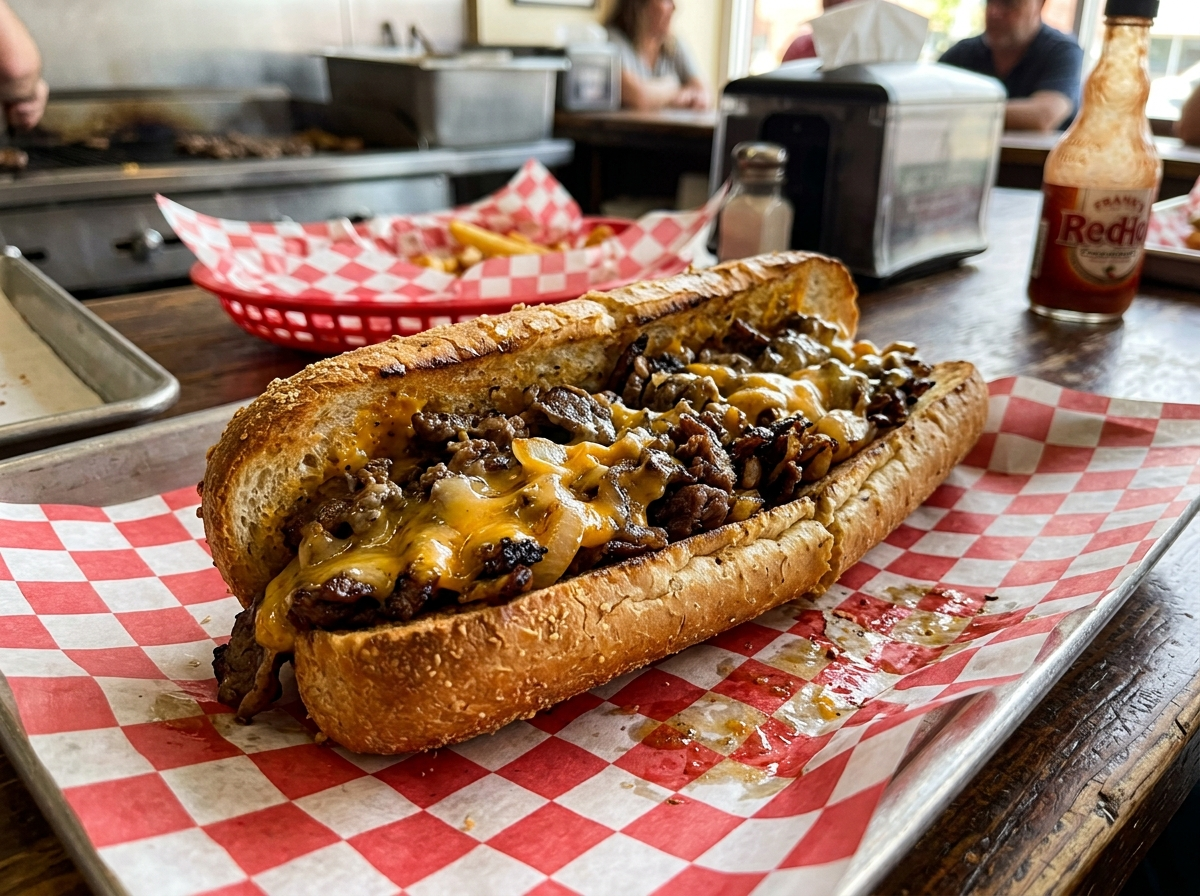
You’ve probably eaten something called a Philly cheesesteak at a food court or a chain restaurant. Thin meat, some melted cheese, a soft roll. Maybe it was fine. Maybe it was forgettable. But if you’ve never had one from a proper shop in South Philadelphia — the kind where the grill hisses and the line wraps around the corner — you haven’t really had the real thing yet.
So what exactly makes a cheesesteak a Philly cheesesteak? And how did a simple steak sandwich from a hot dog cart turn into one of America’s most iconic foods? Let’s break it all down.
What Is a Philly Cheesesteak?
A Philly cheesesteak is a hot sandwich made from thinly sliced ribeye steak, melted cheese, and (usually) grilled onions, all stuffed into a long, soft Italian-style roll. That’s it. No lettuce. No tomato. No mayo. No ketchup. The beauty of this sandwich lives in its simplicity.
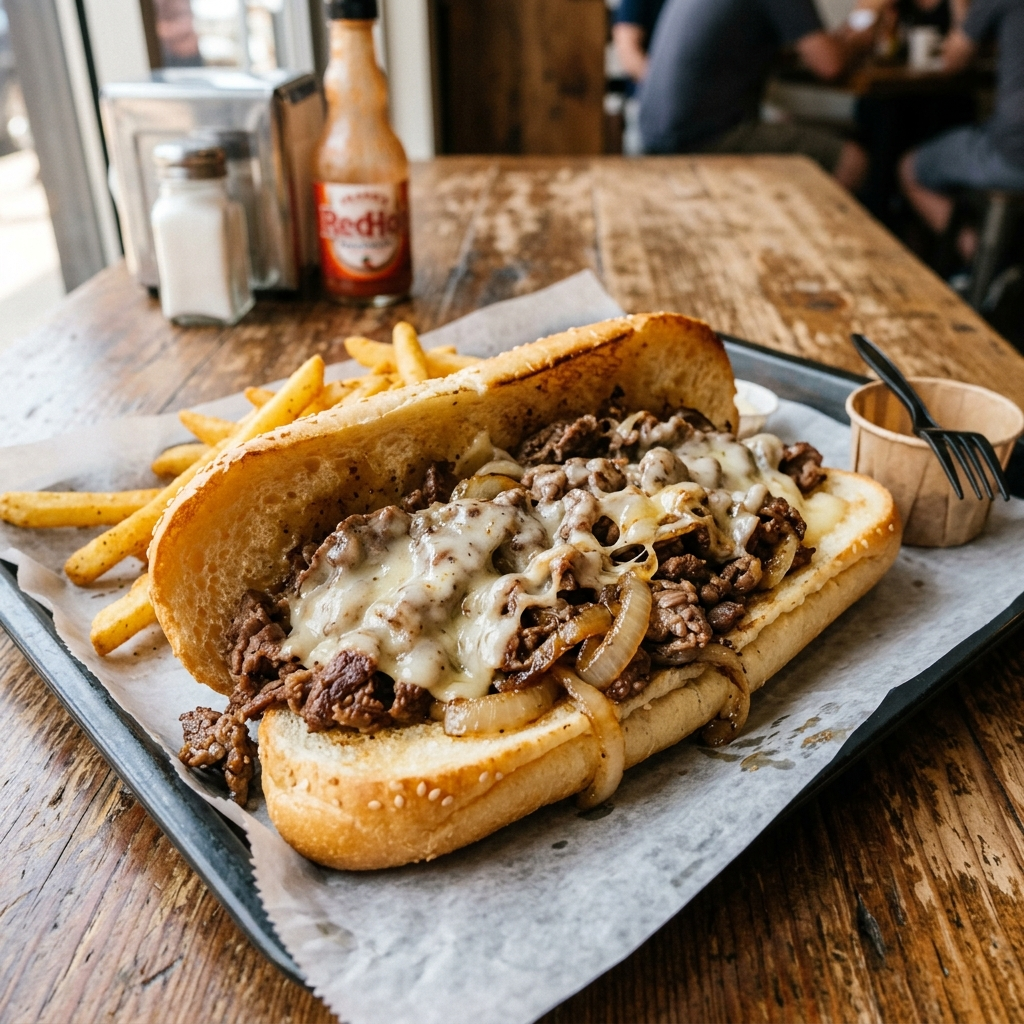
The magic is in the details, though. Every single component matters, and swapping one out changes the whole experience.
The Meat
Real cheesesteak meat is ribeye. Not sirloin, not round steak, not shaved beef from a frozen bag (though plenty of places cut corners this way). Ribeye has the right balance of fat and tenderness to stay juicy when you cook it fast on a flat-top griddle.
The steak gets sliced paper-thin — we’re talking almost translucent — and then chopped up on the griddle with a spatula as it cooks. This gives you those crispy, caramelized edges mixed with tender, fatty bits. That texture contrast is the whole point. You can read more about choosing the right cheesesteak meat cut if you want to nail this at home.
Some shops use top round or chuck to save money. It works, but it won’t give you the same richness. The fat in ribeye melts into the roll and the cheese, and that’s what makes the sandwich taste like it’s greater than the sum of its parts.
The Cheese
Here’s where things get heated — literally and figuratively.
You’ve got three main options in Philadelphia:
| Cheese | Flavor Profile | Texture When Melted | Who Swears By It |
|---|---|---|---|
| Cheez Whiz | Salty, creamy, bold | Gooey, almost liquid | Old-school traditionalists |
| Provolone | Mild, slightly sharp | Smooth, stretchy | People who want “real” cheese |
| American | Mild, buttery | Creamy, even melt | The quiet majority |
Cheez Whiz is the most famous choice, and it’s the one tourists expect. But plenty of locals actually prefer provolone or American. There’s no single “correct” answer, despite what people on the internet will tell you. The best cheesesteak cheese is the one you enjoy most, and you can explore the full breakdown of the best cheesesteak cheese options to decide for yourself.
One thing worth noting: Cheez Whiz wasn’t even invented until 1952, so the earliest cheesesteaks didn’t have it. More on that in a minute.
The Roll
The roll is the unsung hero of this sandwich. You need a long, soft Italian-style roll with a slightly crisp exterior and a pillowy interior that can soak up grease without falling apart. In Philadelphia, the gold standard is the Amoroso roll, baked locally since 1904. It’s sturdy enough to hold a pile of hot steak and melted cheese but soft enough that you don’t need strong jaws to bite through it.
A soggy roll ruins everything. A crusty baguette shreds the roof of your mouth. The roll has to be just right. If you’re curious about how the right bread changes a sandwich, the guide to best cheesesteak bread covers what to look for.
The Toppings (Keep It Simple)
Grilled onions are the standard add-on. That’s “wit” in Philly ordering lingo. No onions is “witout.” Some places offer hot peppers, sweet peppers, or mushrooms, but purists will tell you those are extras, not essentials.
You won’t find lettuce, tomato, pickles, or any kind of sauce on a traditional cheesesteak. The steak, cheese, and roll do all the heavy lifting. Adding more just gets in the way.
The Origin of the Cheesesteak
The philly cheesesteak history goes back to the early 1930s in South Philadelphia, and like most great food stories, it started almost by accident.
Pat and Harry Olivieri
Pat and Harry Olivieri were brothers running a hot dog stand near the 9th Street Italian Market in South Philly. The story, as told by the family and repeated in countless food histories, goes like this:
Sometime around 1930, Pat got tired of eating hot dogs for lunch every day. He grabbed some thinly sliced beef from a nearby butcher, threw it on the griddle with onions, and stuffed it into an Italian roll. A cab driver pulled up, smelled the steak, and asked if he could get one too. Pat made him one. The driver supposedly told Pat he should forget about hot dogs and start selling steak sandwiches instead.
Pat took the advice. He opened Pat’s King of Steaks at the corner of 9th Street and Passyunk Avenue, and the steak sandwich became his entire business. Notice the name — it was a steak sandwich at this point. No cheese yet.
The location is still open today, nearly a century later, which tells you something about how good the idea was.
How Cheese Got Added
The original Olivieri sandwich was just steak, onions, and bread. Cheese came later, and the exact timeline is a little fuzzy depending on who you ask.
The most widely accepted version is that provolone was added sometime in the 1940s, reportedly by a manager at Pat’s named Joe Lorenzo. This makes sense chronologically — provolone was already a staple in South Philly’s Italian-American community, so putting it on a hot steak sandwich was a natural move.
Cheez Whiz entered the picture after Kraft introduced it in 1952. Its creamy, shelf-stable convenience made it a hit at sandwich shops across the city, and it eventually became the most iconic (and most debated) cheesesteak topping.
So the “original” cheesesteak didn’t actually have cheese at all. It evolved over a couple of decades into the version we recognize now.
The Pat’s vs. Geno’s Rivalry
You can’t talk about the origin of the cheesesteak without mentioning the most famous rivalry in sandwich history. In 1966, Joe Vento opened Geno’s Steaks directly across the intersection from Pat’s. The two shops have been competing for customers — and arguing about who makes the better sandwich — ever since.
Pat’s chops its meat finer. Geno’s lays the slices out flatter. Pat’s uses a seeded roll. Geno’s goes with a smoother one. Both are open 24 hours a day. Both have lines out the door at midnight on a Saturday.
Which one is better? That’s a question Philadelphians will argue about until the end of time, and honestly, the best move is to try both and decide for yourself. The rivalry is more about neighborhood pride than any dramatic difference in quality.
Philly Cheesesteak Facts You Might Not Know
Here are a few philly cheesesteak facts that don’t always make it into the standard history retellings:
The sandwich was originally called a “steak sandwich” or just a “cheese steak” (two words). The single-word “cheesesteak” became standard much later, and you’ll still see both spellings on menus around Philadelphia.
Philadelphia consumes an estimated amount of ribeye that would make any cattle rancher smile. While exact city-wide numbers are hard to pin down, the major cheesesteak shops alone go through thousands of pounds of beef every week.
The cheesesteak isn’t technically a hoagie, even though it uses a similar roll. If you want to understand the difference, the breakdown of what is a hoagie explains how Philly’s other famous sandwich compares. A hoagie is a cold deli sandwich. A cheesesteak is hot, griddled, and assembled to order.
Cheesesteaks have gone national (and global), but most versions outside Philadelphia miss the mark because they use the wrong bread or pre-sliced frozen meat. The roll and the fresh-cut ribeye are the two things that are hardest to replicate far from South Philly.
The 9th Street Italian Market, where the whole thing started, is one of the oldest continuously operating outdoor markets in the United States. It’s been running since the late 1800s and is still a working market, not a tourist trap.
How to Order One Like a Local
Walking up to a cheesesteak counter in Philadelphia can feel intimidating if you don’t know the system. The line moves fast, the person behind the counter is shouting, and there’s no time to stare at a menu.
Here’s the simple formula: cheese choice + “wit” or “witout.”
That’s your entire order. For example:
- “Whiz wit” = Cheez Whiz with grilled onions
- “Provolone witout” = provolone cheese, no onions
- “American wit” = American cheese with onions
You say it when you reach the front of the line. Don’t ask questions. Don’t say “um.” Don’t ask for ketchup. The person behind the counter will appreciate your efficiency, and you’ll get your sandwich faster.
Pro Tip: Have your cash ready before you reach the window. Most of the famous spots are cash-only or prefer it, and fumbling for your wallet holds up the line behind you.
If you’re visiting both Pat’s and Geno’s (and you should), order the same combination at each so you can actually compare them fairly. Switching from Whiz at one to provolone at the other makes the comparison meaningless.
Making a Cheesesteak at Home
You don’t need to book a flight to Philadelphia to eat a decent cheesesteak. You can make a solid version in your own kitchen with a few key moves.
Start with a good ribeye. Freeze it for about 30 to 45 minutes so it firms up, then slice it as thin as your knife skills allow. The thinner the slices, the faster they cook and the better the texture. If you want a guide on technique, learning how to slice meat thin properly makes a huge difference here.
Use a cast-iron skillet or a flat-top griddle if you have one. Get it ripping hot before the meat goes on. You want a fast sear, not a slow braise. Spread the slices out, let them get some color, then chop them up with your spatula right on the cooking surface.
Melt your cheese of choice directly on top of the meat in the last 30 seconds of cooking. Toast your roll on the griddle for a few seconds to give it some structure. Pile the cheesy steak into the roll, add your onions if you want them, and eat it immediately.
Leftovers don’t reheat perfectly — the roll gets soggy and the cheese separates — but if you end up with extras, there are ways to reheat a cheesesteak that minimize the damage.
Frequently Asked Questions
What is a real Philly cheesesteak made of?
A real Philly cheesesteak is made of thinly sliced ribeye steak, melted cheese (Cheez Whiz, provolone, or American), and optionally grilled onions, all served on a soft, long Italian-style roll. That’s the full ingredient list. Anything beyond that — peppers, mushrooms, pizza sauce — is a variation, not the classic.
Who invented the Philly cheesesteak?
Pat and Harry Olivieri are credited with inventing the steak sandwich in the early 1930s at their hot dog stand in South Philadelphia. The cheese was added later, in the 1940s, transforming it into the cheesesteak we know today. Pat’s King of Steaks, their original shop, still operates at the same intersection.
What’s the difference between a cheesesteak and a steak and cheese?
A “steak and cheese” is the generic term used outside Philadelphia for any sandwich with steak and melted cheese, often made with shaved beef, peppers, and whatever bread is available. A Philly cheesesteak specifically uses ribeye, a proper Italian roll, and follows the traditional preparation method. The difference is mostly in the quality of ingredients and the technique.
The Philly cheesesteak didn’t start as some carefully engineered recipe. It started because a hot dog vendor got bored with his own lunch and a cab driver had a good nose. Almost a hundred years later, that happy accident is still one of the best sandwiches you can eat in America.
If you’ve been making do with food-court versions, do yourself a favor: grab some ribeye, find the softest roll you can, and try making one at home this weekend. Once you taste the real thing, the imitations stop being satisfying. And if you ever find yourself in South Philly at 1 a.m. with a craving and a few dollars in your pocket, you’ll know exactly what to say when you reach the front of the line.