
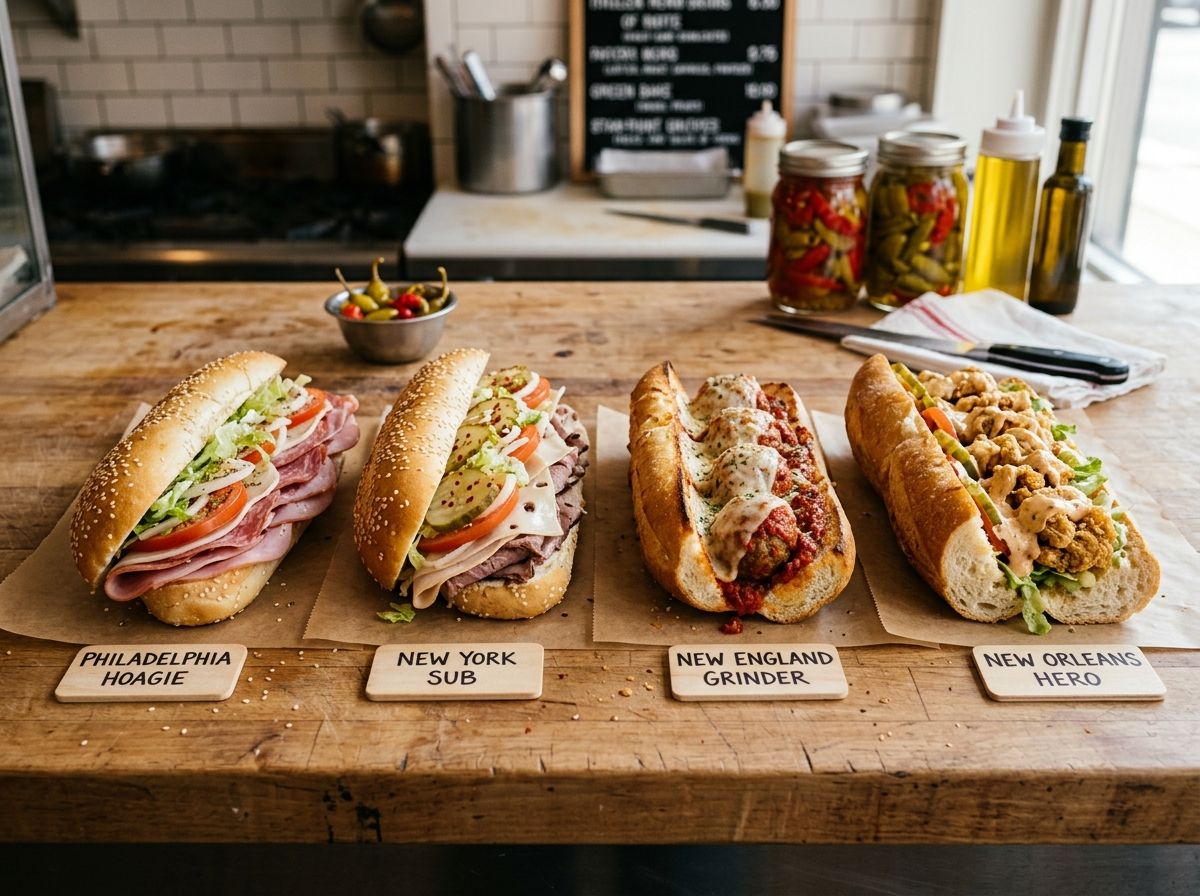
You’re at a deli in a new city and the menu says “grinder.” Your Philly friend insists it’s a hoagie. Your New York buddy calls it a hero. Who’s right? You all are. These names mostly describe the same long, loaded sandwich on a crusty roll. But the story behind each name — and the subtle differences in how they’re built — is more interesting than you’d think.
The Short Answer: Same Sandwich, Different Names
A hoagie, sub, grinder, and hero are all long sandwiches made on an oblong roll, stuffed with deli meats, cheeses, vegetables, and condiments. The biggest difference between them isn’t the ingredients — it’s geography. Where you grew up almost certainly determines which word you use.
That said, there are small but real differences in bread style, typical fillings, and whether the sandwich gets toasted. The name on the menu tells you a lot about the city you’re standing in and the traditions that shaped its delis. Let’s break down each name so you know exactly what you’re ordering no matter where you are.
What Is a Hoagie?
If you’re in Philadelphia or anywhere in southeastern Pennsylvania, you order a hoagie. Period. Call it a sub in front of a Philly local and you’ll get a look that could melt provolone.
The hoagie is the city’s signature sandwich, and locals take it seriously. A classic Italian hoagie is loaded with capicola, salami, ham, and provolone, then dressed with shredded lettuce, sliced tomato, onion, oregano, and a splash of oil and vinegar. If you want to see the gold standard, check out how a traditional Italian hoagie is supposed to be built.
Where the Name Comes From
The most popular origin story traces back to World War I. Italian immigrants working at the Hog Island shipyard in Philadelphia supposedly brought large sandwiches for lunch, and coworkers started calling them “hoggies.” Over time, the pronunciation shifted to “hoagie.”
Food historians have debated this origin, and some point to earlier references involving Italian street vendors known as “hokey-pokey men” who sold similar sandwiches from pushcarts. The exact truth is a little murky, but the Hog Island story is the one Philadelphians tell, and they’re sticking with it. The term was well established in local usage by the 1940s, and it has only grown more entrenched since.
How It’s Built
The bread matters a lot here. A proper hoagie roll has a crisp outer crust and a soft, airy interior — sturdy enough to hold a mountain of meat without falling apart but soft enough that you don’t need a jaw workout. The roll is typically split lengthwise with a hinge left intact, so the fillings stay cradled inside. If you want a deeper look at the roll itself, this breakdown of what makes a hoagie a hoagie covers the details.
The layering order also matters to hoagie purists. Meats go down first, then cheese, then the vegetables, and the oil and vinegar get drizzled on top so everything gets seasoned. It’s a small detail, but it’s the kind of thing that separates a great hoagie from a soggy mess.
What Is a Sub?
“Sub” is the most widely recognized name across the United States. You’ll hear it from coast to coast, and it’s the default term for most national sandwich chains. If someone says “let’s grab a sub,” nobody asks for clarification.
The word is short for submarine sandwich, and the name is pretty literal. The long, rounded roll looks like a submarine when it’s stuffed and sealed. According to Merriam-Webster, the term “submarine sandwich” has been in documented use since at least the 1950s, though some food historians trace regional usage back to the 1920s and 1930s in Connecticut and New Jersey.
The Submarine Connection
Several cities claim to have invented the sub, including New London, Connecticut, and Paterson, New Jersey. The competing origin stories are a little like arguing over who invented the hamburger — everyone wants the credit. What we know for sure is that the name caught on because it’s descriptive and easy to say. “Sub” rolls off the tongue faster than “submarine sandwich,” and by the mid-20th century, it had become the go-to term for most of the country.
A sub tends to be the most flexible of the four names. You’ll find cold cut subs, meatball subs, chicken parm subs, and even breakfast subs. The bread is usually a soft Italian-style roll, though the exact texture varies by shop. For a classic version, this Italian sub recipe nails the traditional build.
Because “sub” is so universal, it’s also the name most likely to show up on a menu outside the East Coast. If you’re in the Midwest, the South, or the West Coast, “sub” is probably the word you’ll see. It’s the safe bet when you’re not sure what the local lingo is.
What Is a Grinder?
Head up to New England — Connecticut, Massachusetts, Rhode Island, and parts of Vermont — and you’ll hear “grinder.” Order a sub in Hartford and the person behind the counter will know what you mean, but “grinder” is the word they grew up with.
The most widely accepted explanation for the name is that the original grinders were made on crusty Italian bread that required some serious chewing. You had to “grind” your way through the sandwich. It’s a fitting name if you’ve ever bitten into a grinder on a thick, crackly roll that fights back a little. Another theory suggests the term comes from Italian-American slang for dockworkers, who were among the sandwich’s earliest and most loyal fans. Most food historians lean toward the chewing explanation, but both stories have stuck around.
Hot vs. Cold Grinders
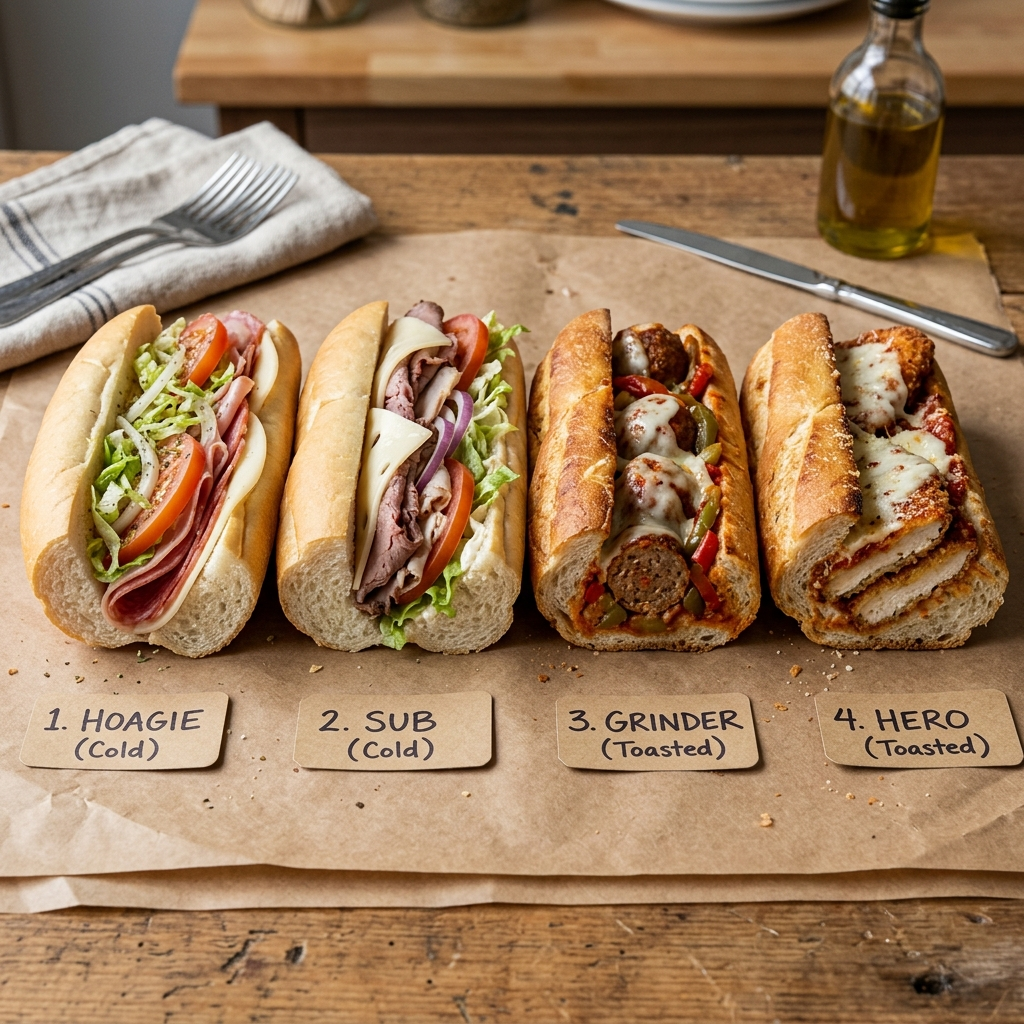
Here’s a distinction you won’t always hear about: in some parts of New England, “grinder” specifically refers to a hot sandwich, while a cold version gets called a sub. So a meatball grinder or a sausage-and-peppers grinder would be served hot on a toasted roll, while a cold cut version on the same bread might just be called a sub.
This rule isn’t universal — plenty of New Englanders use “grinder” for both hot and cold — but it’s a useful nuance to know if you want to sound like a local. The bread for a grinder tends to be the crustiest of the four styles. Think of a roll with a shatteringly crisp exterior that gives way to a chewy, dense crumb. It’s built to stand up to heat, sauce, and melted cheese without turning into mush.
What Is a Hero?
New York City claims the hero, and the name has a great backstory. Food writer Clementine Paddleford is widely credited with coining the term in the 1930s. After tasting an enormous stuffed sandwich, she reportedly wrote that you’d have to be a “hero” to eat the whole thing. The name stuck, and it’s been a New York staple ever since.
A hero is typically the biggest of the four sandwiches. New York delis are famous for piling on the ingredients — thick slices of fresh mozzarella, generous layers of capicola, heaps of roasted peppers, and enough olive oil to make the paper wrapper translucent. The bread is a long, wide Italian roll with a slightly softer crust than a grinder but more structure than a standard sub roll.
You’ll mostly hear “hero” in New York City and the surrounding metro area. Venture upstate or into New Jersey, and the terminology starts to shift. The hero is as much a cultural identity as it is a sandwich, and New Yorkers will defend the name with the same passion Philadelphians bring to the hoagie.
Other Regional Names You Might Hear
The hoagie-sub-grinder-hero debate doesn’t cover the whole map. Depending on where you are, you might run into a few other names for essentially the same sandwich.
In New Orleans, you’ll find the po’ boy, a sandwich built on crispy French bread and traditionally filled with fried shrimp, oysters, or roast beef with gravy. The po’ boy has its own rich history tied to a 1929 streetcar workers’ strike — you can read the full po’ boy origin story if you’re curious. It’s a distinct sandwich with its own bread and filling traditions, but it belongs to the same long-roll family.
In Boston, some old-school shops still use the word spuckie, short for “spuccadella,” an Italian bread roll. In upstate New York, you might hear wedge, and in parts of Michigan and Wisconsin, the term “hoagie” shows up thanks to East Coast transplants. In Maine, the Italian sandwich is the default term, and it usually comes loaded with ham, American cheese, onions, green peppers, tomatoes, and black olives on a soft roll.
All of these are cousins in the same sandwich family. The fillings shift based on local tastes and immigrant traditions, but the core concept — a long roll stuffed with good stuff — stays the same.
Side-by-Side Comparison and What Actually Changes
Here’s a quick breakdown so you can see the differences at a glance:
| Feature | Hoagie | Sub | Grinder | Hero |
|---|---|---|---|---|
| Region | Philadelphia, SE Pennsylvania | Nationwide | New England | New York City |
| Bread | Crusty outside, soft inside | Soft Italian roll | Very crusty, dense crumb | Wide, slightly soft Italian roll |
| Typical Size | 6–12 inches | 6–12 inches | 6–12 inches | Often 12+ inches |
| Served Hot or Cold | Usually cold | Both | Both (hot in some areas) | Both |
| Name Origin | Hog Island shipyard workers | Resembles a submarine | Crusty bread “grinds” your teeth | You’d have to be a hero to finish it |
Now, does the name actually change what you get on your plate? Sometimes, yes — but the differences are subtle and driven more by local tradition than by strict rules.
The biggest real difference is the bread. A Philly hoagie roll has a specific texture that’s hard to replicate elsewhere: crackly on the outside, pillowy on the inside, and strong enough to hold wet ingredients without disintegrating. A New England grinder roll is typically denser and crustier, built to handle hot fillings and heavy sauces. A New York hero roll is wider and softer, designed to cradle massive portions. A generic sub roll tends to be the softest and most uniform of the bunch.
The fillings also shift by region. A Philly Italian hoagie leans heavily on cured meats and sharp provolone with oil and vinegar. A New York hero might include fresh mozzarella and roasted red peppers. A New England grinder could feature meatballs and marinara. A Midwest sub might come with a heavier hand on the mayo and pickles.
But here’s the honest truth: if you blindfolded someone and fed them a well-made version of each, they’d probably have a hard time telling you which was which. The meat-to-cheese ratio, the vegetable toppings, and the condiments overlap more than they differ. The name on the menu tells you more about where you are than what’s inside the sandwich.
If you want to build a great version at home regardless of what you call it, this guide to building the perfect deli sandwich covers the layering technique that keeps everything balanced. And if you end up with leftovers, here’s how to reheat a sub sandwich without ruining the bread.
Frequently Asked Questions
Is a hoagie the same thing as a sub?
Yes, for the most part. A hoagie and a sub are both long sandwiches on an oblong roll filled with deli meats, cheeses, and toppings. The main difference is regional. “Hoagie” is the Philadelphia term, while “sub” is used across most of the United States. Some Philly locals will argue that a hoagie uses a specific type of roll and a traditional Italian filling, but structurally, they belong to the same sandwich family.
Why do they call it a grinder in New England?
The most common explanation is that the original grinders were made on very crusty Italian bread that required a lot of chewing — you had to “grind” your teeth to get through it. Another theory suggests the name comes from Italian-American slang for dockworkers, who were among the sandwich’s biggest fans. The chewing explanation is the one most food historians favor, and it makes sense when you bite into a proper New England grinder roll.
What’s the difference between a hero and a hoagie?
The biggest difference is geography and size. A hero is a New York City term, while a hoagie belongs to Philadelphia. Heroes tend to be larger and loaded with bigger portions, reflecting the generous style of New York delis. The bread is also slightly different — hero rolls are typically wider and softer than the crusty, hinged rolls used for hoagies. Beyond that, both sandwiches follow the same basic blueprint of meat, cheese, vegetables, and condiments on a long roll.
So the next time someone corrects your sandwich vocabulary, you can tell them they’re not wrong — they’re just from somewhere else. Whether you call it a hoagie, sub, grinder, or hero, you’re talking about one of America’s greatest sandwich traditions. The best move? Try them all in their home cities and decide for yourself which version wins. Your taste buds will thank you, even if your vocabulary gets a little confused.