
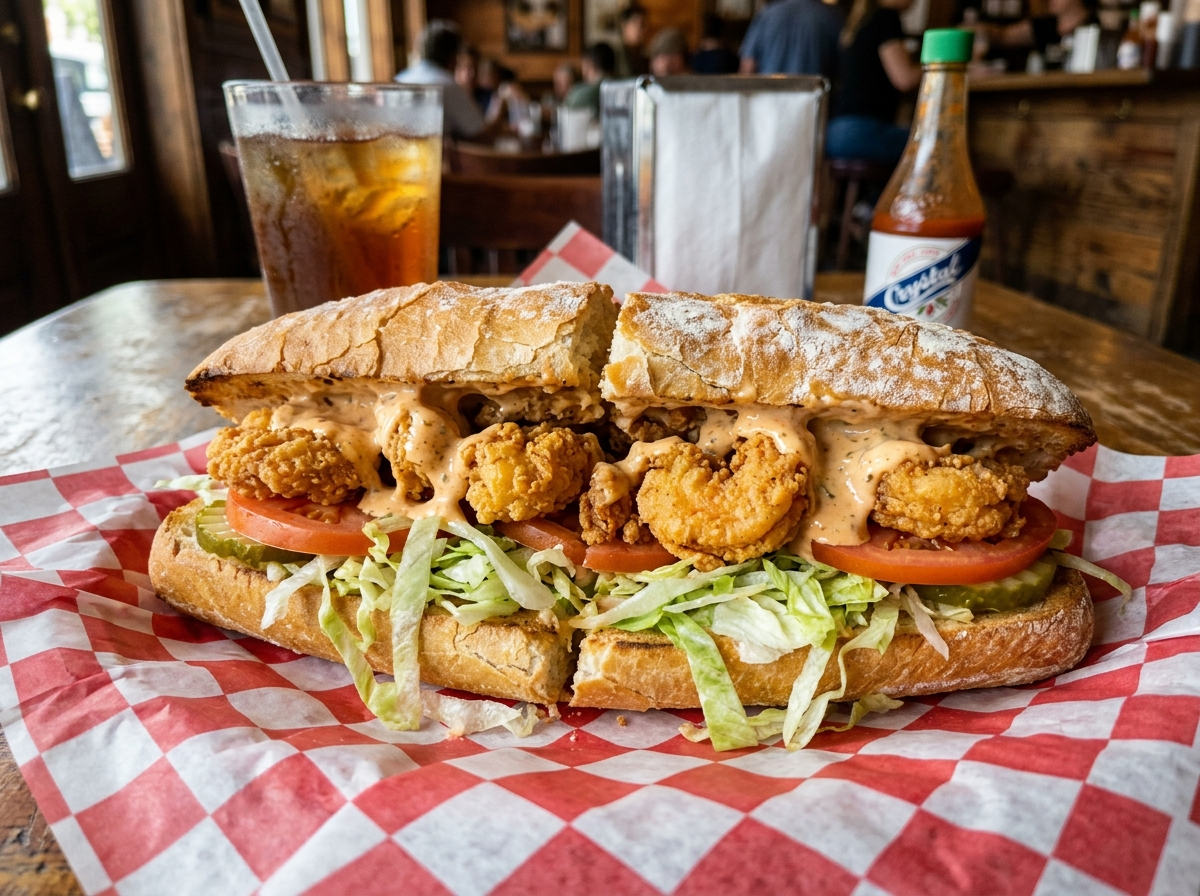
A po boy is a New Orleans sandwich built on crispy French bread and stuffed with fried seafood, roast beef, or other fillings. It sounds simple, but the details — the shattering crust, the airy crumb, the remoulade dripping into every pocket — set it apart from any sub or hoagie you’ve had.
If you’ve seen “po boy” on a menu and weren’t sure what to order, or you want the real story behind the name, here’s what you need to know.
What Is a Po Boy Sandwich?
A po boy is a traditional sandwich from New Orleans, Louisiana. At its core, it’s a generous filling piled onto a very specific type of French bread. The filling gets the attention, but the bread and the assembly style are what actually define the sandwich.
The most common fillings are fried shrimp, fried oysters, and slow-cooked roast beef. You’ll also find soft-shell crab, fried catfish, crawfish, and hot sausage versions across the city. Every neighborhood shop has its own spin, but the bones of the sandwich stay the same.
Here’s the definition you can keep in your back pocket: a po boy is a New Orleans sandwich served on crispy, airy French bread, typically filled with fried seafood or roast beef and dressed with lettuce, tomato, pickles, and mayonnaise.
The Bread That Makes or Breaks It
You can’t make a po boy with just any roll. The bread has to be New Orleans-style French bread, which is a different animal from the dense baguettes you’d find in a Parisian bakery.
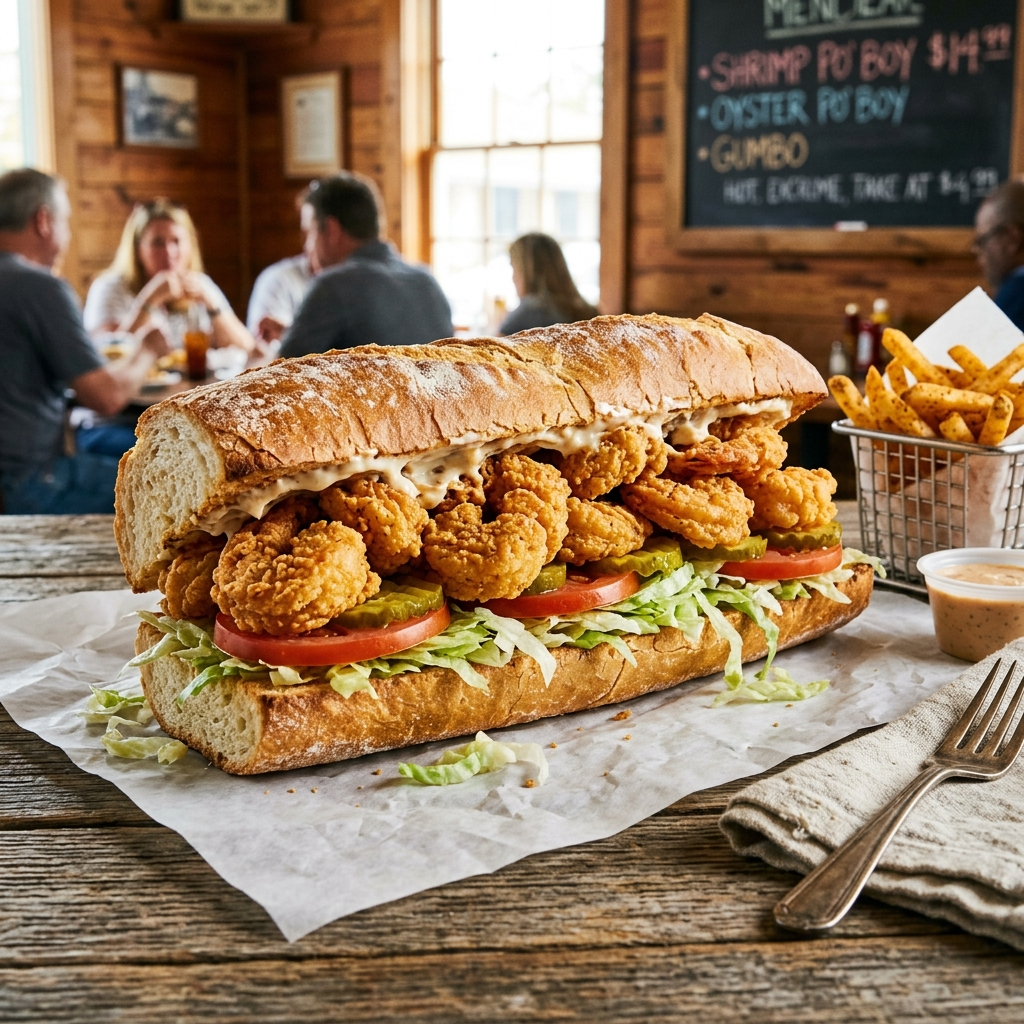
New Orleans French bread has a thin, crackly crust that shatters when you bite into it. The inside is soft, fluffy, and almost cotton-like. That texture contrast is the whole point. The crust gives you a satisfying crunch, while the airy interior soaks up sauces and juices without collapsing into mush.
The most famous supplier is Leidenheimer Baking Company, a family-run bakery that’s been making po boy bread for New Orleans restaurants since 1896. Their loaves are lighter and crispier than standard French bread, and they stale fast — which is actually a feature, not a flaw. Day-old bread won’t give you the right crunch, so freshness is non-negotiable.
If you’ve ever bitten into a proper po boy and felt the crust crackle before giving way to that pillowy softness, you know exactly what I mean. That textural contrast is something you just don’t get with a standard hoagie roll. If you’re curious how po boys stack up against other regional sandwiches, this breakdown of hoagie vs. sub vs. grinder shows where the lines blur and where they don’t.
Classic Fillings You’ll Find
The filling lineup in New Orleans is well-established, though every shop guards its own recipes.
Fried shrimp is the most iconic. You’re talking about plump, cornmeal-dusted Gulf shrimp fried until golden and stacked high on the loaf. Fried oysters run a close second, especially during the cooler months when the oysters are plump and briny.
Roast beef is the other major category, and it’s a completely different experience. The beef is slow-cooked until it falls apart, then the gravy — known locally as “debris” — gets ladled over the meat and soaks straight into the bread. A roast beef debris po boy is messy, dripping, and absolutely worth the pile of napkins you’ll go through.
Other popular options include fried soft-shell crab (a spring seasonal treat), fried catfish, crawfish étouffée, and hot sausage with gravy. Some modern spots experiment with fillings like fried green tomatoes or alligator, but the classics remain the most popular for good reason.
Po Boy Sandwich Origin — The 1929 Streetcar Strike Story
The po boy sandwich origin story is one of the best in American food history, and it starts with a labor dispute, not a restaurant kitchen.
In 1929, streetcar workers in New Orleans went on strike against the New Orleans Railway & Light Company. The strike dragged on for months and turned violent at points — there were riots, clashes with police, and thousands of workers suddenly out of a paycheck.
Bennie and Clovis Martin
Bennie and Clovis Martin were two brothers who had worked as streetcar conductors before leaving to open a coffee stand and sandwich shop in the French Market. When the strike hit, they felt a deep loyalty to their former coworkers.
The Martins wrote a letter to the striking workers that ran in local newspapers. In it, they promised to feed any striking streetcar worker for free. The letter reportedly included the line: “Our meal is free to any members of Division 194.” Division 194 was the streetcar workers’ union local.
When the hungry strikers showed up at the shop, the Martins’ staff would call out, “Here comes another poor boy.” The name stuck to the sandwich itself.
From “Poor Boy” to “Po Boy”
Over the following years, “poor boy” got shortened to “po’ boy” and eventually “po boy.” The spelling still varies depending on who you ask — you’ll see “po’boy,” “po-boy,” and “po boy” on menus all over Louisiana. All are acceptable, though locals tend to favor “po’ boy” with the apostrophe.
Now, I want to be upfront about something. Food historians have debated a few of the finer details of this story. The Martin brothers definitely existed, and they definitely fed striking workers during the 1929 walkout. But some researchers point out that the term “poor boy” may have described cheap sandwiches in New Orleans even before the strike. The strike story is the most widely accepted origin, and the Martin family has consistently told it this way for decades, so it’s the version most food writers and historians go with. If you want to dig into the full backstory and the competing theories, this po boy sandwich origin piece covers the details thoroughly.
What nobody debates is that the po boy became a defining part of New Orleans food culture in the decades that followed. By the mid-20th century, po boy shops sat on nearly every neighborhood corner in the city.
Po Boy vs. Sub vs. Hoagie — What’s the Real Difference?
This is the question people ask most often, and the answer comes down to three things: bread, fillings, and geography.
The bread is the biggest differentiator. A po boy uses New Orleans French bread — crispy, airy, and light as a regular loaf of bread has no right to be. A sub or hoagie uses a denser Italian-style roll with a chewier crust and a tighter crumb. That difference in texture changes the entire eating experience. A po boy crunches. A sub has more chew and heft.
The fillings lean differently too. Po boys are strongly associated with fried seafood — shrimp, oysters, catfish. Subs and hoagies tend to feature cold cuts, provolone, and Italian-style cured meats. There’s overlap (you can absolutely get a ham and cheese po boy), but the default order in each category tells you a lot about the regional identity behind the sandwich.
And then there’s geography. Po boys are a Louisiana thing, specifically a New Orleans thing. Hoagies belong to Philadelphia. Subs are a more general American term, though they’re strongly tied to the Northeast. If you want to understand the Philly side of this debate, this guide on what is a hoagie lays out that tradition clearly.
Calling a po boy a “sub” in New Orleans won’t get you kicked out of the shop, but you might get a raised eyebrow. They’re different sandwiches with different histories, and the locals take that distinction seriously.
How to Order a Po Boy Like a Local
Walking into a po boy shop in New Orleans can feel a little overwhelming if you don’t know the lingo. The menu might be handwritten on a chalkboard, the line might be out the door, and the person behind the counter will ask you a question that sounds like code.
What “Dressed” Means
When the counter person asks if you want your po boy “dressed,” they’re not talking about a dress code. “Dressed” means the sandwich comes with shredded lettuce, sliced tomato, dill pickle chips, and mayonnaise. That’s the standard setup, and it’s the default for most fried seafood po boys.
If you say “no,” you’ll get the filling on bread and nothing else. Some people prefer it that way, especially with roast beef debris, where the gravy does all the heavy lifting. But for a fried shrimp po boy, dressed is the move. The cool crunch of the lettuce and the sharp acidity of the pickles cut right through the richness of the fried seafood, and the mayo ties everything together.
You can also ask for extras. Hot sauce is always within reach. Many shops offer remoulade — a tangy, slightly spicy Creole sauce made with mustard, horseradish, and paprika — as an upgrade over plain mayo. Creole mustard is another popular add. Don’t be shy about customizing. The folks behind the counter do this all day and they’re used to it.
Quick tip: If you’re ordering a roast beef po boy, ask for it “debris style” if it’s not already the default. That means extra gravy and the crispy, caramelized bits of beef that fall off during the long cook. It’s the best part of the sandwich, and it’s what separates a good roast beef po boy from a great one.
Making a Po Boy at Home
You don’t need to live in New Orleans to make a decent po boy, but you do need to pay close attention to the bread. This is where most home attempts fall short, and it’s the one thing you can’t really fake.
Step 1: Find the right bread. Look for a French bread loaf with a thin, crispy crust and a soft, airy interior. Standard grocery store French bread can work in a pinch, but it’s usually too dense and too chewy. If you have a local bakery that makes a lighter, airier French loaf, grab that instead. The bread should feel almost hollow when you tap the crust.
Step 2: Prep your filling. For a classic fried shrimp po boy, peel and devein large shrimp, dredge them in a mix of seasoned cornmeal and flour, and fry them in oil at 350°F until golden — about 2 to 3 minutes per batch. For roast beef, slow-braise a chuck roast with beef broth, garlic, onion, and a splash of Worcestershire until it shreds with a fork, then reduce the cooking liquid into a thick, glossy gravy.
Step 3: Toast the bread lightly. Split the loaf lengthwise and warm it in a 350°F oven for three to five minutes. You want the crust to crisp back up, not dry out the interior. This step also helps prevent a soggy sandwich, which is the number one thing that ruins homemade po boys. If you’ve dealt with soggy bread before, these tips on how to prevent a soggy sandwich are worth a quick read before you start assembling.
Step 4: Assemble. Spread mayonnaise or remoulade on both halves of the bread. Pile on your filling generously — a po boy should look overstuffed. If you’re going dressed, layer on shredded lettuce, sliced tomato, and pickle chips. Close the sandwich, press down gently, and cut it in half on a diagonal.
A note on food safety: When frying seafood at home, make sure your oil stays at a steady 350°F and that the shrimp reach an internal temperature of 145°F. Never let raw and cooked seafood share the same plate, cutting board, or utensils. This is general kitchen guidance — for detailed food safety protocols, check your local health department’s recommendations.
Why the Po Boy Still Matters
New Orleans has no shortage of iconic foods — gumbo, jambalaya, beignets, étouffée, muffulettas. But the po boy occupies a special place because it’s the city’s everyday food. It’s not a special-occasion dish reserved for holidays or company. It’s what you grab for lunch on a random Tuesday, what you eat on a park bench after a long shift, what you order at 1 a.m. after a night out on Frenchmen Street.
The Oak Street Po-Boy Festival, held every November in New Orleans, draws tens of thousands of people who line up for both creative and traditional versions from dozens of local vendors. It’s a loud, joyful, deeply local event, and it’s a testament to how deeply this sandwich is woven into the city’s identity. You can learn more about the festival and its history at poboyfest.com.
The po boy also represents something bigger about New Orleans food culture: the idea that working-class food can be extraordinary. This sandwich was literally born out of a labor strike, created to feed people who had lost their income. Nearly a century later, it’s one of the most celebrated sandwiches in America. That trajectory says a lot about the city and its relationship with food.
If you’re planning a Southern-themed gathering and want to bring some of this energy to your own table, this roundup of Southern comfort foods for your watch party has some great ideas that pair perfectly with a platter of po boys.
Frequently Asked Questions
What is the difference between a po boy and a sub?
The main difference is the bread. A po boy uses New Orleans French bread, which has a thin, crispy crust and a very airy, soft interior. A sub uses a denser Italian-style roll with more chew and a tighter crumb. Po boys also lean heavily toward fried seafood fillings, while subs typically feature cold cuts and cheeses. The two sandwiches come from different regional traditions — Louisiana for the po boy, the Northeast for the sub.
Why is it called a po boy?
The name comes from the 1929 New Orleans streetcar strike. Brothers Bennie and Clovis Martin, former streetcar conductors who owned a sandwich shop, offered free meals to striking workers. When a striker walked in, staff would call out, “Here comes another poor boy.” The phrase got shortened to “po’ boy” and eventually “po boy,” and the name stuck to the sandwich itself.
What does “dressed” mean on a po boy?
“Dressed” means the po boy comes with shredded lettuce, sliced tomato, dill pickle chips, and mayonnaise. It’s the standard way to order in New Orleans po boy shops. If you don’t want those toppings, you’d order it “undressed” or just tell the counter person what to leave off. The term is specific to New Orleans and you won’t hear it used the same way at sub shops in other cities.
What is the best filling for a po boy?
That depends on who you ask, but fried shrimp is the most popular and widely considered the classic choice. Fried oysters and roast beef debris are close seconds. Soft-shell crab is a beloved seasonal option available in the spring. If you’re trying a po boy for the first time, a fried shrimp po boy dressed is the safest and most representative order.
Can you make a po boy without frying?
Yes. Roast beef po boys don’t involve any frying — the beef is slow-braised and served with gravy. You can also find versions with grilled chicken, ham and cheese, or even vegetarian fillings like fried green tomatoes. The bread and the assembly style are what make it a po boy, not the cooking method of the filling.
The po boy is more than a sandwich. It’s a piece of New Orleans history you can hold in your hands — crispy, messy, and deeply satisfying. Whether you’re ordering one from a corner shop in the Ninth Ward or frying up shrimp in your own kitchen, the key is respecting the bread and keeping the fillings generous.
Next time you see “po boy” on a menu, you’ll know exactly what you’re getting and where it came from. And if you ever make it to New Orleans, skip the tourist-trap versions and ask a local where they get their lunch. You’ll thank yourself later.