
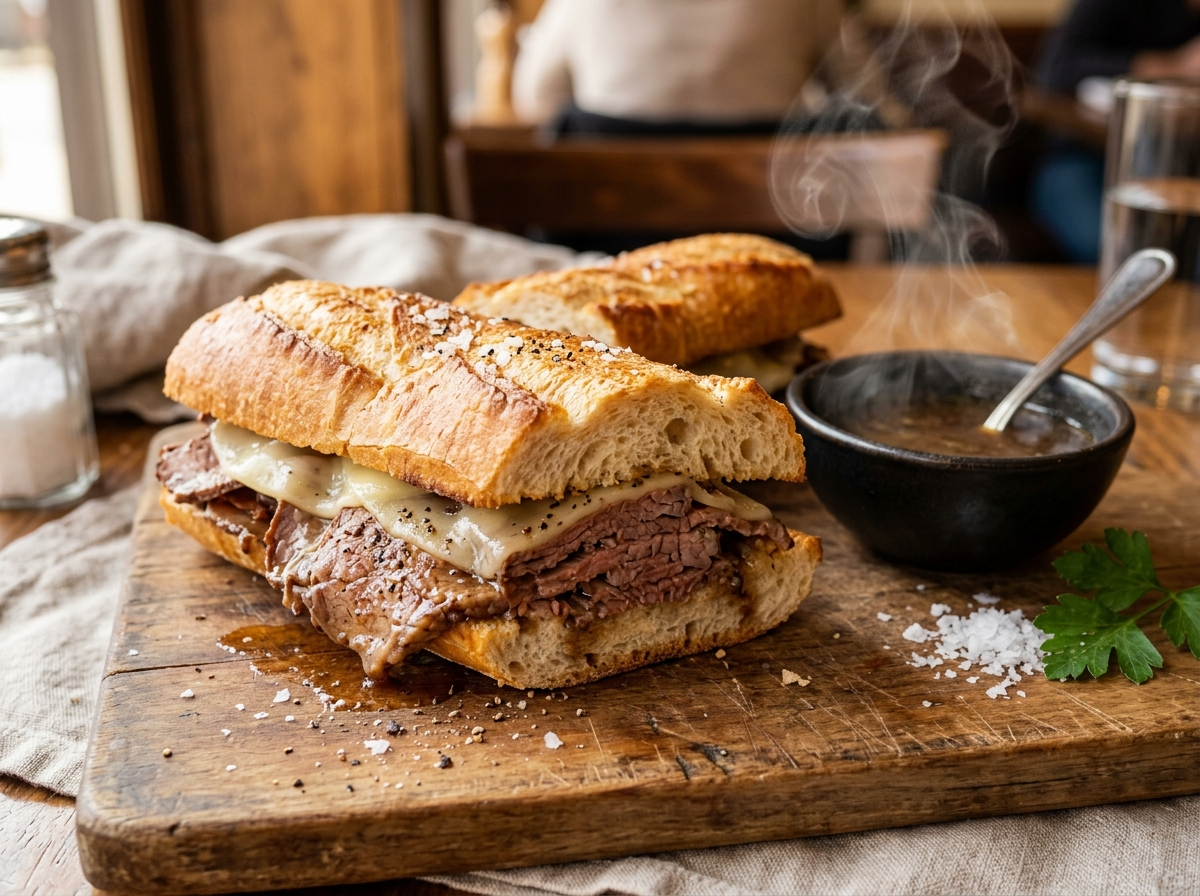
A French dip sandwich is a hot sandwich made with thinly sliced roast beef piled onto a crusty French roll, served with a small bowl of warm beef jus for dipping. That’s the short version. The long version involves a century-old Los Angeles rivalry, a mystery nobody has fully solved, and one of the most satisfying eating experiences you can have with a sandwich.
If you’ve never dunked a warm, meaty roll into a cup of rich beef broth and taken that first soggy-crisp bite, you’re in for a treat. Let’s walk through exactly what makes this sandwich special, where it came from, and how you can pull one off in your own kitchen.
What Is a French Dip Sandwich?
At its core, a French dip is a study in contrasts. You get the chew of crusty bread, the tenderness of slow-roasted beef, and the savory punch of warm jus soaking into every bite. It’s messy, it’s unpretentious, and it’s one of those sandwiches that tastes way better than its simple ingredient list suggests.
The name can confuse people. There’s nothing particularly French about it. The “French” part refers to the bread — a French roll or baguette — not the country of origin. This sandwich is as American as it gets, born right in downtown Los Angeles in the early 1900s.
The “dip” part is where the magic lives. Your sandwich arrives with a ramekin or small cup of au jus on the side. Au jus is a French term that literally means “with juice,” and in this context, it refers to the natural drippings and broth from the roasted beef. You dip each bite — or the whole sandwich, no judgment — into that warm liquid before eating.
The Key Components
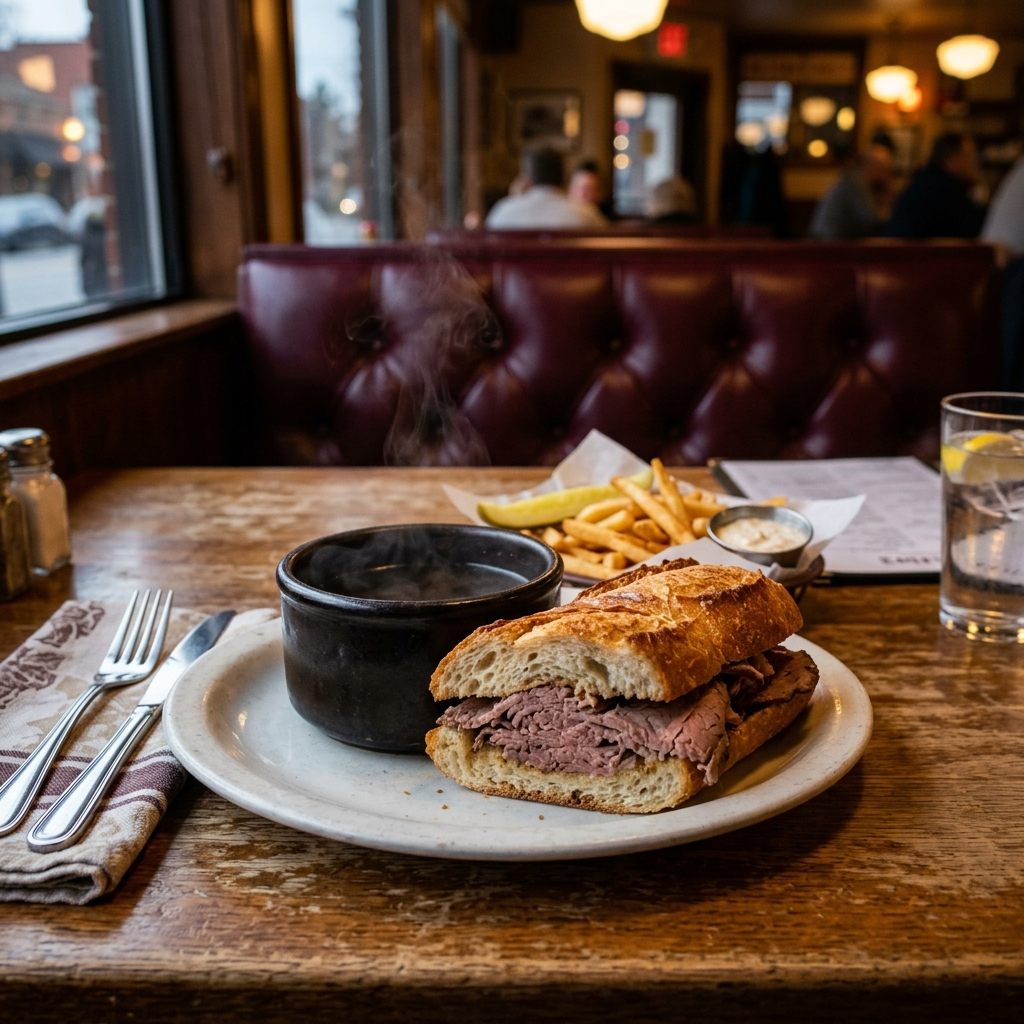
A proper French dip has four non-negotiable elements:
The bread. You need a French roll with a sturdy crust and a soft interior. The crust matters because it has to hold up to dipping without dissolving into mush. A soft hamburger bun would fall apart on contact. The roll should have some chew and structure. If you want to dig deeper into how bread choice changes a sandwich, our guide on how to build the perfect deli sandwich covers this in more detail.
The meat. Thinly sliced roast beef is the standard. The slices should be shaved almost paper-thin, which lets the jus penetrate the layers and keeps every bite tender. Some spots use prime rib, others use top round or sirloin. The cut matters less than the preparation — slow-roasted, seasoned simply, and sliced against the grain.
The au jus. This is the warm, seasoned beef broth served on the side. Good au jus tastes like the essence of roast beef — deeply savory, slightly salty, with just enough body to coat the bread without turning it into soup. Some restaurants add a splash of Worcestershire sauce, garlic, or onion to their jus. Others keep it pure.
The cheese (optional but popular). Many versions add a slice of melted provolone or Swiss cheese. It’s not traditional in the strictest sense, but it’s become so common that most people expect it. The cheese adds a creamy, salty layer that plays well against the beef and jus.
You’ll also see horseradish offered on the side at many restaurants, and for good reason. A thin smear of horseradish cuts through the richness of the beef and jus in a way that wakes up the whole sandwich.
French Dip Sandwich Origin: The Great LA Debate
Here’s where things get fun — and a little contentious. Ask anyone in Los Angeles where the French dip was invented, and you’ll get one of two answers, delivered with genuine conviction.
Two downtown LA restaurants both claim to have invented the French dip sandwich, and both have been serving it for over a century. The debate is one of the most famous food rivalries in American history, and honestly, it’s never been fully settled.
The Philippe the Original Story
Philippe the Original, located near Olvera Street in downtown LA, claims the French dip was born in their kitchen in 1918. The story goes like this: a police officer came in and ordered a roast beef sandwich. The owner, Philippe Mathieu, accidentally dropped the sliced French roll into a pan of hot beef drippings. Rather than toss it, he served it to the officer, who apparently loved it and came back the next day asking for another “dipped” sandwich.
Philippe’s still operates today at 1001 N. Alameda Street, and they serve their French dip the old-school way — the entire sandwich gets dunked in jus before it reaches your hands. It’s a wet sandwich. Your fingers will get messy. That’s the point.
The Cole’s Pacific Electric Buffet Story
Cole’s Pacific Electric Buffet, located in the Pacific Electric Building on 6th Street, tells a different story. They claim the French dip dates back to 1908, a full decade before Philippe’s version. According to their account, a customer who had recently had dental work complained that the crusty French roll was too hard on his sore gums. The cook, out of sympathy, softened the bread by dipping it in the warm jus from the roasting pan. The customer loved it, word spread, and a sandwich was born.
Cole’s is still open and still serves French dips, though their approach tends to be a bit less aggressive with the dipping than Philippe’s. You can get it “wet” or “dry,” depending on your preference.
So Who Actually Invented It?
Nobody knows for sure, and that’s the honest answer. Both stories are charming and plausible. Both restaurants were operating in the same neighborhood during the same era, serving similar working-class customers — railroad workers, factory employees, and commuters passing through downtown LA.
Food historians have dug into this question for decades. The Los Angeles Times has covered the rivalry extensively, and even they stop short of declaring a definitive winner. The earliest written references to the sandwich don’t clearly favor one story over the other.
What we do know is that by the 1920s, the French dip was a recognized item on LA lunch counters, and both restaurants were serving it to long lines of hungry customers. The rivalry itself has become part of the sandwich’s identity. If you visit LA, the real move is to try both and form your own opinion.
French Dip History: How It Spread Across America
For the first few decades of its life, the French dip was a strictly Los Angeles phenomenon. It lived on the menus of downtown lunch counters and diner-style restaurants, feeding workers who needed a hot, filling, affordable meal.
The sandwich started spreading beyond Southern California in the mid-20th century, riding the wave of postwar car culture and the rise of roadside diners. As Americans drove cross-country and regional food traditions started mixing, the French dip found its way onto menus in the Midwest, the East Coast, and eventually everywhere in between.
A few things helped it travel well. First, the ingredients are simple and cheap — roast beef, bread, broth. Any diner kitchen could pull it off without special equipment. Second, it filled a gap on the menu. Most hot sandwiches at the time were grilled cheese, Reubens, or patty melts. The French dip offered something different: a hot, juicy, dunkable sandwich that felt more substantial than a cold deli number but less heavy than a full roast beef dinner.
By the 1970s and 80s, the French dip had become a standard item at chain restaurants, truck stops, and neighborhood delis across the country. Arby’s, the fast-food chain known for roast beef, popularized a version that introduced the sandwich to millions of people who’d never set foot in LA.
Today, you’ll find the French dip on menus from Seattle to Miami. The basic formula stays the same, but regional touches have crept in. Some places use prime rib instead of standard roast beef. Others add caramelized onions, sautéed mushrooms, or pepperoncini. A few adventurous spots have tried it with lamb or pork, though beef purists will tell you that’s a bridge too far.
The sandwich also reflects a broader truth about American deli history — some of the most iconic American foods weren’t invented by famous chefs. They were created by working cooks solving practical problems for hungry customers. The French dip is a perfect example. Whether it was a dropped roll or a sore-gummed customer, the sandwich came from a moment of improvisation, not a recipe book.
How to Make a French Dip at Home
You don’t need a commercial kitchen to make a great French dip. The sandwich is forgiving, and the technique is straightforward once you understand the basics.
Start with the roast beef. A 3- to 4-pound top round or sirloin tip roast works well. Season it generously with salt, pepper, and garlic powder, then sear it in a hot Dutch oven before transferring it to a 325°F oven. Roast it until the internal temperature hits about 130°F for medium-rare, which usually takes around 20-25 minutes per pound. Let it rest for at least 20 minutes before slicing.
Here’s a detail that makes a real difference: slice the meat as thin as you possibly can. If you have a meat slicer, use it. If you’re using a knife, partially freeze the roast for about 30 minutes before slicing — it firms up the meat and lets you get those paper-thin shaves that soak up jus beautifully. Our guide on how to slice meat thin walks through the technique if you want more detail.
Choosing the Right Bread
The bread can make or break your French dip. You want a roll with a thick, crackly crust and a relatively open crumb inside. A classic French roll from a bakery is ideal. A baguette works too, though you’ll want to cut it into shorter sections.
Avoid anything too soft or too dense. Soft dinner rolls will disintegrate the second they touch the jus. Dense sourdough won’t absorb the liquid properly and you’ll end up with a dry sandwich and a full cup of broth. The bread needs to strike a balance — sturdy enough to hold together, porous enough to drink up the jus.
One trick I’ve found useful: lightly toast the rolls before assembling the sandwich. A quick pass under the broiler gives the crust extra structure and adds a subtle crunch that holds up better against the dipping liquid. You want the bread to soften from the jus, not collapse. If you’ve ever dealt with a sandwich that turned into a soggy mess halfway through, you know the frustration — our tips on how to prevent a soggy sandwich apply here too.
The Au Jus Technique
Your au jus starts with the pan drippings from the roast. After you pull the beef from the oven, you’ll have a layer of browned bits and fat in the bottom of the pot. Don’t throw that out — that’s flavor gold.
Place the roasting pan on the stove over medium heat. Add a cup or two of beef broth and scrape up all the browned bits from the bottom. Let it simmer for about 10 minutes, then strain it through a fine mesh sieve. Taste it and adjust the seasoning with salt, pepper, and maybe a splash of Worcestershire sauce if it needs more depth.
Keep the jus warm in a small saucepan while you assemble the sandwiches. Pile the sliced beef onto the rolls, add cheese if you want it, and pop them under the broiler for a minute or two to melt the cheese. Serve immediately with the jus in small bowls on the side.
Pro tip: Don’t dip the entire sandwich and let it sit. The bread will absorb too much liquid and lose its texture. Instead, dip each bite as you eat it. You get the warmth and flavor of the jus without the sogginess. This is one of those small details that separates a good French dip from a great one.
French Dip vs Other Hot Sandwiches
It’s easy to lump the French dip in with other hot beef sandwiches, but it occupies its own lane. Here’s how it compares to a few similar options.
French dip vs Italian beef. Both involve thinly sliced roast beef and a jus-like liquid, and both originated in working-class urban neighborhoods (the Italian beef comes from Chicago). The big difference is the bread and the dipping method. Italian beef uses a longer, softer roll and is typically dunked entirely before serving. The French dip uses a crustier roll and gives you more control over the dipping. Italian beef also leans heavily on giardiniera or sweet peppers as a topping, while the French dip keeps things simpler.
French dip vs cheesesteak. A Philly cheesesteak uses chopped or shaved beef cooked on a flat top with melted cheese on a soft hoagie roll. It’s a griddled sandwich, not a roasted one, and there’s no dipping involved. The textures are completely different — the cheesesteak is soft and gooey, while the French dip has more contrast between the crusty bread and the tender meat. If you’re curious about the cheesesteak side of things, our piece on Philly cheesesteak history covers that story in depth.
French dip vs Reuben. These two don’t have much in common beyond being hot sandwiches. A Reuben uses corned beef, sauerkraut, Swiss cheese, and Russian dressing on grilled rye bread. It’s tangy, rich, and crunchy. The French dip is savory, juicy, and focused on the pure flavor of beef and broth. They scratch very different itches, and honestly, there’s no reason to choose between them.
The French dip stands out because of its interactive element. Dipping your sandwich into a bowl of warm jus is a hands-on eating experience that most other sandwiches don’t offer. It’s part of what makes the sandwich memorable — you’re not just eating, you’re participating.
Frequently Asked Questions
Why is it called a French dip if it’s from America?
The “French” in French dip refers to the type of bread used — a French roll — not the country of origin. The sandwich was invented in Los Angeles, California, in the early 1900s. The name stuck because the French roll was the defining feature that set it apart from other hot beef sandwiches of the era.
What is the best meat for a French dip sandwich?
Top round, sirloin tip, and prime rib are the most popular choices. Top round is lean and affordable, making it the go-to for most home cooks. Prime rib is richer and more tender but costs more. Regardless of the cut, the key is to slow-roast the meat and slice it as thinly as possible so the jus can penetrate the layers.
Can you make a French dip in a slow cooker?
Yes, and it’s one of the easiest ways to do it at home. Place a 3-pound chuck roast in the slow cooker with beef broth, onion, garlic, and a splash of Worcestershire sauce. Cook on low for 8-10 hours until the meat shreds easily. The cooking liquid doubles as your au jus — just strain it and keep it warm. The texture will be more shredded than shaved, which is a slightly different experience but still delicious.
Is a French dip a hot or cold sandwich?
A French dip is always served hot. The roast beef is warm, the bread is usually toasted, and the au jus is served steaming. If you’re curious about how temperature changes the sandwich experience, our breakdown of hot vs cold sandwiches covers why heat matters for certain ingredients and textures.
What side dishes go well with a French dip?
Classic pairings include French fries, coleslaw, potato chips, and a simple green salad. Because the sandwich is rich and savory, you want sides that offer some crunch or acidity to balance things out. Pickles are also a great choice — their sharp tang cuts through the beef and jus nicely.
The French dip is one of those rare sandwiches that’s both dead simple and deeply satisfying. Thin beef, crusty bread, warm jus — three ingredients that somehow add up to more than the sum of their parts. Whether you side with Philippe’s or Cole’s in the origin debate, the real winner is anyone who gets to sit down with a freshly made French dip and a cup of hot au jus on a cold afternoon.
If you haven’t made one at home yet, grab a roast this weekend and give it a shot. The technique is forgiving, the ingredients are easy to find, and the payoff is enormous. And if you do make it, try the bite-by-bite dipping method — your bread will thank you. For more sandwich inspiration and techniques, check out the full collection at Antney’s Grub.