
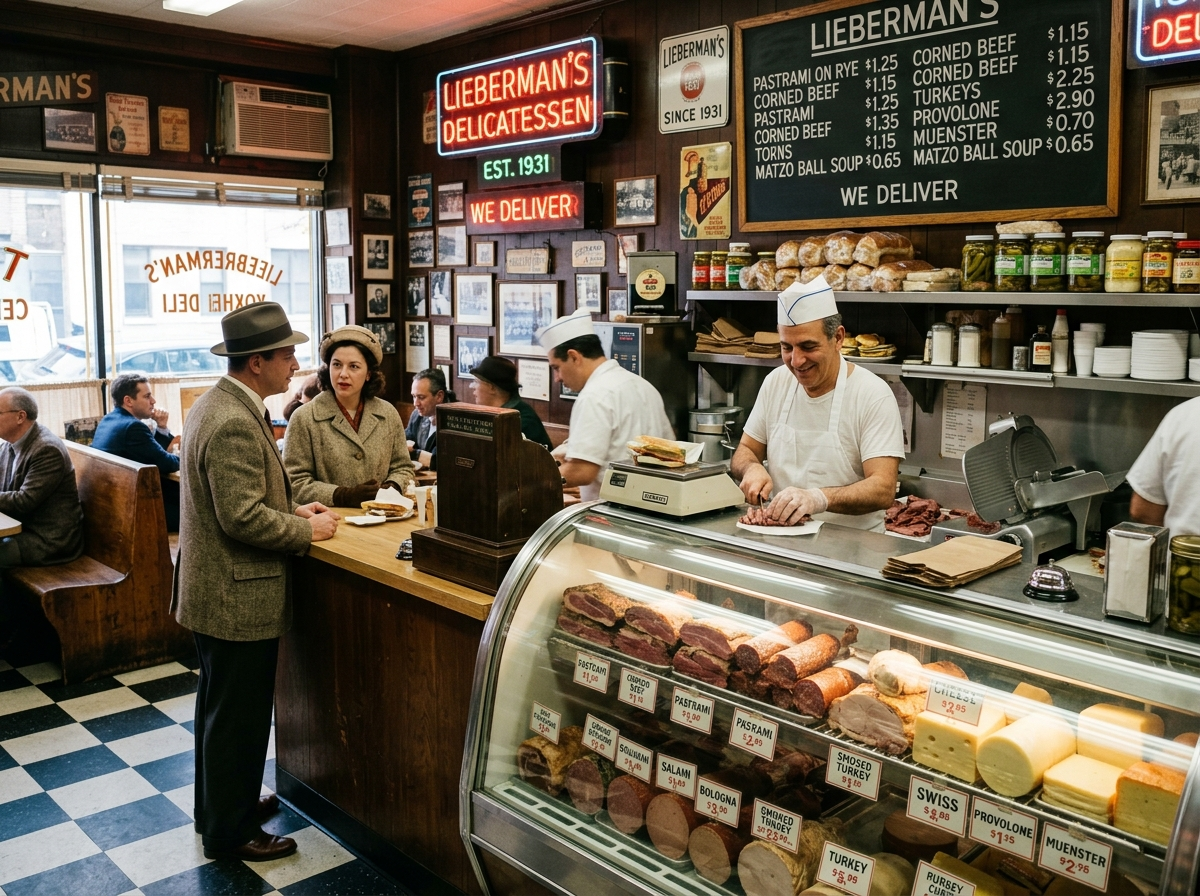
The American deli didn’t start as a sandwich shop. It started as a survival strategy. European immigrants arriving in the late 1800s needed ways to preserve and sell meat without reliable refrigeration. That practical need turned into one of the most beloved food traditions in the country. The history of the American deli is really a story about immigration, adaptation, and a whole lot of cured meat.
What Does “Deli” Actually Mean?
You probably walk past a deli counter at your grocery store without thinking twice about the name. But “deli” is short for delicatessen, and that word tells you a lot about where this whole thing started.
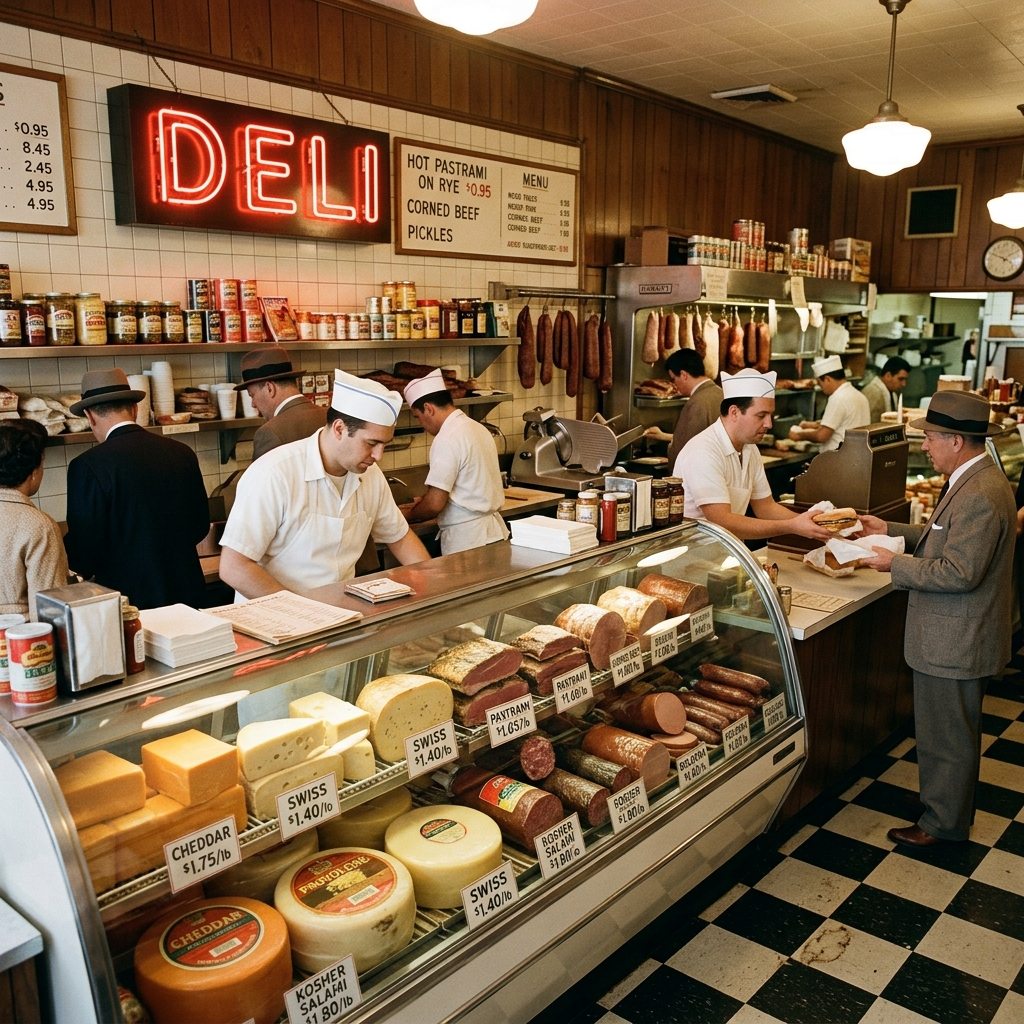
The term comes from the German word Delikatessen, which literally means “delicate things to eat.” In 18th-century Germany, a Delikatessen shop sold fine, imported, or hard-to-find foods — think cured sausages, pickled vegetables, imported cheeses, and spiced meats. These weren’t everyday groceries. They were specialty items.
When German immigrants brought the concept to America in the mid-1800s, the meaning shifted slightly. The shops still sold high-quality prepared foods, but they became more practical and less luxurious. The focus moved toward affordable, ready-to-eat meats and sides that working-class families could grab on their way home.
By the early 1900s, “deli” had become the common shorthand. And the definition kept stretching. Today, a deli can mean a standalone sandwich shop, a counter inside a supermarket, or a full-service restaurant with a massive menu. The american deli origins trace back to that German idea of carefully prepared specialty foods, but the American version grew into something much bigger and more diverse.
One quick clarification that trips people up: a traditional Jewish “appetizing store” and a deli are technically different things. An appetizing store sells dairy and fish items (think lox, cream cheese, and herring), while a deli focuses on meat. In practice, most places blurred those lines decades ago. But if you walk into Russ & Daughters on the Lower East Side and call it a deli, a regular might gently correct you.
The European Roots Behind American Deli Origins
To understand the history of the American deli, you have to look at three major immigrant groups: Germans, Eastern European Jews, and Italians. Each brought their own meat-curing traditions, and each shaped the deli in different ways.
The German Influence
German immigrants were the first to use the word “delicatessen” in America. Starting in the 1840s and 1850s, German communities in cities like New York, Cincinnati, and Milwaukee opened shops selling wurst (sausages), smoked hams, sauerkraut, and dark rye breads. These shops served a real purpose. Most working families didn’t have iceboxes yet, so buying small amounts of preserved meat from a trusted local shop made more sense than trying to store raw meat at home.
The German deli model was straightforward: cure it, smoke it, pickle it, and sell it sliced. That philosophy became the backbone of the entire American deli tradition.
The Eastern European Jewish Contribution
The biggest wave of Jewish immigration from Eastern Europe hit between 1880 and 1920. Millions of people arrived in cities like New York, Chicago, and Philadelphia, and they brought food traditions shaped by kosher dietary laws and centuries of preservation techniques.
Kosher rules meant no mixing meat and dairy, no pork, and specific slaughter methods. That constraint actually drove incredible creativity. Jewish immigrants perfected beef-based cured meats — especially corned beef and pastrami — because beef was the most accessible kosher protein in America. If you’ve ever wondered why pastrami became such a deli staple, it’s largely because Eastern European Jewish immigrants adapted a Romanian technique (smoking and spicing goose or duck) to the cheap, abundant beef brisket they found in American butcher shops. You can dig deeper into the differences between these two iconic meats in this breakdown of corned beef vs. pastrami.
Pushcart vendors on New York’s Lower East Side were the earliest version of the Jewish deli. A vendor would set up a cart with barrels of pickled meat, hand-sliced brisket, and dark bread. Over time, successful vendors saved enough to open brick-and-mortar shops. That’s how legendary spots like Katz’s Delicatessen got started. Katz’s opened on Houston Street in 1888 and still operates in the same spot today, which makes it one of the oldest continuously running delis in the country.
The Italian Salumeria Tradition
Italian immigrants brought a parallel tradition: the salumeria. These shops specialized in cured pork products — salami, capicola, prosciutto, and soppressata — along with sharp cheeses, olive oil, and crusty bread. Italian delis clustered in neighborhoods like Little Italy in New York, the North End in Boston, and South Philadelphia.
The Italian deli model was more focused on dry-cured meats that could hang in a shop window for weeks without spoiling. That’s a different preservation approach than the brine-and-smoke methods of the Jewish and German traditions, and it gave American deli culture a much wider range of flavors and textures.
The Golden Age: How Delis Took Over American Cities
The period from roughly 1900 to the 1950s was the golden age of the American deli. Several forces came together to make delis explode in popularity.
First, urbanization. American cities were packed with factory workers, office clerks, and shopkeepers who needed quick, affordable lunches. A deli sandwich — piled high with sliced meat, mustard, and pickles on rye — was cheap, filling, and fast. You didn’t need a table or a waiter. You grabbed your sandwich and ate it at your desk or on a park bench.
Second, refrigeration technology improved dramatically in the 1920s and 1930s. Commercial refrigeration meant delis could store more meat safely, slice it to order, and offer a wider variety. The mechanical meat slicer, which became standard equipment in the 1930s, changed everything. Before the slicer, meat was carved by hand with a knife, which limited how thin and consistent the slices could be. The slicer made those paper-thin, melt-in-your-mouth stacks of pastrami possible.
Third, delis became social hubs. A big Jewish deli in New York wasn’t just a place to eat — it was a gathering spot. Families came on Sundays. Comedians and actors hung out at places like the Carnegie Deli (opened in 1937 on Seventh Avenue) and Lindy’s. The menus grew enormous, sometimes running to 20 pages. You could get matzo ball soup, knishes, blintzes, towering Reuben sandwiches, and egg creams all under one roof. Speaking of the Reuben, the story behind that iconic sandwich is more debated than you’d think — check out this look at the Reuben sandwich origin for the competing claims.
By the 1950s, New York City alone had an estimated 1,500 Jewish delis. That number is almost hard to believe today, when you can count the famous surviving ones on two hands.
Jewish Delis vs. Italian Delis: Two Traditions, One Love of Cured Meat
People often talk about “the American deli” as if it’s one thing. It’s really two (or three, if you count the German roots) overlapping traditions that developed side by side.
Jewish delis built their identity around beef. Corned beef, pastrami, brisket, and tongue were the stars. The bread was rye or pumpernickel. The sides were pickles, coleslaw, and potato salad. The drinks were egg creams and celery soda. The vibe was loud, warm, and a little chaotic — waiters who called you “hon,” portions that defied physics, and menus that seemed to go on forever.
Italian delis centered on cured pork and sharp flavors. Genoa salami, capicola, mortadella, and provolone layered onto crusty Italian rolls with oil, vinegar, oregano, and hot peppers. The Italian deli sandwich — what many cities call a “hoagie,” “grinder,” or “sub” depending on where you grew up — has its own fascinating regional history that parallels the Jewish deli story. The Philly cheesesteak history is a great example of how Italian-American sandwich culture evolved in one specific city.
The two traditions rarely mixed in the early days. Kosher rules kept Jewish delis strictly meat-only (no cheese on that pastrami), while Italian delis happily layered provolone on top of salami. Over time, though, the lines blurred. Many modern delis pull from both traditions freely.
The Decline: Why Did So Many Delis Disappear?
If the 1950s were the peak, the 1960s through the 1990s were a long, slow slide. The deli history explained in most articles skips over this part, but it’s crucial to understanding why your town probably doesn’t have a classic deli anymore.
Several things happened at once.
Suburbanization pulled families out of dense city neighborhoods. When people moved to the suburbs, they stopped walking to the corner deli and started driving to supermarkets. The supermarket deli counter — with its pre-sliced meats in plastic tubs — was more convenient, even if the quality dropped. Understanding how long those pre-sliced meats actually last is worth knowing, and this guide to deli meat fridge life covers the real timelines.
Rising costs squeezed deli owners. Prime urban real estate got expensive. Hand-slicing meat to order takes skilled labor, and labor costs climbed. The massive portions that made delis famous also meant thin profit margins. A sandwich stacked with half a pound of pastrami looks impressive, but it doesn’t leave much room for profit when beef prices rise.
Generational shifts played a role too. The children and grandchildren of the original deli owners often didn’t want to take over a grueling, low-margin family business. They went to college, moved to the suburbs, and pursued different careers. When the original owners retired or passed away, the shop closed.
Health trends in the 1980s and 1990s didn’t help. Cured meats are high in sodium and fat, and the medical community started flagging those concerns more aggressively. The image of the deli as a place for enormous, greasy sandwiches didn’t fit the new wellness culture.
By the early 2000s, the number of traditional Jewish delis in New York had dropped from around 1,500 to fewer than 30. The Carnegie Deli, one of the most famous delis in the world, closed its doors in 2016 after 79 years.
The Modern Deli Revival
Here’s the good news: the deli isn’t dead. It’s evolving.
Starting around 2010, a new generation of chefs and food entrepreneurs began reopening and reimagining the classic deli. The revival is driven by a few factors.
Nostalgia and heritage. Younger food lovers want connections to real culinary traditions. A hand-sliced pastrami sandwich on house-baked rye feels authentic in a way that a fast-food burger doesn’t. Organizations like the Jewish Food Society in New York have been actively documenting and preserving deli recipes and stories that were at risk of disappearing.
Craft food culture. The same movement that gave us craft breweries, artisan bakeries, and farm-to-table restaurants also boosted the deli. Modern deli owners cure their own meats, bake their own bread, and source from local farms. Zingerman’s Delicatessen in Ann Arbor, Michigan — which opened in 1982 and is often credited with kicking off the craft deli movement — showed that you could run a successful deli outside of New York by obsessing over quality.
The sandwich boom. Sandwiches have become a serious category in the restaurant world. Fast-casual chains and independent shops alike have raised the bar for what a sandwich can be. The deli counter, with its focus on high-quality sliced meats and bold flavor combinations, fits perfectly into this trend. Learning how to build a perfect deli sandwich at home has become a genuine skill people want to develop.
The modern deli looks a bit different from the old-school version. Menus are shorter and more focused. The portions are still generous but maybe not quite as absurd. Many new delis blend traditions — you might find pastrami next to Italian-style mortadella on the same menu, with house-made pickles and locally sourced mustard.
What Makes a Great Deli Today?
After spending time around deli culture and talking to people who run these shops, a few things stand out as non-negotiable for a deli that actually earns its reputation.
Sliced-to-order meat. This is the single biggest difference between a real deli and a grocery store counter. When meat sits pre-sliced in a plastic container, it dries out and loses flavor within hours. A great deli slices your meat right in front of you, which keeps the texture and moisture intact. The sound of the slicer humming is basically the deli’s heartbeat.
Quality bread. You can pile the best pastrami in the world onto bad bread, and the sandwich will still disappoint. The bread needs to hold up to the weight and moisture of the fillings without falling apart or getting soggy. Rye, pumpernickel, and crusty Italian rolls each serve different sandwich styles, and a good deli knows which bread pairs with which meat.
House-made sides. The pickles, coleslaw, potato salad, and mustard should taste like someone made them in the back that morning — because at a great deli, someone did.
A sense of place. The best delis feel like they belong to their neighborhood. The regulars have their usual orders. The staff remembers your name. The menu might have a few items you won’t find anywhere else. That local character is hard to replicate and impossible to franchise.
Frequently Asked Questions
What is the oldest deli in America?
Katz’s Delicatessen in New York City is widely considered the oldest continuously operating deli in the United States. It opened in 1888 on the Lower East Side and still serves customers at the same Houston Street location. The Katz family originally partnered with the Iceland family to run the shop, and the name “Katz’s” stuck even after ownership changed hands over the decades.
Why are Jewish delis closing?
The decline comes down to a combination of rising real estate costs, suburban migration, expensive labor, and generational turnover. Running a traditional deli is physically demanding and financially tight. Many second- and third-generation owners chose different careers, and the shops closed when the original owners retired. Health concerns around cured meats also reduced demand in the late 20th century.
What’s the difference between a deli and a sandwich shop?
A traditional deli sells sliced meats, cheeses, and prepared foods by weight, in addition to making sandwiches. A sandwich shop typically focuses only on assembled sandwiches. In practice, the terms overlap a lot today. Most places people call “delis” are functionally sandwich shops with a deli counter, while the old-school model of selling meats and sides by the pound is less common.
The history of the American deli is still being written. Every time a new shop opens with a hand-cranked slicer and a cooler full of house-cured brisket, the tradition gets another chapter. The next time you bite into a properly stacked deli sandwich — the meat warm, the mustard sharp, the rye holding everything together — you’re tasting more than lunch. You’re tasting over a century of immigrant ingenuity, neighborhood culture, and a stubborn refusal to let a great food tradition fade away.
If you want to bring some of that deli magic into your own kitchen, start with the basics: good bread, freshly sliced meat, and a willingness to pile it higher than seems reasonable. Your sandwich will thank you.