
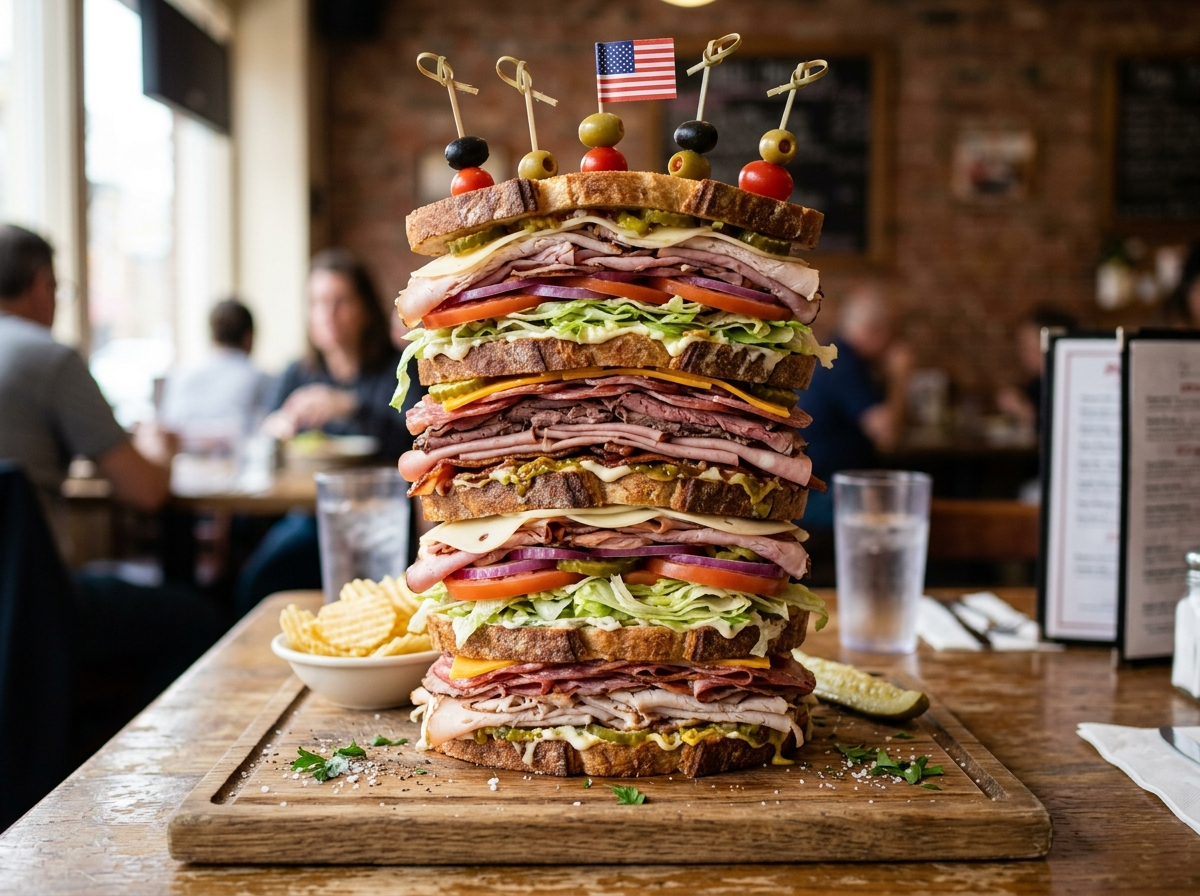
You’ve probably seen the cartoon. A guy stands in front of an open fridge at midnight, balancing a sandwich so tall it defies physics, with an olive perched on top like a flag on a mountain peak. That’s the Dagwood sandwich, and it’s one of the most recognizable food images in American pop culture.
But what is a Dagwood sandwich when you move it off the comic page and onto an actual plate? Is there a real recipe, or is it just a joke? The answer is a little bit of both, and the story behind it is genuinely fun. Let’s break it all down.
What Is a Dagwood Sandwich?
A Dagwood sandwich is an impossibly tall, multi-layered sandwich stuffed with whatever deli meats, cheeses, vegetables, and condiments you can find in the fridge. There’s no single “correct” recipe. The whole point is excess. You pile on layer after layer until the thing looks like it might topple over, then you stab an olive on a toothpick through the top to hold it all together.
The one-sentence definition you’ll want to remember: a Dagwood sandwich is a towering, multi-decker sandwich made with multiple slices of bread and an exaggerated number of fillings, inspired by the Blondie comic strip character Dagwood Bumstead.
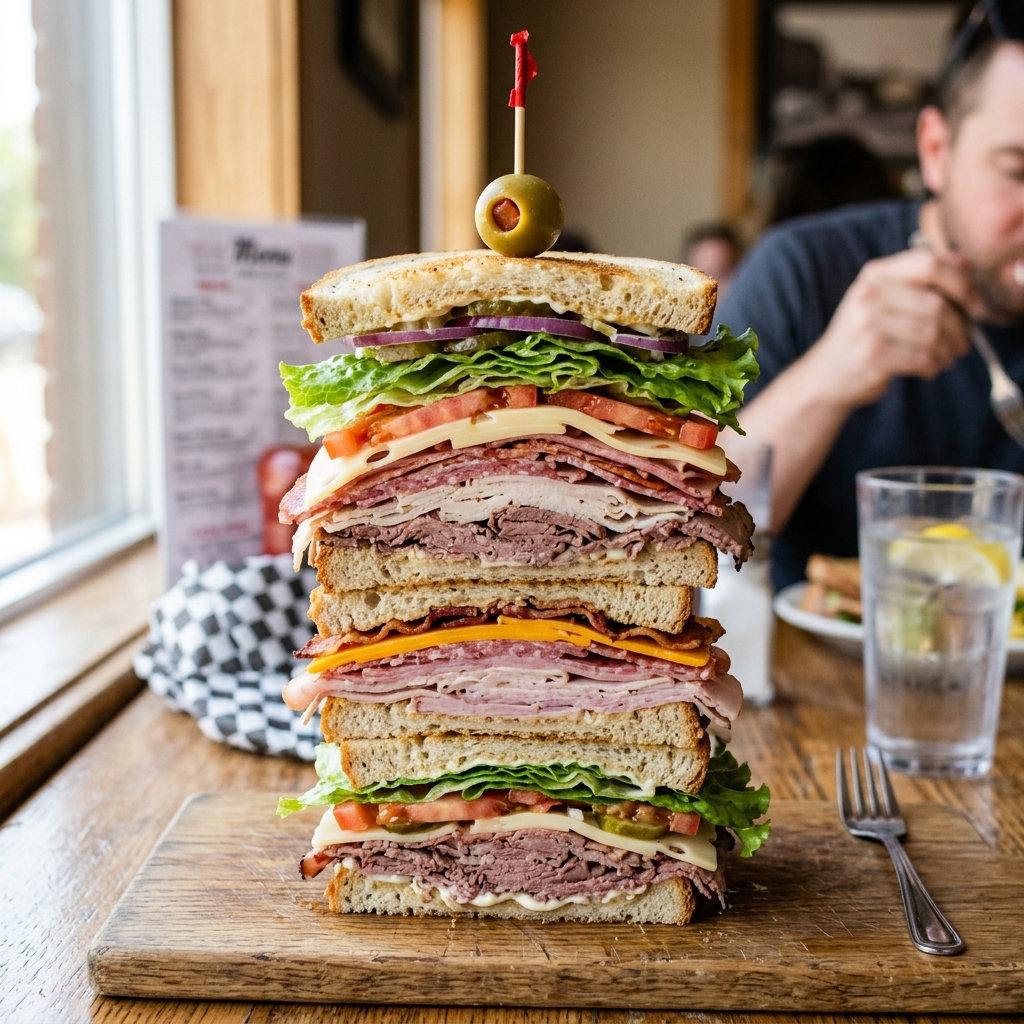
Unlike a club sandwich, which follows a fairly strict three-decker structure with turkey, bacon, lettuce, and tomato, a Dagwood has no rules. You might find ham, salami, roast beef, Swiss cheese, cheddar, lettuce, tomato, pickles, onion, mustard, mayo, and a fried egg all stacked between four or five slices of bread. The more ridiculous it looks, the more “Dagwood” it is.
This lack of rules is actually what makes the Dagwood so interesting from a food history standpoint. Most famous sandwiches — the Reuben, the po’ boy, the Philly cheesesteak — have specific ingredients tied to their identity. The Dagwood’s identity is its attitude: bigger is better, and restraint is for other people.
If you want a deeper look at how other classic American sandwiches earned their names and recipes, the broader American deli history is full of these quirky origin stories.
The Dagwood Sandwich Origin Story
The Dagwood sandwich didn’t start in a deli or a restaurant. It started in the funny pages of the newspaper.
Who Was Dagwood Bumstead?
Dagwood Bumstead is one half of the married couple at the center of the Blondie comic strip, created by cartoonist Murat Bernard “Chic” Young. The strip launched on September 8, 1930, through King Features Syndicate and quickly became one of the most popular comics in America.
Dagwood was originally drawn as a wealthy playboy — the heir to a locomotive fortune — who got disowned by his family after marrying Blondie Boopadoop, a flapper from a much humbler background. Stripped of his inheritance, Dagwood had to get a regular office job, and the strip shifted into a domestic comedy about everyday middle-class life.
That shift is where the sandwich comes in. Dagwood became famous for his late-night raids on the refrigerator. He’d open the fridge door, pull out every cold cut, cheese, leftover, and condiment in sight, and assemble a sandwich of comical proportions. Chic Young drew these towering creations with meticulous detail — you could count the layers of ham, the wedges of cheese, the tomato slices peeking out from between the bread. The olive-on-a-toothpick garnish on top became the signature finishing touch.
The gag worked because it was relatable. Everyone has stood in front of the fridge at midnight and thought about piling everything onto a piece of bread. Dagwood just actually did it, and he did it bigger than anyone else.
From Comic Panel to Real Kitchen
The giant stacked sandwich became such a defining trait of the character that readers started calling any oversized, overstuffed sandwich a “Dagwood.” By the late 1930s and early 1940s, the term had entered everyday American English. Diners and lunch counters began offering “Dagwood sandwiches” on their menus — towering creations meant to mimic the cartoon.
After Chic Young passed away in 1973, his son Dean Young took over the strip and kept the sandwich tradition alive. The Blondie comic is still running today, making it one of the longest-running comic strips in history, and Dagwood is still raiding the fridge.
The giant stacked sandwich history doesn’t end with the comic, though. The Dagwood helped popularize the idea that a sandwich could be a spectacle, not just a meal. It paved the way for the over-the-top deli sandwiches you see in competitive eating contests and viral food videos today.
What Goes Into a Giant Stacked Sandwich?
Since there’s no official recipe, the answer is “whatever you want.” But if you look at how Chic Young actually drew the sandwiches in the comic panels, certain ingredients show up again and again.
The Classic Dagwood Layers
The most traditional Dagwood build includes some combination of these:
- Deli meats: ham, turkey, roast beef, salami, bologna
- Cheeses: Swiss, cheddar, American, provolone
- Vegetables: lettuce, tomato slices, onion rings, pickles
- Condiments: mustard, mayonnaise, sometimes ketchup
- Extras: hard-boiled egg slices, bacon strips, a sardine (yes, really — Dagwood was not picky)
- The crown: a green olive speared on a toothpick, pushed into the very top
The bread is typically white sandwich bread, and you’ll need at least three slices — often four or five — to create the multi-decker structure. Each “deck” gets its own layer of fillings, which is what gives the sandwich its height.
If you’re looking for inspiration on which toppings pair well together, this guide to popular sandwich toppings covers combinations that actually taste good, not just look impressive.
Why Bread Choice Makes or Breaks It
Here’s a practical detail most articles skip: the bread you choose matters enormously when you’re building something this tall. Thin, soft white bread is the most “authentic” to the comic strip look, but it’s also the hardest to work with structurally. It compresses under the weight of all those layers, and the whole thing starts leaning like the Tower of Pisa within minutes.
A slightly sturdier bread — think a soft potato bread or a thick-sliced Texas toast — gives you more structural integrity without losing that classic Dagwood feel. You want something soft enough to bite through (because you will be biting through four inches of sandwich) but firm enough to hold its shape under pressure.
How to Build Your Own Dagwood at Home
Building a Dagwood is more of an engineering challenge than a cooking one. The flavors are easy — you’re stacking deli staples you already like. The hard part is keeping the whole thing upright long enough to take a photo and actually eat it.
Here’s what actually works when you try this at home.
Start with a solid base. Your bottom slice of bread needs to be flat and stable. If you’re using a round loaf or a roll, slice a thin piece off the bottom to create a flat foundation. A wobbly base means a wobbly sandwich, and you don’t want that.
Layer strategically, not randomly. Even though the Dagwood is supposed to look chaotic, you’ll get better results if you alternate flat ingredients (meat, cheese) with uneven ones (tomato, onion, pickle). Flat layers act like mortar between the bricks. If you stack three tomato slices in a row, the whole thing slides sideways.
Use condiments as glue. A thin layer of mayo or mustard on each bread slice helps the fillings stick in place. It sounds small, but it genuinely makes a difference in structural stability.
Don’t overfill each deck. The temptation is to pile each layer as high as possible. Resist it. Two to three thin slices of meat per deck with a single slice of cheese holds together much better than a fistful of cold cuts.
The toothpick is not optional. That olive-on-a-toothpick garnish isn’t just decorative — it’s a structural pin that helps hold the top layers together. Push it all the way down through the center of the sandwich. You can use two or three toothpicks if your creation is especially tall.
For more tips on keeping your sandwich intact and avoiding the dreaded soggy bottom layer, this piece on how to prevent a soggy sandwich covers the moisture barrier tricks that work for any stacked build.
A Quick Note on Food Safety
When you’re stacking multiple types of deli meat and cheese, you’re working with perishable ingredients that shouldn’t sit out at room temperature for long. The general food safety guideline is that cold cuts and prepared sandwiches shouldn’t be left out for more than two hours (or one hour if the temperature is above 90°F). If you’re building a Dagwood for a party or gathering, keep it refrigerated until right before serving. And if you’re curious about how long your deli meats stay fresh in the fridge in the first place, check this guide on deli meat fridge life so you’re not stacking ingredients that are already past their prime.
Dagwood Sandwich vs. Other Famous Stacked Sandwiches
It’s easy to confuse a Dagwood with other tall sandwiches, so here’s how they differ in practice.
A club sandwich is the most structured of the bunch. It uses exactly three slices of toasted bread, two layers of filling (typically turkey, bacon, lettuce, tomato, and mayo), and gets cut into quarters. It’s tidy, deliberate, and follows a recipe. A Dagwood is none of those things.
A triple-decker deli sandwich is closer to a Dagwood in spirit, but it usually sticks to one or two types of meat and keeps the layers relatively organized. Think of the kind of towering pastrami sandwich you’d get at a New York deli — tall, yes, but focused.
The Dagwood’s defining feature is its variety and chaos. It’s the sandwich equivalent of a kitchen-sink approach. If a club sandwich is a well-organized filing cabinet, a Dagwood is the junk drawer dumped onto a plate. And that’s the charm.
If you want to explore the club sandwich side of things for comparison, this breakdown of the classic club sandwich shows how a more structured multi-decker comes together.
Why the Dagwood Still Matters Today
You might think a sandwich born from a 1930s comic strip would feel dated, but the Dagwood’s influence is everywhere in modern food culture. Every time you see a viral video of someone stacking an absurd sandwich for social media, that’s the Dagwood’s DNA at work. Every “challenge” sandwich at a local deli that dares you to finish it in one sitting traces its lineage back to Dagwood Bumstead and his midnight fridge raids.
The Dagwood also represents something genuinely appealing about home cooking: the freedom to ignore rules. Most sandwich recipes tell you exactly what to put between the bread. The Dagwood tells you to open the fridge and go for it. That kind of permission is rare in food writing, and it’s a big reason the concept has stuck around for nearly a century.
Frequently Asked Questions
Is a Dagwood sandwich a real sandwich or just a cartoon joke?
Both. The Dagwood started as a recurring gag in the Blondie comic strip in the 1930s, but the term quickly entered real-world usage. Diners and restaurants began offering “Dagwood sandwiches” on their menus, and the name is now widely used to describe any oversized, multi-layered sandwich. It’s a real sandwich style with a cartoon origin.
What is the difference between a Dagwood sandwich and a club sandwich?
A club sandwich follows a specific recipe: three slices of toasted bread, turkey, bacon, lettuce, tomato, and mayo, cut into quarters. A Dagwood sandwich has no fixed recipe and uses as many bread slices and fillings as you want. The Dagwood is defined by its height and variety, while the club is defined by its structure and specific ingredients.
Who created the Dagwood sandwich?
The Dagwood sandwich was created by cartoonist Chic Young as a recurring visual gag in the Blondie comic strip, which launched in 1930. The character Dagwood Bumstead would build impossibly tall sandwiches during late-night trips to the refrigerator. The term was adopted by real restaurants and diners within a decade of the strip’s debut.
The next time you’re standing in front of the fridge at midnight with a loaf of bread in one hand and a package of deli ham in the other, you’ll know exactly what tradition you’re carrying on. Grab an extra slice of bread, stack it high, and don’t forget the olive on top. That’s the Dagwood way. And if you want to take your sandwich game even further, learning how to build a perfect deli sandwich from the ground up will give you the layering skills to make your Dagwood taste as good as it looks.