
The most interesting burger in the world might be one you cannot order in America. Walk into a McDonald’s in Mumbai and ask for a Big Mac, and you will not get one — because in India, the Big Mac does not exist. What exists instead is the Maharaja Mac, a tall, tiered, sesame-topped burger that looks like its famous cousin and tastes like somewhere else entirely. It is the story of what happens when a global icon stops insisting on itself and starts listening to the country it landed in.
Burger Weekly’s founder got the assignment in person. On a trip to India in 2015, his friend from the beef world insisted it was his duty to eat the Chicken Maharaja Mac and report back. He did, at the Colaba Causeway location in Mumbai, and came away with a mixed verdict: a clean, efficient, very cheap restaurant, and a burger that tasted distinctly Indian but left him underwhelmed after ten days of real Indian cooking. That honest shrug is actually the perfect starting point, because the Maharaja Mac was never really about being the best burger in Mumbai. It is about being the burger that made sense in Mumbai — and about what home cooks and burger joints everywhere can learn from it.
Why India Got a Different Burger
When McDonald’s entered India in 1996, it walked into a market where its signature product was a non-starter. Beef is off the table for most of the country’s Hindu majority, and pork is avoided by many Muslims, so the chain made a decision no other McDonald’s market had made: it serves no beef and no pork in India at all. The Big Mac’s double beef patties had to go, and the replacement became the Chicken Maharaja Mac — a chicken patty in the same tall, three-part-bun format, seasoned for Indian palates. A vegetarian version, built around a spiced corn-and-bean patty, followed in January 2016.
That is not a footnote. It is the whole lesson. The chain did not just swap a protein; it rethought the menu around the people eating it, down to separate cooking lines for vegetarian and non-vegetarian food and eggless sauces. The Maharaja Mac works as a cultural artifact precisely because it is a compromise that refuses to feel like one — familiar enough to be recognizably a Mac, different enough to belong where it is sold.
The Fusion Formula: What Makes It Taste Indian
Strip away the branding and the Maharaja Mac idea comes down to a formula any cook can steal. Take a burger structure everyone knows, and rebuild its flavor from Indian building blocks.
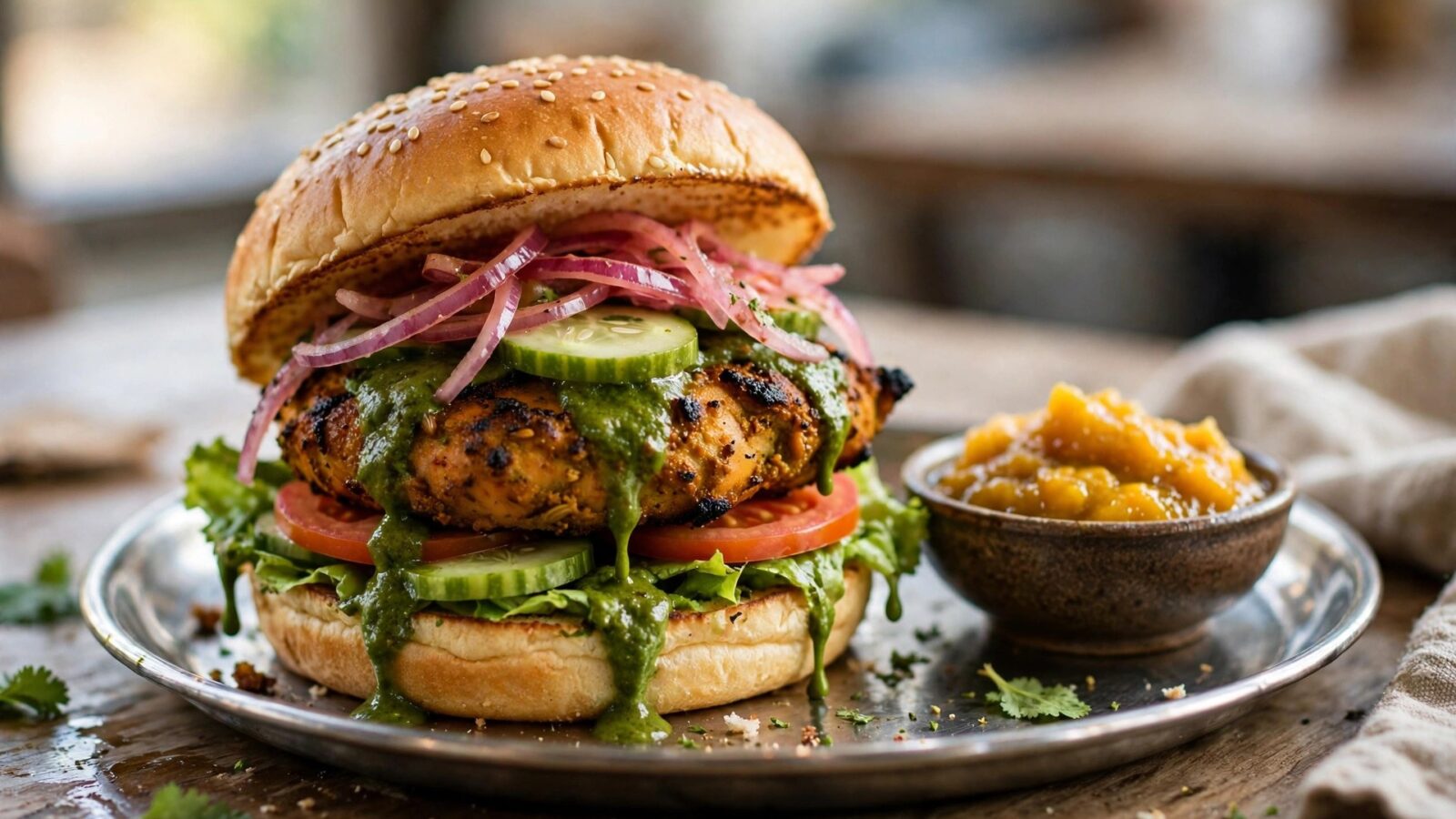
Start with the patty. A tandoori-style marinade is the obvious move: yogurt, lemon juice, ginger-garlic paste, and a spice blend built on cumin, coriander, turmeric, and garam masala, with Kashmiri chili for color and gentle heat. Yogurt does real work here — its acidity tenderizes the chicken while the spices cling to the surface and char beautifully on a hot grill. That char is the tandoor’s signature, and it is what separates a tandoori burger from a chicken sandwich with curry powder sprinkled on top.
Then come the toppings, and this is where most fusion burgers either soar or collapse. Mint-coriander chutney is the single most important addition: cool, herbal, sharp, and bright, it does the job that pickles and mustard do on a classic burger, cutting through the richness and waking up the palate. Pickled red onions add a second layer of acid and crunch. A swipe of mango chutney, thinned with a little yogurt, brings sweetness the way barbecue sauce does on a bacon burger. Cucumber and tomato keep it fresh. The bun can stay a soft sesame roll — familiarity is part of the charm — or you can go further and serve the whole thing on a toasted naan, which is messier and, frankly, better.
Where Home Cooks Go Wrong
The most common mistake with Indian fusion burgers is treating spice as a single dial labeled “hot.” Indian cooking is not about heat; it is about layers. A patty seasoned only with chili powder tastes one-note and aggressive. A patty built on cumin’s earthiness, coriander’s citrus edge, turmeric’s warmth, and garam masala’s depth tastes like something, even before the chutney goes on. Taste your spice blend before it touches the meat. If it smells flat, it will taste flat.
The second mistake is drowning the burger. Two chutneys plus a yogurt sauce plus mango pickle is a puddle, not a burger. Pick one hero sauce — mint chutney, usually — and let the second one play a supporting role in a thin layer. The third mistake is forgetting texture. A soft patty on a soft bun with soft sauces is baby food. That is why the pickled onions and the char on the patty matter so much: they give your teeth something to do.
If you want a meat-free version, the same formula holds, and the veggie patty deserves the same respect as the chicken one. Our honest review of plant-based burgers makes the case that a good non-meat patty needs its own identity rather than an apology, and a spiced chickpea or potato-pea patty with tandoori seasoning is a great example — it has flavor and bite of its own, not a borrowed one.
Build Your Own Maharaja at Home
Marinate chicken breast fillets or ground chicken patties for at least two hours in yogurt, tandoori masala, ginger-garlic paste, lemon juice, and salt. Grill over medium-high heat until charred at the edges and cooked through — chicken should reach 165°F internally. Meanwhile, blitz fresh mint and coriander with green chili, lemon juice, and a pinch of salt for the chutney, and quick-pickle thin-sliced red onion in vinegar, sugar, and salt for twenty minutes.
Toast your buns, spread mint chutney generously on the bottom half, add the patty, then tomato, cucumber, pickled onions, and lettuce. If you want the mango note, spread a thin layer of mango chutney thinned with yogurt on the top bun. Serve it with fries or a simple kachumber salad of chopped onion, tomato, and cucumber with lemon.
What you end up with is not a copy of a fast-food item. It is better than the original Burger Weekly reviewer found in Mumbai, because you control the marinade time, the char, and the chutney — the three things a chain kitchen cannot lavish attention on. And it belongs to a bigger story on this site: the fusion burger as a genre, from the ramen-bun craze at Smorgasburg to whatever mashup comes next. The best fusion burgers do not just combine two cuisines. They find the place where both make sense, and they build the burger there.
Why the Maharaja Still Matters
It would be easy to dismiss the Maharaja Mac as a corporate adaptation, a footnote in a business-school case study. But thirty years after McDonald’s arrived in India, the burger is still on the menu, still ordered, still argued about by travelers who expected a Big Mac and got something else. That staying power says something worth remembering: a burger is not a fixed object. It is a format — a patty, a bun, toppings, sauce — and formats travel. What changes is the flavor, and the flavor should always belong to the people eating it.
The Maharaja Mac’s real legacy is not a recipe. It is permission. Permission to take the most American food there is and season it like it grew up somewhere else. Take that permission and run with it.