
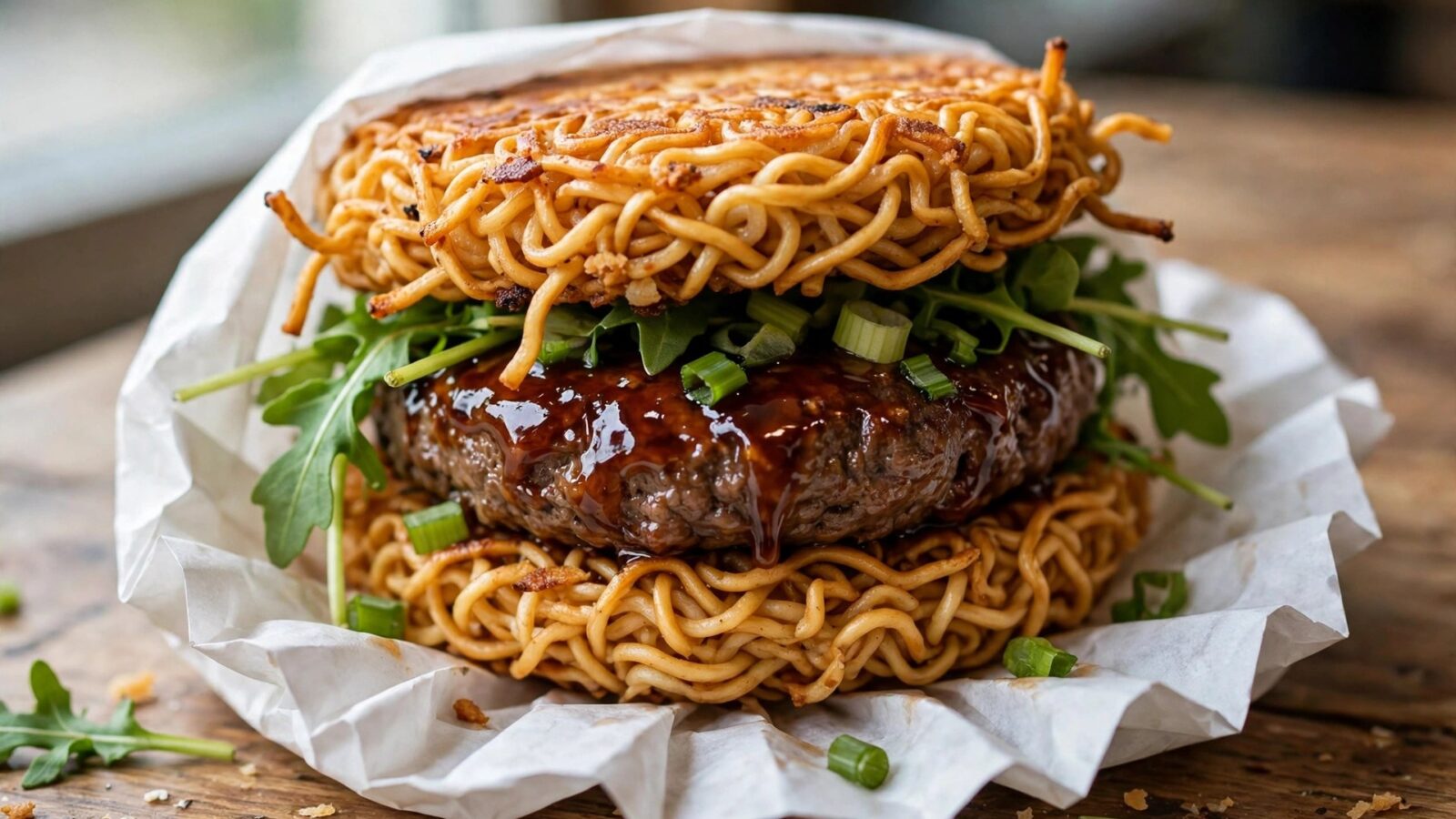
The summer of 2013 had already given New York the cronut when something even stranger showed up in Williamsburg: a cheeseburger with no bread at all. In its place, two round patties of fried ramen noodles, crisped golden in sesame oil, holding a beef patty glazed in a secret soy sauce. It cost eight dollars, it sold out in twenty minutes, and it made grown adults stand in the rain for an hour and a half. This is the story of the ramen burger.
The programmer who fell in love with ramen
Keizo Shimamoto was not a chef by training. He was a computer programmer who became obsessed with ramen, started a blog called Go Ramen! documenting his noodle adventures, and then did what obsessive people do — he moved to Japan and spent four years working in ramen shops, learning the craft from the inside. He ran a ramen spot called Bassanova in Tokyo before coming back to the States to help open a New York outpost.
The ramen burger didn’t come out of nowhere. Shimamoto had seen ramen burgers at festivals and fast-food counters in Japan — notably at Lotteria — where squiggly fried-noodle buns were stuffed with chashu pork. But the Japanese versions were loose and improvisational. Shimamoto’s idea was tighter: an American beef burger, built like a classic, wearing a Japanese costume. He took his two childhood loves, as one pre-debut tasting account put it — ramen and hamburgers — and fused them.
August 3, 2013: 150 burgers, 20 minutes
The debut happened on a Saturday at Smorgasburg, Brooklyn’s sprawling food market. The plan was to sell 100 Shoyu Ramen Burgers. One early reviewer counted himself 47th in line, waited more than 90 minutes in falling rain, and watched chef Shimamoto beam at the crowd like a man who couldn’t quite believe what was happening. By the end of the day, 150 burgers had gone out the door. The first hundred or so had vanished in about twenty minutes. Food writers were already drawing comparisons to the cronut — Dominique Ansel’s pastry had debuted in SoHo that same summer — and the line was only going to get longer from there.
What kept the thing standing up was the part everyone had been skeptical about. The bun didn’t fall apart. It held through nearly the entire burger, and the crispy grilled faces of the noodle patties turned out to be the best part — a crackly, savory crunch you can’t get from bread.
What’s actually inside it
The original build was specific: a USDA Prime beef patty with a 75/25 lean-to-fat ratio — fattier than most restaurant burgers, deliberately so, because Shimamoto wanted the juices running down into the noodle buns like soup. The patty got glazed in a secret shoyu sauce instead of ketchup, then stacked with arugula and a pile of chopped scallions, lettuce and onion’s sharper cousins.
The buns were the engineering feat. Fresh ramen noodles from Sun Noodle in New Jersey were formed into rounds and fried in a skillet with sesame oil until they held together as a solid, golden disc. Shimamoto never revealed his exact binding process — copycats across the country settled on egg as the glue, packing cooked noodles into ramekins, chilling them firm, and pan-frying both sides — but whatever his method was, the result had to do something no bread bun has to do: survive as a structural component while soaking up beef fat and shoyu.
Even the wrapper was thought through. The burger came in a PleatPak that pinched shut into a little bowl, catching the loose noodles and sauce so you could slurp the remains at the end. It was street food designed by someone who had spent years thinking about how noodles behave.
And it raises a question we keep coming back to on this site: how much of a burger’s identity lives in its bun? Our guide to the best burger buns argues the bun is a load-bearing decision, not an afterthought — the ramen burger is the extreme proof. Change the bun to fried noodles and you’ve changed the entire flavor architecture.
Why it went viral — and why it stuck
Timing did half the work. The ramen burger landed at the exact moment food mashups became a genre — the cronut had just proved that a hybrid could own a news cycle, and Instagram-era food culture was built for exactly this kind of spectacle. Scarcity did the rest. One stand, one weekend, 150 burgers: the math of the line became the story, and the story became the brand. Shimamoto ended up on Conan and the Food Network; within a year there were knockoffs in a dozen cities.
But here’s the thing most viral foods don’t get: the ramen burger actually worked as food. The reviews weren’t just hype — they kept coming back to texture. Crispy noodle faces, a juicy 75/25 patty, the sweet-salty shoyu cutting through the fat. It wasn’t a stunt burger; it was a well-constructed one wearing a stunt’s outfit.
Where the craze went
Shimamoto turned the pop-up into a real business. The ramen burger became a permanent fixture at Smorgasburg, where weekend lines kept forming years after the debut. He opened Ramen Co. in the Financial District, ran a stand at Berg’n, and in 2014 brought the Original Ramen Burger to Koreatown in Los Angeles. More recently he’s been serving ramen out of a ghost-kitchen setup in Irvine, California — back to the noodles themselves, which is where his heart was all along.
The ramen burger never became a permanent menu item everywhere the way the cronut spawned a whole pastry category. But it didn’t need to. It was the opening shot of the mashup era — the burger that proved you could rebuild the format from the bun outward and have it hold together, literally and figuratively. Every sushi burrito, every birria ramen, every fried-chicken-sandwich-on-a-donut owes it a small debt.
And if you want to try the concept at home, the copycat method is well documented by now: cook the noodles, mix with a beaten egg, pack into ramekins, chill until firm, and fry hard in a little oil until both faces are deeply golden. Just don’t expect Shimamoto’s secret. Some things stay in the kitchen.